
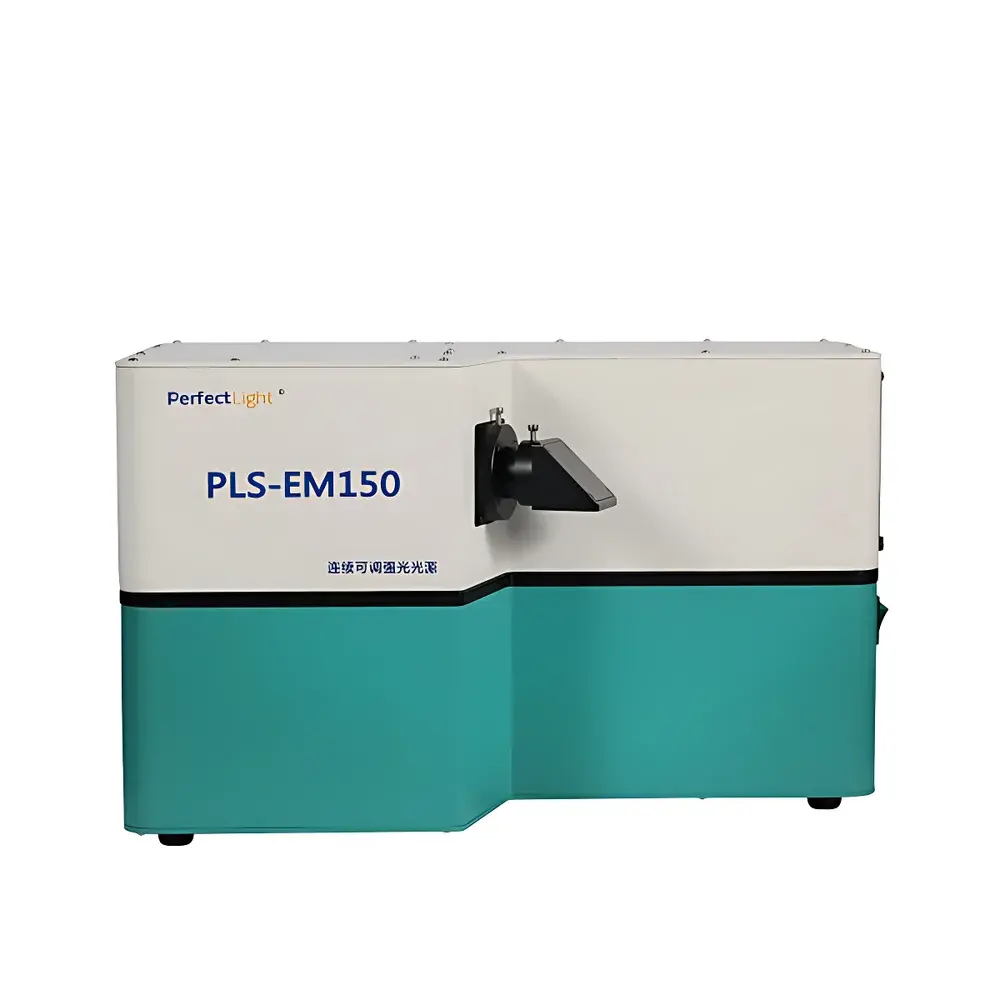
PLS-EM150 Tunable High-Intensity Monochromatic Light Source
| Brand | PerfectLight (PoPhilae) |
|---|---|
| Origin | Beijing, China |
| Model | PLS-EM150 |
| Light Source Type | Integrated Xenon-Based Tunable Monochromator System |
| Illumination Mode | External Irradiation |
| Electrical Power | 300 W |
| Focal Length | 150 mm |
| Wavelength Tuning Step | 1 nm |
| Grating Dimensions | 50 × 50 mm² |
| Grating Line Density | 2400 lines/mm (multi-option available) |
| Blaze Wavelength | 300 nm |
| Spectral Output Range | 350–680 nm |
| Irradiance at 470 nm | >40 mW/cm² |
| Output Configurations | Rotatable Head, Homogenizer, Fiber-Coupled Output |
| Key Compliance Context | Designed for ISO/IEC 17025-aligned photoreactor calibration, compatible with ASTM E973 and IEC 60904-8 for spectral responsivity validation |
Overview
The PLS-EM150 Tunable High-Intensity Monochromatic Light Source is an engineered optical instrument designed specifically for quantitative photochemical and photoelectrochemical research requiring spectrally resolved, high-flux irradiation. Unlike conventional monochromators optimized for spectroscopic signal detection—where spectral purity and stray-light suppression take precedence over photon flux—the PLS-EM150 integrates a stabilized 300 W xenon arc lamp with a high-efficiency Czerny–Turner monochromator architecture and proprietary optical coupling. This unified design enables continuous wavelength selection from 350 nm to 680 nm in 1 nm increments while delivering irradiance exceeding 40 mW/cm² at 470 nm—two orders of magnitude higher than typical benchtop scanning monochromators. Its core measurement principle relies on grating dispersion followed by precision slit-controlled bandpass filtering, ensuring reproducible narrowband excitation essential for incident photon-to-current efficiency (IPCE), action spectrum analysis, and wavelength-dependent quantum yield determination.
Key Features
- Integrated high-power optical platform: Combines a stabilized short-arc xenon lamp, ellipsoidal collector optics, and a motorized monochromator in a rigid, thermally managed housing to minimize beam drift and intensity fluctuation.
- High-irradiance monochromatic output: Achieves >40 mW/cm² at 470 nm across a 10 mm diameter collimated beam—validated using NIST-traceable calibrated photodiodes.
- Precision wavelength control: 1 nm step resolution over 350–680 nm range, supported by encoder feedback and factory-wavelength-calibrated grating positioning.
- Multi-modal beam delivery: Standard configurations include a rotatable output head for angular irradiation, an integrated quartz homogenizer for spatial uniformity (±3% over Ø15 mm), and SMA905 fiber-coupled output (400 µm core, NA 0.22) for remote or confined-space applications.
- Optimized optical train: Features imported 50 × 50 mm² holographic grating with 2400 lines/mm density and 300 nm blaze, enabling high diffraction efficiency in the UV–visible range and <10⁻⁴ stray light rejection ratio (measured per ISO 10110-7).
Sample Compatibility & Compliance
The PLS-EM150 is compatible with standard photoelectrochemical cells (e.g., three-electrode quartz cuvettes), thin-film solar cell test fixtures (ASTM E927-compliant mask apertures), and gas-phase photocatalytic reactors equipped with quartz windows. Its spectral stability (<±0.5 nm over 2 h) and irradiance repeatability (±1.2% RSD over 1 h) support GLP-compliant experimental protocols. The system meets mechanical and electrical safety requirements per IEC 61010-1 and supports audit-ready operation when paired with time-stamped data logging. While not certified as medical or industrial equipment, its optical performance aligns with key reference standards including ASTM E973 (for spectral mismatch correction), IEC 60904-8 (spectral responsivity measurement), and ISO/IEC 17025 clause 5.4.2 regarding measurement traceability.
Software & Data Management
The PLS-EM150 operates via USB-connected PC software supporting Windows 10/11 (64-bit). The native interface enables full parameter scripting—including wavelength sweeps, dwell-time sequencing, and synchronized shutter control—with real-time irradiance monitoring via optional calibrated photodiode feedback. Export formats include CSV and HDF5, preserving metadata such as timestamp, grating position, lamp hours, and ambient temperature. Software logs maintain immutable records compliant with FDA 21 CFR Part 11 requirements when configured with user authentication and electronic signature modules. Third-party integration is supported via LabVIEW VIs, Python (PyVISA), and MATLAB Instrument Control Toolbox.
Applications
- Incident photon-to-current efficiency (IPCE) mapping of dye-sensitized, perovskite, and organic photovoltaic devices under monochromatic illumination.
- Wavelength-resolved photocatalytic degradation kinetics (e.g., methylene blue, phenol) using immobilized TiO₂ or g-C₃N₄ catalysts.
- Action spectrum derivation for photosynthetic systems and photobioreactors.
- Calibration of spectroradiometers and reference photodetectors in metrology labs.
- Photoelectrochemical impedance spectroscopy (PEIS) under controlled monochromatic bias conditions.
FAQ
What is the typical warm-up time required to achieve spectral and irradiance stability?
Stabilization to ±0.3% irradiance and ±0.2 nm wavelength accuracy is achieved within 15 minutes after lamp ignition, verified per internal thermal equilibrium protocol.
Can the PLS-EM150 be used with liquid light guides or liquid-core fibers?
No—only solid-core silica optical fibers (400 µm or 600 µm core) are supported; liquid light guides introduce unacceptable transmission loss and thermal instability above 30 mW average power.
Is the grating interchangeable for extended UV or NIR coverage?
Yes—optional gratings (e.g., 1200 L/mm blazed at 500 nm or 600 L/mm blazed at 1000 nm) are available; however, spectral range extension beyond 350–680 nm requires recalibration and may reduce maximum irradiance due to grating efficiency roll-off.
Does the system include radiometric calibration documentation?
Each unit ships with a NIST-traceable irradiance calibration certificate (at 470 nm, 550 nm, and 630 nm), valid for 12 months from date of shipment.
How is lamp lifetime monitored and managed?
Lamp operating hours are logged automatically; recommended replacement interval is 1,000 hours for optimal spectral output consistency and arc stability.





