
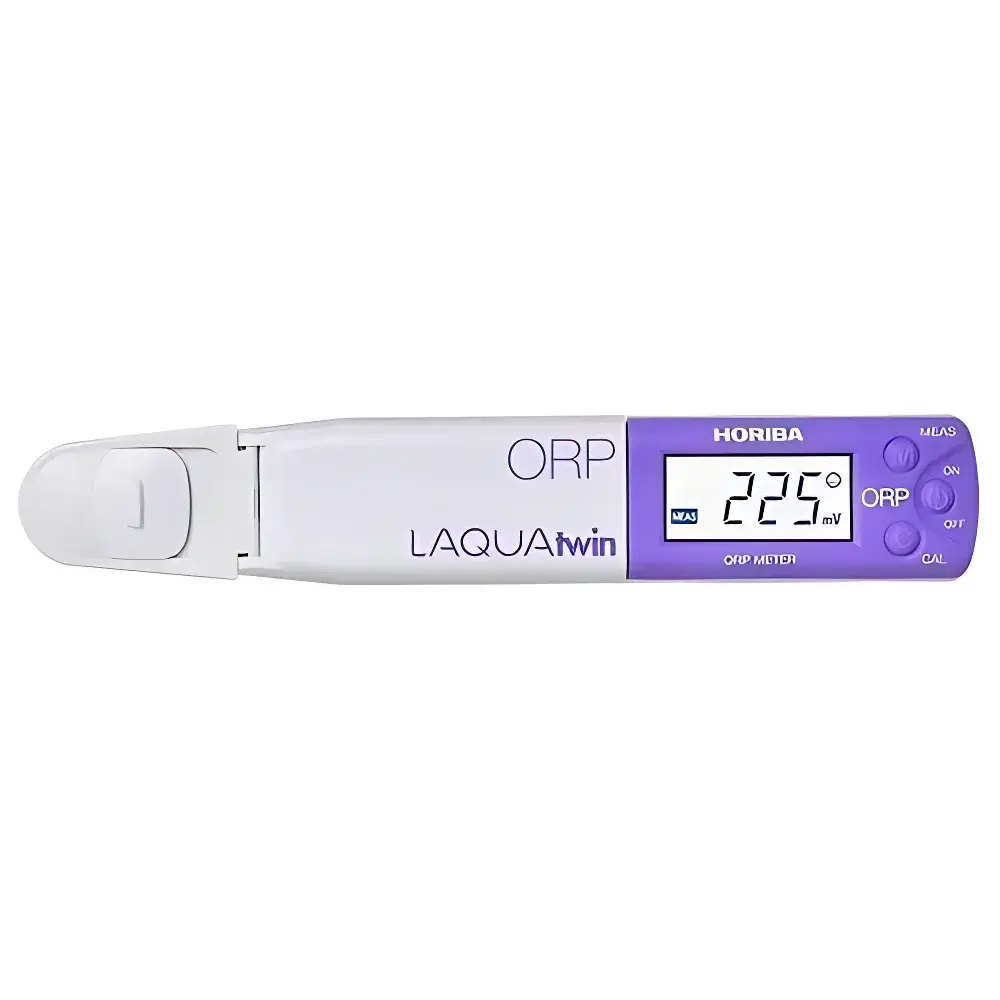
HORIBA LAQUAtwin ORP-11 Pocket-Sized Redox (ORP) Meter
| Brand | HORIBA |
|---|---|
| Origin | Japan |
| Model | ORP-11 |
| Type | Laboratory ORP Meter |
| Measurement Range | −1000 to +1000 mV |
| Accuracy | ±2 mV |
| Minimum Sample Volume | 0.3 mL (0.05 mL with sampling sheet) |
| Calibration | Auto-recognition of 225 mV standard solution, customizable with other ORP standards |
| Temperature Range | Up to 50.0 °C with automatic temperature compensation |
| Protection Rating | IP67 |
| Display | Backlit LCD |
| Operating Mode | Auto-hold with stability indicator (smiley icon) |
Overview
The HORIBA LAQUAtwin ORP-11 is a compact, handheld redox potential (ORP) meter engineered for rapid, reliable electrochemical assessment of oxidation-reduction reactions in aqueous samples. Based on the fundamental principle of potentiometric measurement against a stable reference electrode (typically Ag/AgCl), the ORP-11 quantifies the tendency of a solution to gain or lose electrons—expressed in millivolts (mV) relative to the Standard Hydrogen Electrode (SHE). Unlike pH meters, ORP measurements do not require buffer-based calibration; instead, they rely on traceable redox standards to verify electrode response and system integrity. The instrument is designed for routine quality control, environmental monitoring, water treatment validation, and process hygiene verification where real-time redox status informs critical decisions—such as disinfectant efficacy (e.g., chlorine, ozone, or peracetic acid residual activity), fermentation stage tracking, or anaerobic digestion stability.
Key Features
- Pocket-sized form factor with ergonomic, one-handed operation—ideal for field deployment, benchtop spot-checking, or integration into multi-parameter workflows.
- Replaceable platinum-disk sensing element enabling low-volume analysis: as little as 0.3 mL bulk sample or 0.05 mL when used with optional disposable sampling sheets—minimizing reagent consumption and cross-contamination risk.
- Full-scale measurement range of −1000 mV to +1000 mV, covering typical applications from highly reducing environments (e.g., sulfide-rich groundwater) to strongly oxidizing conditions (e.g., chlorinated cooling water).
- Auto-recognition of included 225 mV ORP standard solution during calibration—eliminating manual input errors and streamlining daily verification procedures.
- Support for user-defined calibration using alternative certified ORP standards (e.g., quinhydrone, Zobell’s solution), accommodating method-specific requirements under ASTM D1129 or ISO 5814.
- Automatic endpoint detection with visual stability confirmation: a “smiley face” icon appears once signal drift falls below 0.5 mV/3 sec, followed by auto-hold activation to freeze the validated reading.
- Integrated temperature sensor (range: 0.0–50.0 °C) enables automatic temperature compensation (ATC) based on Nernstian slope adjustment—critical for maintaining accuracy across variable ambient or process conditions.
- IP67-rated enclosure ensures operational reliability in humid laboratories, wet processing areas, or outdoor sampling sites—withstanding immersion up to 1 m for 30 minutes and complete dust ingress protection.
Sample Compatibility & Compliance
The ORP-11 is optimized for aqueous solutions with conductivity ≥100 µS/cm and pH between 2 and 12. It is incompatible with non-aqueous solvents, viscous slurries, or samples containing heavy metal ions that may poison the Pt surface (e.g., Hg²⁺, Ag⁺). For regulated environments—including pharmaceutical water systems (PW, WFI), food safety audits, or municipal wastewater compliance—the device supports documented calibration practices aligned with ISO/IEC 17025 traceability requirements. While the meter itself does not generate electronic audit trails, its calibration logs (date, standard used, measured value, deviation) can be manually recorded to satisfy GLP documentation expectations. No internal memory or data export functionality is provided—consistent with its role as a dedicated, entry-level verification tool rather than a data-logging instrument.
Software & Data Management
The LAQUAtwin ORP-11 operates as a standalone, firmware-controlled instrument with no embedded software stack, USB interface, or Bluetooth connectivity. All configuration and measurement functions are managed via tactile button inputs and interpreted through the backlit LCD display. As such, it requires no driver installation, operating system compatibility testing, or cybersecurity validation—reducing IT overhead in regulated facilities. Data output is limited to real-time mV and °C readings; users must transcribe values into LIMS, ELN, or paper-based records manually. This architecture prioritizes operational simplicity, electromagnetic immunity, and long-term firmware stability over digital integration—a design choice common among portable electrochemical tools deployed in GMP-adjacent settings where change control rigor exceeds connectivity benefits.
Applications
- Verification of disinfectant residual capacity in drinking water distribution networks and swimming pool management (per EPA Method 334.0 and WHO guidelines).
- Monitoring redox potential shifts during activated sludge processes, denitrification stages, and sulfate-reducing bacterial activity in bioreactors.
- Routine check of sanitizing solution potency (e.g., peracetic acid, hydrogen peroxide) in pharmaceutical clean-in-place (CIP) cycles.
- Assessment of spoilage risk in food processing rinse waters and brine solutions via correlation with microbial metabolic activity.
- Educational use in university chemistry and environmental science labs for introducing electrochemical thermodynamics and Nernst equation applications.
FAQ
Does the ORP-11 support two-point calibration?
No—the ORP-11 performs single-point calibration only, leveraging auto-recognition of the supplied 225 mV standard. Two-point calibration is not supported due to inherent limitations in slope-based ORP interpretation without a defined zero-reference point.
Can the sensor be cleaned with ethanol or isopropyl alcohol?
Yes—platinum disk surfaces may be gently wiped with lint-free tissue dampened with >70% IPA; avoid prolonged soaking or ultrasonic cleaning, which may compromise electrode adhesion.
Is temperature compensation mandatory for accurate ORP readings?
While not strictly mandatory, ATC is strongly recommended: a 10 °C shift introduces ~0.2 mV/°C theoretical Nernst error in ideal systems; empirical deviations often exceed this in complex matrices.
What is the expected service life of the replaceable sensor?
Under normal use (≤5 measurements/day, proper storage in KCl solution), the sensor typically maintains specification-grade performance for 6–12 months before replacement is advised.
Does the IP67 rating apply when the battery compartment is open?
No—IP67 certification is valid only when all covers, including the battery door, are fully sealed and latched. Always verify gasket integrity before submersion or high-pressure washdown.




