
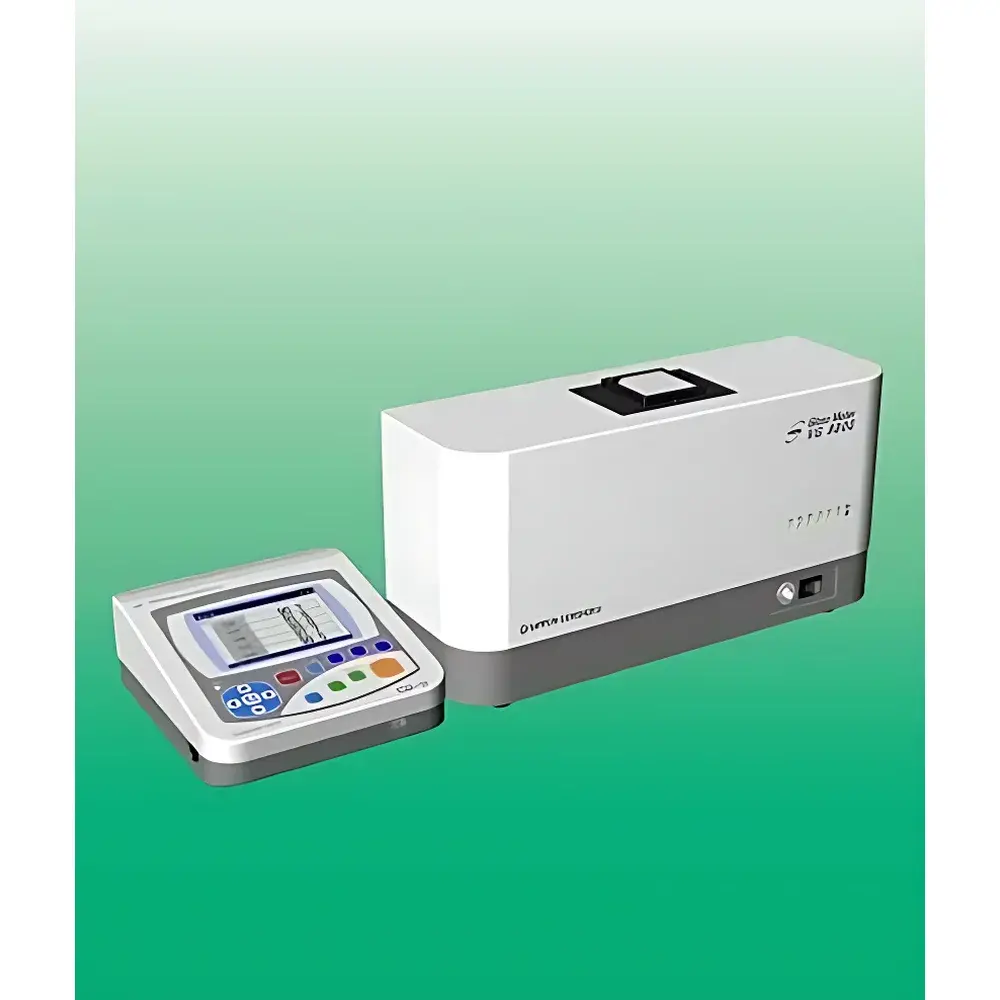
NIPPON DENSHOKU VG Series Multi-Angle Gloss Meter
| Brand | NIPPON DENSHOKU |
|---|---|
| Origin | Japan |
| Model | VG Series |
| Light Source | White LED |
| Measurement Angles | 20°, 45°, 60°, 75°, 85° |
| Compliance | ISO 8254-1, ISO 8254-3, ISO 2813, ISO 7668, JIS Z 8741, JIS P 8142, ASTM D523, ASTM D1223, TAPPI T480, TAPPI T653, DIN 67530 |
| Measurement Aperture | 14 mm × 45 mm |
| Measurement Range (GU) | 20°: 0.1–2038 |
| 45° | 0.1–1675 |
| 60° | 0.1–1000 |
| 75° | 0.1–378 |
| 85° | 0.1–162 |
| Repeatability | ±0.1% after 30-min warm-up (23 °C, standard white tile, 20 measurements at 10-s intervals) |
| Measurement Time | ~1 s (single angle), ~2 s (dual angle), ~4 s (full 5-angle scan) |
| Operating Environment | 10–40 °C, 30–80% RH (non-condensing) |
| Power Supply | 100–240 V AC, 50/60 Hz |
| Power Consumption | 20 W |
| Optical Unit Dimensions | 483 × 157 × 240 mm (W×D×H) |
| Control Unit Dimensions | 220 × 255 × 100 mm (W×D×H) |
| Weight | ~13 kg |
| Detector | High-sensitivity silicon photodiode |
| Interface | RS-232C |
Overview
The NIPPON DENSHOKU VG Series Multi-Angle Gloss Meter is a precision optical instrument engineered for quantitative specular gloss evaluation across industrial substrates including paper, coated board, metallic sheets, thermoplastic polymers, vinyl films, and float glass. It operates on the principle of directional reflectance measurement—quantifying the ratio of reflected luminous flux to incident flux at defined geometries—per standardized photometric conventions. Unlike single-angle glossmeters, the VG Series integrates five fixed-angle optical paths (20°, 45°, 60°, 75°, and 85°) within a single optical head, enabling simultaneous acquisition of angular gloss profiles without mechanical repositioning. This architecture eliminates operator-induced alignment variability and supports robust inter-laboratory correlation in quality control environments governed by ISO/IEC 17025 or GMP-aligned documentation systems.
Key Features
- White LED light source with >50,000-hour operational lifetime, delivering stable spectral output (CIE Illuminant D65-equivalent) and eliminating lamp replacement cycles common in tungsten-halogen systems.
- Five-angle parallel measurement capability ensures full angular characterization in under 4 seconds—critical for high-throughput production line verification and statistical process control (SPC) applications.
- Optical design conforms to collimated beam requirements specified in ISO 8254-3 (20°), ISO 8254-1 (75°), and JIS P 8142 (75°), with beam divergence <±0.5° and aperture definition traceable to NMIJ/JCSS calibration standards.
- High-sensitivity silicon photodiode detector with linear response across full dynamic range (0.1–2038 GU), coupled with temperature-compensated analog front-end circuitry to minimize drift over ambient fluctuations (10–40 °C).
- Modular hardware architecture: optically isolated measurement head and dedicated control unit allow flexible integration into automated inspection stations or benchtop QC labs.
- RS-232C interface enables direct communication with LIMS, MES, or custom SCADA platforms—supporting ASCII command protocol for automated data logging, pass/fail flagging, and audit-trail generation compliant with FDA 21 CFR Part 11 requirements when paired with validated software.
Sample Compatibility & Compliance
The VG Series is validated for use on flat, non-porous, and moderately textured surfaces where surface geometry permits specular reflection dominance. Its 14 mm × 45 mm rectangular aperture accommodates both sheet-fed paperboard (per TAPPI T480) and rigid metal panels (per ASTM D523). Calibration traceability is maintained via factory-certified reference tiles (certified by NMIJ, Japan) with assigned gloss values at all five angles. Regulatory compliance includes full alignment with ISO 8254-1 (paperboard, 75°), ISO 8254-3 (high-gloss paper, 20°), ISO 2813 (non-metallic coatings), ISO 7668 (plastics), JIS Z 8741 (general-purpose gloss), JIS P 8142 (Japanese paper standard), ASTM D1223 (vinyl flooring), and TAPPI T653 (coated paper). Instrument validation protocols—including repeatability, intermediate precision, and linearity assessment—are documented per ISO/IEC 17025 Clause 7.7 and support GLP/GMP audit readiness.
Software & Data Management
While the VG Series operates as a standalone instrument with local display on the control unit, its RS-232C port facilitates bidirectional data exchange with external host systems. Raw gloss values, measurement timestamps, angle identifiers, and operator IDs (when entered manually) are transmitted in ASCII format with configurable delimiters. When integrated into enterprise-grade QA workflows, the device supports structured data export (CSV/TSV) for statistical analysis in Minitab, JMP, or Python-based SPC libraries. Audit trails—including measurement history, calibration events, and firmware version logs—can be archived externally to satisfy FDA 21 CFR Part 11 electronic record retention mandates. Optional OEM SDKs enable OEM-level integration into proprietary inspection software stacks without reliance on third-party drivers.
Applications
- Coating uniformity verification on gravure- and flexo-printed packaging substrates, where 20° gloss correlates strongly with pigment dispersion and binder distribution.
- Surface finish grading of cold-rolled steel strips prior to tinplate or chrome coating—75° and 85° readings detect micro-roughness variations below 0.1 µm Ra.
- Quality gate monitoring for automotive interior trim plastics (PP, ABS, PC), where multi-angle gloss profiles differentiate between matte, semi-gloss, and high-gloss grades per OEM specifications (e.g., GMW14872, Ford CETP).
- Batch-to-batch consistency assessment of cast-coated paperboard used in luxury packaging, per TAPPI T480 and ISO 8254-3.
- Research-grade angular scattering analysis for developing novel anti-glare or directional-diffuse coatings—leveraging the instrument’s calibrated angular resolution and low-noise detection floor.
FAQ
Is the VG Series suitable for curved or irregularly shaped samples?
No. The instrument requires optically flat, planar surfaces with minimal curvature (radius > 1 m) to ensure valid specular reflection geometry. Curved samples introduce beam divergence and cosine error, invalidating results per ISO 2813 Annex A.
How often must the instrument be recalibrated?
Annual recalibration against NMIJ-traceable standards is recommended. In-house verification using certified reference tiles should be performed daily or per shift, per ISO/IEC 17025 Clause 6.5.1.
Does the VG Series support automatic pass/fail judgment based on user-defined tolerance bands?
Yes—via external host software that parses RS-232C output. The meter itself does not embed logic-based decision rules but transmits raw, unprocessed GU values with metadata for deterministic downstream evaluation.
Can measurement data be exported directly to Excel or LIMS without proprietary software?
Yes. The ASCII-based RS-232C protocol allows direct ingestion into spreadsheet applications or LIMS via serial-to-USB adapters and standard terminal emulators (e.g., PuTTY, Tera Term) configured for carriage-return line termination.
What environmental conditions affect measurement stability?
Ambient humidity above 80% RH may induce condensation on optical windows; temperatures below 10 °C reduce LED output stability during initial warm-up. For metrological equivalence, measurements should be conducted within 23 ±2 °C and 50 ±5% RH per ISO 291 conditioning guidelines.




