
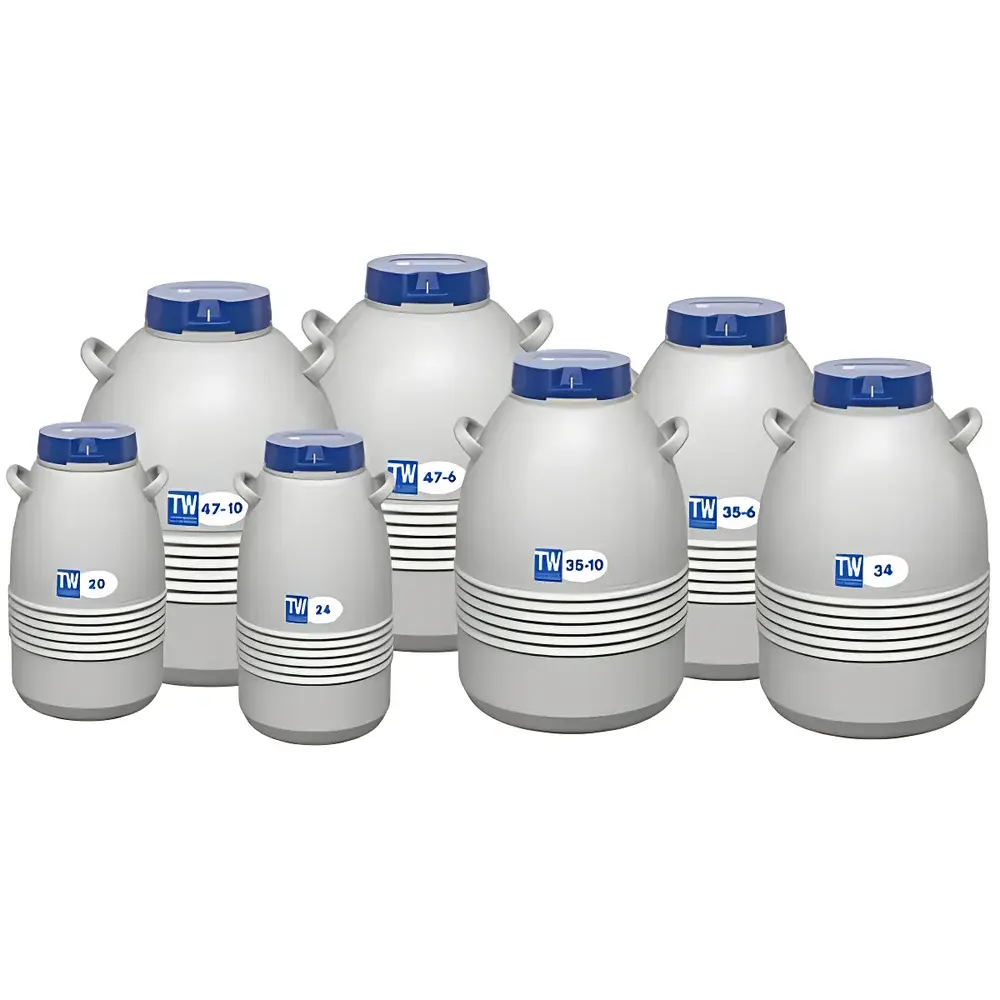
IC Biomedical TW Series Liquid Nitrogen Storage Dewars
| Brand | Ted Pella |
|---|---|
| Origin | USA |
| Manufacturer Type | Authorized Distributor |
| Origin Category | Imported |
| Model | TW Series |
| Quotation | Available Upon Request |
Overview
The IC Biomedical TW Series Liquid Nitrogen Storage Dewars are engineered for long-term, ultra-low-temperature sample preservation in demanding laboratory, biobanking, and translational research environments. These high-performance cryogenic containers operate on the fundamental principle of vacuum-insulated double-walled stainless steel or aluminum construction, minimizing heat ingress through conduction, convection, and radiation. The series leverages advanced multilayer reflective insulation (MLI), high-vacuum integrity (<1×10⁻³ Pa), and optimized neck geometry to achieve industry-leading static hold times—up to 218 days for the TW24 model—without active refrigeration. Designed specifically for biological specimen storage at –196 °C, each dewar maintains thermal stability essential for preserving viability of stem cells, oocytes, embryos, PBMCs, tissue explants, and archival DNA/RNA samples under strict GLP-compliant workflows.
Key Features
- Vacuum-insulated aluminum tank body with reinforced ribbed structure for mechanical durability and thermal stability
- Magnetically formed neck tube design ensuring consistent thermal resistance and reduced boil-off rate
- Electrostatically applied, corrosion-resistant enamel coating for extended service life in humid or saline lab environments
- Lockable, oversized lid with integrated sealing groove—compatible with standard cryo-tape, cable ties, and tamper-evident security seals
- Modular 11-inch (279 mm) canister compatibility across all models, supporting standardized cryovial racks (e.g., Nunc™, Thermo Scientific™ formats)
- Optional heavy-duty swivel casters with brake mechanism for ergonomic repositioning in shared core facilities or ISO-classified cleanrooms
Sample Compatibility & Compliance
The TW Series accommodates a full range of cryogenic storage accessories, including aluminum or polypropylene canisters, cryoboxes (10×10, 8×8 configurations), and programmable vapor-phase monitoring probes. All units comply with ASTM F2163–22 (Standard Specification for Cryogenic Vessels for Biological Specimen Storage) and meet baseline requirements for ISO 13485–2016 (Medical Devices) when deployed in clinical biobanking applications. While not certified as Class II medical devices per FDA 21 CFR Part 820, the dewars support GMP-aligned cold chain documentation protocols—including temperature log integration via third-party IoT sensors—and are routinely validated for use in CAP-accredited laboratories and UK Biobank–aligned repositories.
Software & Data Management
The TW Series is hardware-native and does not include embedded electronics or firmware; however, it is fully interoperable with external monitoring ecosystems. Users may integrate third-party wireless temperature/humidity/liquid-level transmitters (e.g., Sensirion SHT45, Vaisala WXT530, or Temptime CryoView™) into LIMS or ELN platforms via Modbus RTU, Bluetooth LE, or LoRaWAN gateways. Audit trails generated from such integrations satisfy 21 CFR Part 11 requirements when paired with qualified electronic signature modules and time-stamped metadata capture. Optional RFID-enabled canister tracking systems (e.g., Hamilton STARlet-compatible readers) further extend traceability for chain-of-custody compliance in regulated biorepository operations.
Applications
- Long-term cryopreservation of primary human cells, induced pluripotent stem cells (iPSCs), and organoids in academic and pharma R&D labs
- Secure transport and staging of biospecimens between satellite collection sites and central biobanks
- Vapor-phase storage of sensitive monoclonal antibodies and viral vectors where direct liquid immersion poses contamination or thermal shock risks
- Backup storage for automated freezers in critical infrastructure—reducing dependency on compressor-based systems during power outages or maintenance cycles
- Field-deployable cryo-logistics for mobile biorepositories operating in low-resource or remote settings (e.g., WHO STEPwise surveys, NIH-funded global health initiatives)
FAQ
What is the maximum allowable fill level for optimal static hold time?
For rated hold time performance, fill to within 2–3 cm below the neck tube base—overfilling increases evaporative loss and compromises vacuum integrity over extended service intervals.
Can these dewars be used for liquid-phase storage of sensitive cell lines?
Yes—however, vapor-phase operation (–150 °C to –190 °C) is recommended for most mammalian cell types to eliminate cross-contamination risk and minimize thermal cycling stress during routine access.
Are replacement lids and canisters available separately?
Yes—Ted Pella supplies OEM-specified lids (PN: TW-LID-LOCK), 11-inch aluminum canisters (PN: TW-CAN-AL-11), and polypropylene alternatives (PN: TW-CAN-PP-11) with documented lot traceability.
Do TW Series dewars require periodic vacuum reconditioning?
No scheduled re-evacuation is required under normal use; however, annual visual inspection of neck seal integrity and vacuum gauge verification (using handheld Pirani gauges) is advised per ISO 23530:2022 guidelines.
Is there a CE marking or UKCA certification for EU/UK market deployment?
As non-electrical, passive cryogenic vessels, TW Series dewars fall outside the scope of CE/UKCA directives—but full technical documentation, material declarations (RoHS/REACH), and Declaration of Conformity per PED 2014/68/EU Annex I are available upon request.




