
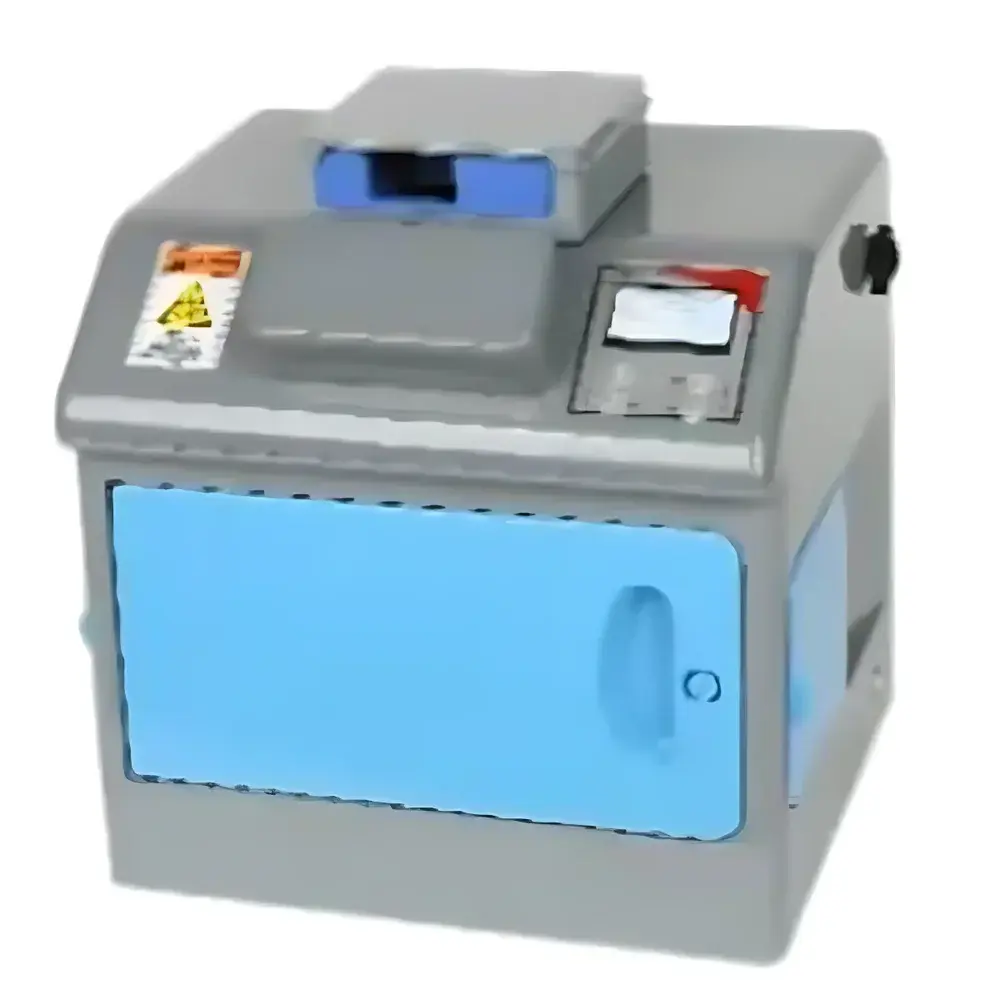
Jiapeng ZF-8ND Smart Darkroom Quad-Mode UV Transilluminator and Gel Cutter
| Brand | Jiapeng |
|---|---|
| Origin | Shanghai, China |
| Model | ZF-8ND |
| Instrument Type | Darkroom-style |
| Wavelength Modes | 254 nm (reflective), 302 nm (transmissive), 365 nm (reflective), plus visible white light (6 W) |
| UV Lamp Count | 4 × 8 W |
| UV Transillumination Area | 200 × 80 mm |
| UV Filter Dimensions | 200 × 80 mm |
| UV Intensity | ≥20 µW/cm² at 20 cm distance (per JJF 1936–2021) |
| Power Input | AC 220 V, 50/60 Hz |
| Internal Cavity Dimensions | 280 × 245 × 220 mm |
| External Dimensions | 280 × 330 × 330 mm |
| Weight | 3.2 kg |
| Compliance | JJF 1936–2021 (National Verification Regulation for UV Analyzers) |
Overview
The Jiapeng ZF-8ND Smart Darkroom Quad-Mode UV Transilluminator and Gel Cutter is a purpose-built instrument for nucleic acid and protein visualization, excision, and documentation in molecular biology laboratories. It operates on the principle of ultraviolet-induced fluorescence—where ethidium bromide, SYBR® dyes, or other UV-excitable fluorophores absorb UV photons and re-emit visible light, enabling rapid detection of DNA/RNA bands in agarose or polyacrylamide gels. Unlike open-frame transilluminators, the ZF-8ND integrates a fully enclosed darkroom architecture with multi-wavelength UV sources (254 nm reflective, 302 nm transmissive, 365 nm reflective) and a dedicated visible-light module (6 W white LED), supporting both high-sensitivity detection and low-photobleaching observation. Its engineered optical path ensures uniform irradiance across the 200 × 80 mm transillumination area, while the adjustable UV lamp assembly allows precise angular targeting—critical for optimizing signal-to-noise ratio during gel slicing or colony screening.
Key Features
- Quad-mode illumination control: Independent microprocessor-driven switching between 254 nm (optimal for UV-absorbing stains and crosslinking verification), 302 nm (standard for ethidium bromide and most commercial DNA dyes), 365 nm (reduced photodamage for sensitive samples and GFP-tagged proteins), and 6 W visible white light (for non-UV documentation or pre-stain alignment).
- Ergonomic darkroom design: Constructed from high-impact, UV-resistant ABS polymer via precision injection molding; includes dual side access ports with flexible silicone seals and an integrated UV-blocking observation window (>99% attenuation of 254/302/365 nm radiation per EN 62471).
- Calibrated UV output: Delivers ≥20 µW/cm² intensity at 20 cm distance under 302 nm transillumination, verified per JJF 1936–2021—the national metrological verification regulation for UV analyzers in China—and traceable to primary standards.
- Intuitive human-machine interface: Backlit LCD display with Chinese-language menu navigation, real-time parameter feedback, and audible alarm upon shutdown or lamp timeout—supporting GLP-compliant operational logging when paired with external lab notebooks.
- Modular expandability: Compatible with optional card-type digital cameras (not included) housed in standardized mounting frames, enabling time-stamped image capture without external tripods or alignment fixtures.
Sample Compatibility & Compliance
The ZF-8ND accommodates standard electrophoresis formats including mini-gels (up to 10 × 10 cm), wide-format gels (e.g., 20 × 20 cm), and multi-well plates. Its 200 × 80 mm active transillumination zone supports simultaneous imaging of two 8 × 10 cm gels or full-length sequencing gels. The unit meets structural safety requirements outlined in IEC 61010-1 for laboratory electrical equipment and incorporates thermal cutoff protection to prevent lamp overheating. While not certified to ISO/IEC 17025 or FDA 21 CFR Part 11 out-of-the-box, its repeatable irradiance profile and stable power delivery support method validation under internal SOPs aligned with ASTM D7212 (for UV-based nucleic acid quantification) and USP (fluorescence instrumentation qualification guidelines). All patented mechanical features—including lamp angle adjustment and filter retention mechanism—are documented in granted Chinese utility model patents (ZL 2019 2 0792756.2 et al.).
Software & Data Management
The ZF-8ND operates as a standalone hardware platform with no embedded firmware-based data storage or network connectivity. Image acquisition relies on externally connected digital cameras or smartphone-based documentation systems. For regulated environments, users may integrate the device into existing LIMS or ELN workflows by recording instrument ID (ZF-8ND), lamp mode, exposure duration, and operator initials manually—or via barcode-scanned log sheets. The consistent spectral output and geometric repeatability enable retrospective correlation of band intensity across experiments when coupled with third-party densitometry software (e.g., ImageJ, AlphaView SA, or TotalLab Quant).
Applications
- DNA/RNA band visualization and excision in agarose and polyacrylamide gels
- Colony PCR screening and plasmid verification
- Protein detection using UV-active tags (e.g., tryptophan fluorescence at 280 nm with 302 nm excitation)
- Fluorescent dye compatibility testing (SYBR Safe®, GelRed®, GelGreen®, Fast-Safe™)
- Forensic sample screening (e.g., latent fingerprint enhancement with fluorescent powders)
- Cultural heritage analysis (e.g., pigment identification in historical manuscripts under 365 nm long-wave UV)
- Industrial QC of UV-curable resins and photoinitiator formulations
FAQ
Is the ZF-8ND compliant with international UV safety standards?
Yes—the observation window attenuates >99% of incident UV radiation across all operating wavelengths (254/302/365 nm), meeting the photobiological safety classification requirements of EN 62471:2006 (Risk Group 1 for lamps).
Can the ZF-8ND be used for UV crosslinking applications?
It is not designed for nucleic acid crosslinking to membranes; the 254 nm reflective mode provides diagnostic-level intensity only—not the sustained high-dose irradiation required for covalent immobilization.
What is the expected service life of the UV lamps?
Each 8 W UV lamp has a rated lifetime of ≥5,000 hours under normal intermittent use (typical gel documentation cycles of ≤10 min per session).
Does the unit include calibration certification?
No factory-issued NIST-traceable calibration certificate is provided; however, the device conforms to JJF 1936–2021, and users may perform in-house verification using a calibrated UV radiometer.
Is visible-light illumination sufficient for Coomassie- or silver-stained gels?
Yes—the 6 W white-light module delivers uniform diffuse illumination ideal for visualizing non-fluorescent protein gels without UV exposure artifacts.
Related Products




