
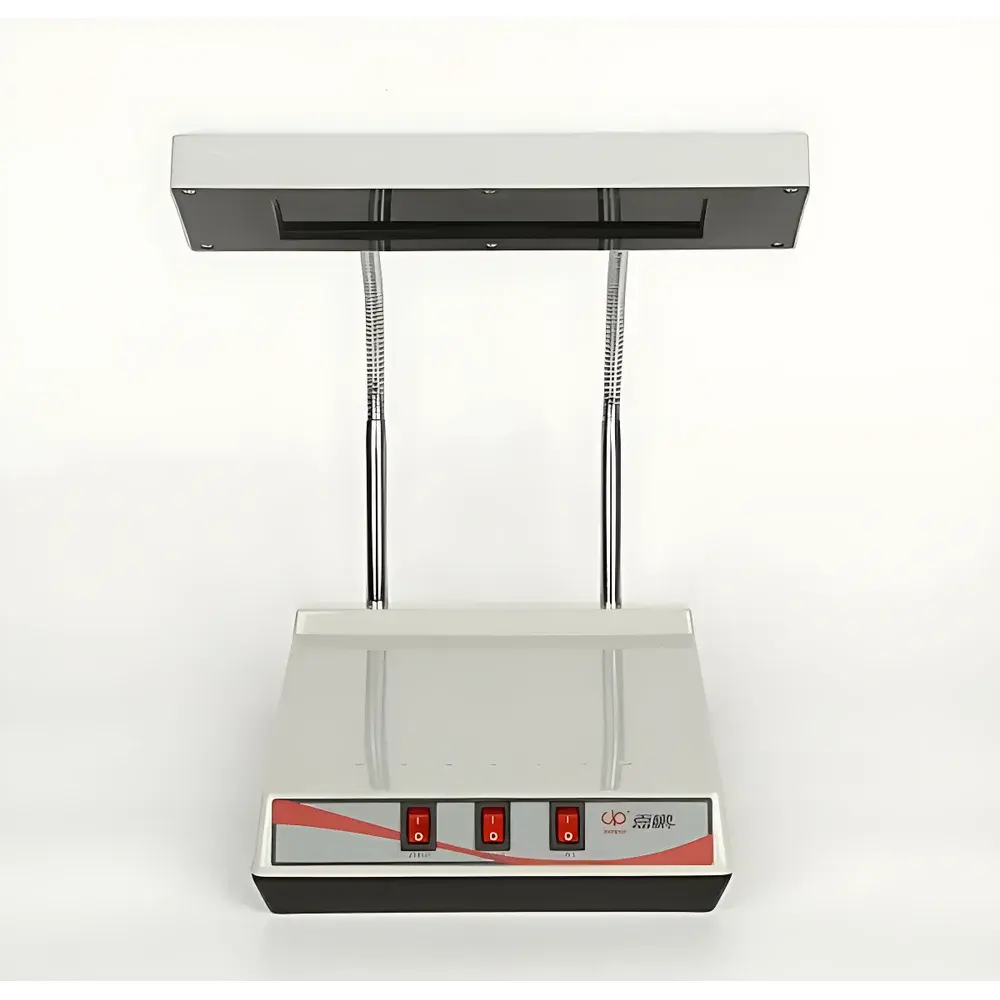
Jiapeng ZF-1 Triple-Function UV Transilluminator with 254 nm & 365 nm Emission
| Brand | Jiapeng |
|---|---|
| Origin | Shanghai, China |
| Model | ZF-1 |
| Instrument Type | Benchtop |
| Wavelengths | 254 nm and 365 nm (dual-band) |
| UV Filter Dimensions | 200 × 50 mm |
| UV Lamp Power | 8 W × 2 tubes |
| Visible Light Source | 4 W × 1 lamp |
| UV Intensity | 20 µW/cm² at 20 cm distance |
| Input Voltage | AC 220 V, 50/60 Hz |
| Dimensions (L×W×H) | 270 × 280 × 270 mm |
| Weight | 1.2 kg |
| Compliance | JJF 1936–2021 (National Verification Regulation for UV Analyzers) |
| Patents | ZL201920792756.2, ZL202221777391.4, ZL202222383825.9 |
Overview
The Jiapeng ZF-1 Triple-Function UV Transilluminator is a benchtop analytical instrument engineered for routine fluorescence visualization and gel documentation in life science laboratories. It operates on the principle of ultraviolet-induced fluorescence excitation—where nucleic acids or proteins labeled with UV-sensitive dyes (e.g., ethidium bromide, SYBR Safe, or GelRed) absorb photons at 254 nm or 365 nm and emit visible light upon relaxation. The dual-wavelength configuration enables selective excitation: 254 nm provides high-sensitivity detection for standard DNA staining, while 365 nm offers reduced photodamage to biological samples and improved compatibility with UV-safe dyes during preparative gel excision. Its compact footprint and integrated visible white-light illumination support both UV transillumination and post-staining documentation under ambient conditions—making it suitable for electrophoresis workflow integration in academic, clinical, and industrial QC settings.
Key Features
- Benchtop design with ergonomic dimensions (270 × 280 × 270 mm) and lightweight construction (1.2 kg), optimized for space-constrained lab benches and mobile applications.
- Dual-band UV emission system: independently switchable 254 nm and 365 nm UV lamps (8 W × 2), each filtered through a precision-cut 200 × 50 mm UV-transmission filter to eliminate stray visible radiation and ensure spectral purity.
- Calibrated UV output: delivers 20 µW/cm² irradiance at 20 cm working distance—verified per JJF 1936–2021, China’s national verification regulation for UV analyzers, ensuring metrological traceability in routine fluorescence assessment.
- Adjustable UV lamp angle for optimal sample illumination geometry, minimizing shadowing and enhancing signal uniformity across the transilluminator surface.
- Integrated 4 W white-light source for simultaneous visible-light imaging, enabling side-by-side comparison of stained gels under UV and daylight-equivalent illumination without repositioning.
- Enclosure constructed from high-impact, flame-retardant ABS polymer via precision injection molding—providing mechanical robustness, chemical resistance to common laboratory solvents, and long-term dimensional stability.
Sample Compatibility & Compliance
The ZF-1 supports standard agarose and polyacrylamide gel formats up to 15 × 15 cm, accommodating common electrophoresis cassettes and mini-gel trays. Its UV transmission window accommodates standard-sized gel combs and excision tools, facilitating direct in-gel band cutting under 365 nm illumination to minimize DNA degradation. The instrument complies with JJF 1936–2021 for photometric performance, intensity stability, and spectral bandwidth validation. While not certified for GLP/GMP-regulated environments as a standalone analytical device, its consistent output and documented calibration framework support data integrity in preliminary screening, teaching labs, and internal R&D workflows aligned with ISO/IEC 17025 preconditions. All safety interlocks and shielding meet GB 4793.1–2019 (equivalent to IEC 61010-1) for electrical safety in laboratory equipment.
Software & Data Management
The ZF-1 is a hardware-only transilluminator with no embedded microprocessor or digital interface; it operates via tactile boat-style toggle switches for UV wavelength selection and visible light activation. As such, it does not require firmware updates, driver installation, or software licensing. Image capture is performed externally using DSLR cameras, smartphone adapters, or dedicated gel documentation systems—enabling full compatibility with third-party analysis platforms (e.g., ImageJ, Bio-Rad Quantity One, TotalLab Quant). No audit trail, electronic records, or 21 CFR Part 11 compliance features are implemented, consistent with its role as a passive excitation source rather than a regulated analytical endpoint.
Applications
- Routine visualization and qualitative assessment of DNA/RNA bands in agarose and PAGE gels.
- Preparative gel excision under 365 nm UV to reduce thymine dimer formation and preserve template integrity for downstream cloning or sequencing.
- Fluorescence-based detection of proteins stained with UV-compatible dyes (e.g., Deep Purple, Krypton).
- Educational demonstrations of nucleic acid electrophoresis principles in undergraduate molecular biology laboratories.
- Field-deployable fluorescence screening in forensic units, archaeological artifact analysis, and environmental sample triage where portability and low power consumption are critical.
- QC support in biomanufacturing for rapid lot-to-lot verification of electrophoretic purity profiles.
FAQ
Is the ZF-1 compliant with international UV safety standards such as IEC 62471?
Yes—the unit incorporates UV-blocking acrylic shielding rated for Class 1 photobiological safety per IEC 62471:2006 when operated with the protective cover closed. Direct exposure to unshielded lamps is prohibited.
Can the ZF-1 be used with ethidium bromide and newer alternatives like SYBR Green?
Yes—both dyes exhibit strong excitation maxima near 254 nm and 365 nm; optimal sensitivity is achieved at 254 nm for EtBr and 365 nm for SYBR Green I/II to balance signal intensity and photostability.
Does the instrument include calibration documentation traceable to national standards?
Each unit ships with a factory verification report referencing JJF 1936–2021 test protocols, including measured irradiance values at specified distances and spectral output verification using calibrated spectroradiometry.
What maintenance is required for long-term UV lamp performance?
UV lamps should be replaced every 1,000–1,500 operating hours to maintain >90% nominal irradiance; cleaning of the filter surface with lint-free wipes and isopropanol is recommended monthly to prevent transmission loss.
Is the ZF-1 compatible with gel documentation systems that require external triggering?
Yes—its purely electrical operation (no signal output ports) allows seamless integration with shutter-triggered cameras via manual or foot-switch control, preserving synchronization in multi-channel imaging setups.





