
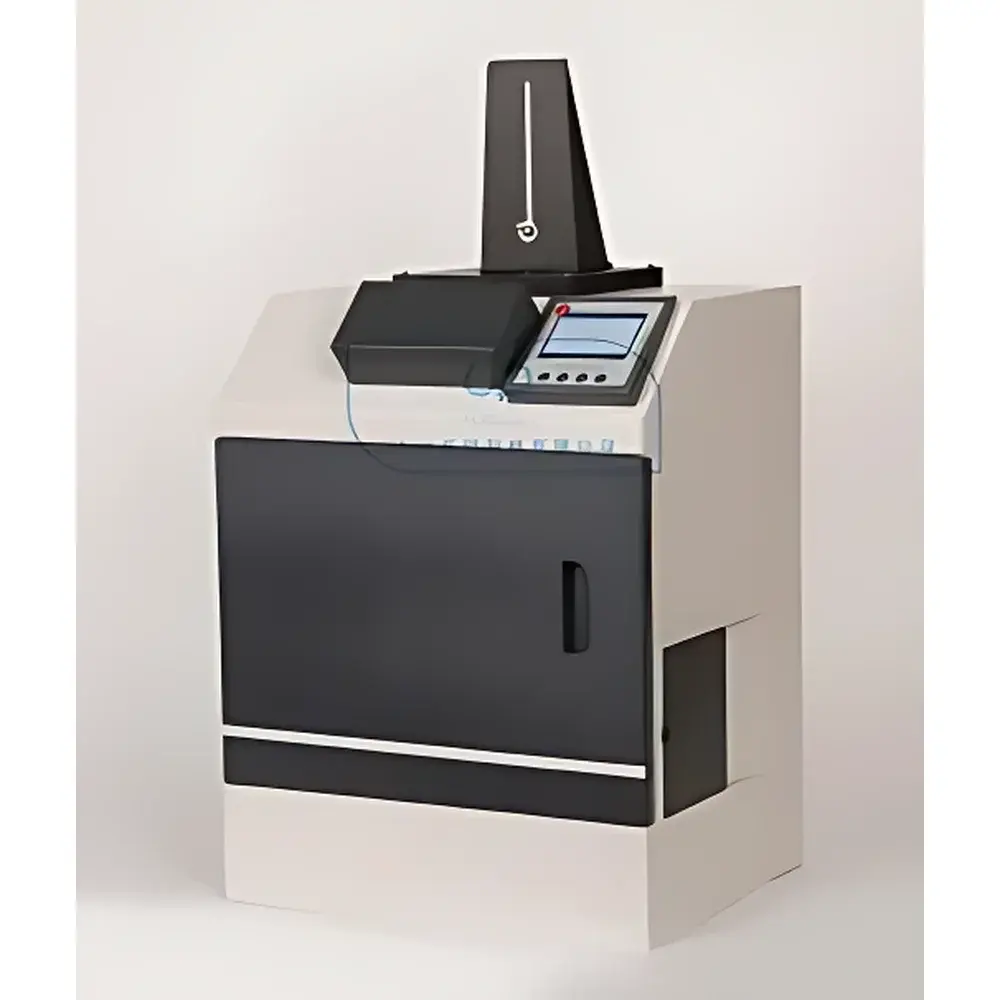
Jiapeng ZF1-IIN Darkroom-Style Multi-Wavelength UV Transilluminator and Gel Cutter
| Brand | Jiapeng |
|---|---|
| Origin | Shanghai, China |
| Model | ZF1-IIN |
| Instrument Type | Darkroom-style |
| Wavelength Modes | 302 nm (transmission), 254 nm & 365 nm (reflection) |
| Transmission Area | 200 × 150 mm |
| Reflection Filter Size | 200 × 80 mm |
| White Light Panel | 210 × 260 mm |
| UV Lamp Configuration | Twelve 8 W UV tubes (ten 302 nm transmission + two dual-wavelength reflection lamps) |
| Total Power Consumption | 80 W |
| UV Intensity at 20 cm | 20 µW/cm² |
| Display | 3.5-inch Chinese LCD with touch membrane keypad |
| Timer Range | 1 min – 24 h (user-programmable) |
| Safety Features | >99% UV-blocking observation window, integrated gel-cutting tools (1 handle + 4 interchangeable blades) |
| Compliance | Designed per JJF 1936–2021 “Verification Regulation for UV Analyzers” |
Overview
The Jiapeng ZF1-IIN is a darkroom-style, multi-wavelength UV transilluminator engineered for routine nucleic acid visualization, gel documentation, and precision excision of DNA/RNA bands following electrophoretic separation. It operates on the principle of ultraviolet-induced fluorescence—where ethidium bromide (EtBr), SYBR® Safe, GelRed®, or other nucleic acid intercalating dyes absorb UV photons and re-emit visible light—enabling rapid detection and qualitative assessment of nucleic acid fragments in agarose or polyacrylamide gels. Unlike open-bench UV boxes, the ZF1-IIN’s enclosed darkroom architecture minimizes ambient light interference and operator UV exposure while maintaining optical uniformity across the entire 200 × 150 mm transmission field. Its triple-wavelength capability supports both standard 302 nm transmission (optimized for EtBr-stained gels) and dual-band 254 nm / 365 nm reflection modes—used for UV-absorbing compounds (e.g., aromatic amino acids, nucleotides on TLC plates) or low-fluorescence dyes requiring shorter excitation. The system complies with JJF 1936–2021, China’s national metrological verification regulation for UV analyzers, and incorporates patented optical shielding and lamp-array thermal management to ensure stable irradiance output over extended operation cycles.
Key Features
- Triple-wavelength UV illumination: 302 nm (transmission), 254 nm and 365 nm (reflection), each independently activated via intuitive membrane keypad interface
- Uniform 200 × 150 mm UV transmission area with calibrated intensity of 20 µW/cm² at 20 cm distance—verified per JJF 1936–2021
- Dual-purpose white light panel (210 × 260 mm, 60 W) for post-UV documentation, protein staining (Coomassie, silver), or non-UV-based assays
- Integrated safety architecture: >99% UV-blocking observation window with optical-grade acrylic filter; side-mounted access ports with UV-sealed gaskets
- Precision gel excision suite: Includes one ergonomic cutting handle and four replaceable stainless-steel blades (straight, curved, fine-tip, scalpel-style)
- Programmable timer (1 minute to 24 hours) with audible end-of-cycle alarm and automatic lamp shutoff for protocol reproducibility and energy conservation
- Camera-ready design: Standardized C-mount compatible port and adjustable tripod bracket accommodate DSLR, mirrorless, and scientific CMOS cameras without optical adapters
Sample Compatibility & Compliance
The ZF1-IIN accommodates standard electrophoresis formats including mini-gels (up to 15 cm wide), slab gels, TLC plates (silica gel F254/F365), and paper chromatography sheets. Its 200 × 80 mm reflective stage supports upright imaging of UV-absorbing analytes under 254 nm (e.g., nucleotide standards, aromatic drugs) or long-wave 365 nm (e.g., coumarin derivatives, fluorescein-labeled oligonucleotides). All UV components meet RoHS Directive 2011/65/EU restrictions on hazardous substances. While not certified to ISO/IEC 17025 or FDA 21 CFR Part 11, the instrument’s traceable timer logic, fixed-intensity lamp configuration, and documented calibration methodology support GLP-aligned lab practices for qualitative gel analysis and archival documentation. It is routinely deployed in academic teaching labs, QC units for molecular biology reagent validation, and forensic DNA profiling workflows where visual band localization—not quantitative densitometry—is the primary objective.
Software & Data Management
The ZF1-IIN operates as a hardware-only platform with no embedded firmware or proprietary software stack. Image acquisition relies on third-party camera systems and standard photography software (e.g., Adobe Lightroom, ImageJ, NIS-Elements). Its timer and lamp control functions are implemented via dedicated microcontroller logic—ensuring deterministic behavior without OS dependencies. For laboratories requiring audit trails, integration with LIMS or ELN systems is achieved through external time-stamped image metadata (EXIF) and manual logbook entries. No data encryption, user authentication, or electronic signature capabilities are provided, consistent with its classification as a Class I laboratory support device under IEC 61010-1 safety standards.
Applications
- Visualization and documentation of EtBr-, SYBR® Gold-, or GelGreen®-stained DNA/RNA gels after agarose or PAGE electrophoresis
- PCR product verification, restriction digest analysis, and DNA ladder sizing
- Fingerprinting applications including RFLP and AFLP pattern comparison
- TLC and paper chromatography development monitoring for pharmaceuticals, metabolites, or plant extracts
- Preparative gel extraction for downstream cloning, sequencing, or mass spectrometry sample preparation
- Educational demonstrations of nucleic acid photophysics and UV safety protocols
FAQ
Is the ZF1-IIN suitable for quantitative densitometry?
No. This instrument delivers consistent qualitative visualization but lacks calibrated CCD sensors, background subtraction algorithms, or optical density linearity certification required for quantification.
Can I use it with SYBR® Safe without filter modification?
Yes. SYBR® Safe exhibits strong excitation at 302 nm; no filter change is needed for standard transmission imaging.
Does it support UV-free gel documentation?
Yes. The integrated 60 W white light panel enables stain visualization (e.g., Coomassie Blue, silver nitrate) without UV activation.
What maintenance does the UV lamp array require?
Lamp output degrades gradually over ~5,000 hours. Replacement is recommended when observed fluorescence intensity falls below 15 µW/cm² at 20 cm, verified using a NIST-traceable UV radiometer.
Is the cutting tool sterilizable?
Stainless steel blades are autoclavable (121 °C, 15 psi, 15 min); handle housing is not autoclave-rated—wipe with 70% ethanol prior to use.
Related Products




