
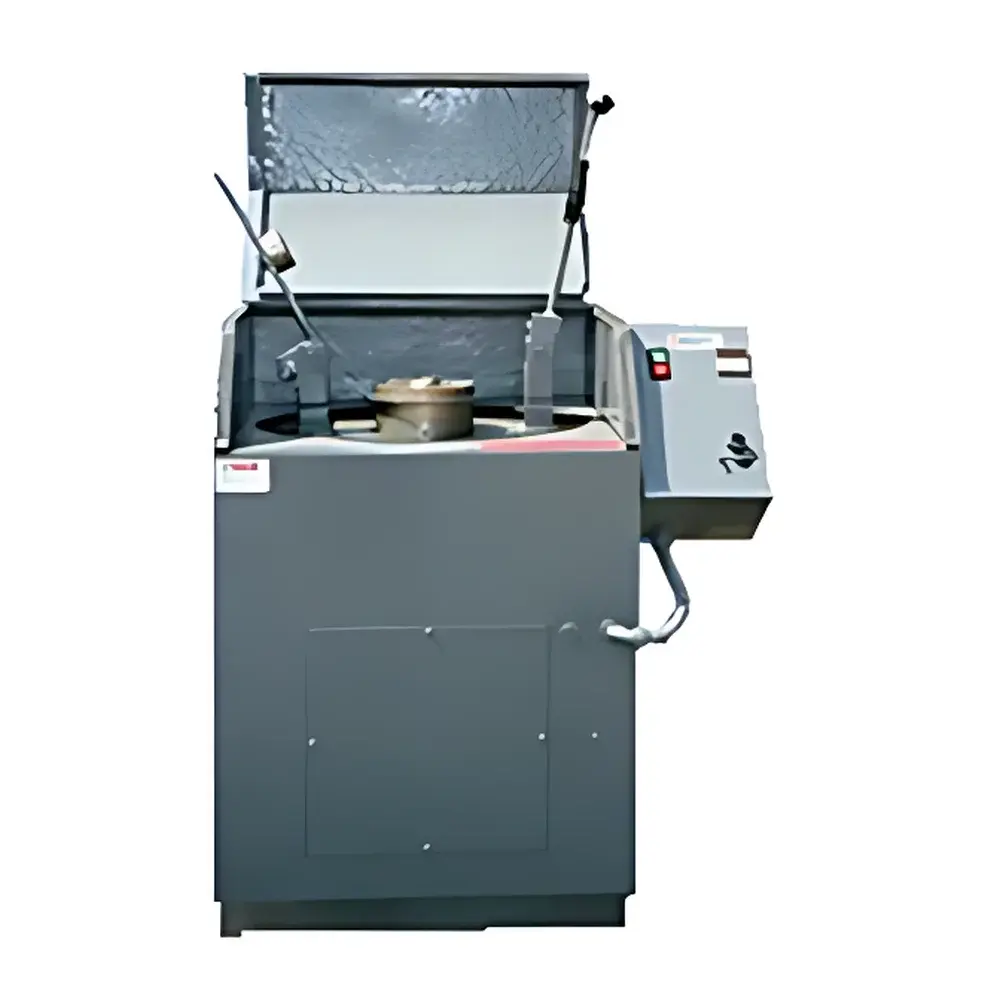
VP Series Cup-Vibration Grinder
| Origin | USA |
|---|---|
| Manufacturer Type | Authorized Distributor |
| Origin Category | Imported |
| Model | VP Series |
| Price Range | USD 1,400 – 7,200 |
| Instrument Type | Grinder |
| Sample Suitability | Hard & Brittle Solids |
| Output Particle Size | ≥ 0.5 mm |
| Feed Particle Size | < 15 mm |
| Batch Grinding Capacity | 60 mL |
| Bowl Volume Options | 150 mL or 250 mL |
| Drive System | Direct-Drive Motor |
| Vibration Frequency | 900 rpm |
| Grinding Time | 1–2 min |
| Dimensions (W×D×H) | 61 × 61 × 109 cm |
| Net Weight | 173 kg |
| Construction | Hardened Chromium Steel Bowl & Media |
| Power Options | VP-1989 (380 V, 3-phase) / VP-1989S (220 V, single-phase) |
Overview
The VP Series Cup-Vibration Grinder is an industrial-grade, high-energy mechanical pulverizer engineered for rapid, reproducible size reduction of hard, brittle, and inhomogeneous solid samples. It operates on the principle of horizontal orbital vibration—where a motor-driven rotating disc imparts controlled oscillatory motion to a spring-suspended grinding bowl assembly. This motion accelerates hardened grinding media (typically two concentric rings and one central grinding puck) within the bowl, generating intense impact and shear forces against the sample. Unlike planetary or ball mills, the cup-vibration mechanism delivers highly efficient energy transfer with minimal heat generation and negligible contamination risk, making it particularly suitable for preparation of analytical-grade powders for X-ray fluorescence (XRF), infrared (IR), and elemental analysis applications.
Key Features
- Direct-drive motor architecture ensures precise rotational stability at 900 rpm, eliminating belt slippage and maintaining consistent amplitude and frequency over extended operation cycles.
- Hardened chromium steel grinding bowl (standard 250 mL; optional 150 mL) and matching media set (two rings + one puck) provide exceptional wear resistance and low metal leaching—critical for trace-element-sensitive analyses.
- Acoustically sealed lid with integrated gasket minimizes operational noise to ≤72 dB(A) and prevents dust dispersion, supporting ISO 14001-compliant laboratory environments.
- Robust cast-iron frame and vibration-dampening base ensure mechanical stability during high-intensity grinding, even with irregularly shaped or dense feed materials (e.g., slag, cast iron, ceramic shards).
- Simple toggle-switch control interface with no programmable logic—designed for reliability, ease of maintenance, and compatibility with GLP-regulated workflows where firmware validation is not required.
- Capable of reducing 13 mm feed particles (dry or wet) to ≤38 µm (400 mesh) in under 120 seconds, verified per ASTM E11-22 sieve calibration standards.
Sample Compatibility & Compliance
The VP Series accommodates a broad spectrum of inorganic, non-fibrous, and thermally stable materials—including metallurgical slags, coal, ores, cement clinker, refractory ceramics, geological core fragments, and sintered alloys. It is explicitly unsuitable for soft, elastic, fibrous, or temperature-sensitive polymers. All standard configurations comply with IEC 61000-6-2 (EMC immunity) and IEC 61000-6-4 (EMC emissions). The sealed grinding chamber meets OSHA 1910.138 requirements for operator protection during routine handling. While not intrinsically rated for Class I Div 1 hazardous locations, optional grounding kits and static-dissipative bowls are available for electrostatic-prone environments.
Software & Data Management
This instrument operates as a standalone mechanical system with no embedded microprocessor, touchscreen, or data logging capability—intentionally designed to eliminate software qualification burdens under FDA 21 CFR Part 11 and EU Annex 11. All operational parameters (time, speed, load) are manually recorded by the user and retained in lab notebooks or LIMS-integrated electronic records. For laboratories requiring audit-ready documentation, we recommend pairing the VP grinder with time-stamped video monitoring (per ISO/IEC 17025:2017 Clause 7.8.2) and pre/post-grind particle size verification using laser diffraction (e.g., Malvern Mastersizer) or sieve analysis (ASTM C136/C780).
Applications
- XRF and ICP-OES sample preparation for geochemical mapping and ore grade assessment
- Homogenization of cementitious materials prior to Blaine fineness testing (ASTM C204)
- Routine pulverization of blast furnace slag and fly ash for pozzolanic activity evaluation (ASTM C618)
- Preparation of IR-transparent KBr pellets from mineralogical standards
- Size reduction of sintered metal powders for SEM-EDS cross-sectional analysis
- High-throughput batch processing in QC labs serving mining, cement, and foundry industries
FAQ
What types of samples are incompatible with the VP Series grinder?
Samples with high elasticity (e.g., rubber, elastomers), fibrous structure (wood, plant tissue), or thermal sensitivity (polymers, pharmaceutical actives above 60 °C) are not recommended due to inefficient energy coupling and potential media clogging.
Can the VP grinder be used under inert atmosphere?
No—standard models lack gas-purge ports or pressure-rated seals. For oxygen-sensitive samples, alternative glove-box-compatible mills (e.g., planetary ball mills with sealed jars) are advised.
Is calibration required before use?
No formal calibration is mandated; however, users must verify rotational speed annually using a certified tachometer (traceable to NIST standards) and inspect bowl/media wear per manufacturer’s visual inspection protocol (Document VP-INS-03 Rev. B).
How does the VP Series compare to planetary ball mills for XRF prep?
VP grinders achieve faster throughput (<2 min vs. 5–15 min) and lower contamination risk for coarse-to-medium hardness materials, but offer less control over final particle distribution width compared to multi-step planetary milling protocols.
Are spare parts and service support available outside North America?
Yes—authorized technical service partners operate in Germany, China, Brazil, and Australia, with lead times for critical spares (bowls, media sets, drive couplings) averaging 12–18 business days ex-warehouse in Cincinnati, OH.



