
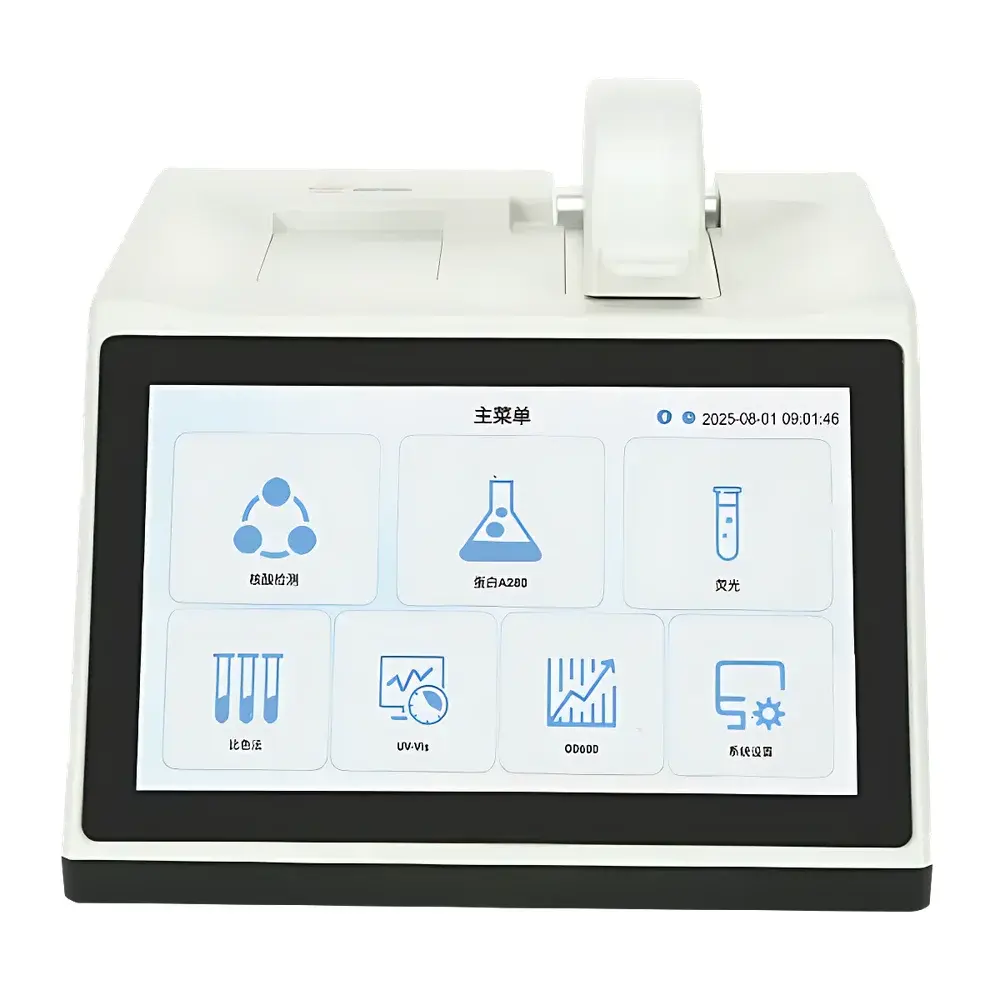
JP-Keebio1000 Ultra-Micro Spectrophotometer
| Brand | JiaPeng |
|---|---|
| Origin | Shanghai, China |
| Model | JP-Keebio1000 |
| Wavelength Accuracy | ±1 nm |
| Wavelength Range | 185–910 nm |
| Cuvette Mode (OD600) | 600 ± 8 nm |
| Sample Volume | 0–2.0 µL |
| Optical Path Lengths | 1.0 / 0.5 / 0.1 / 0.05 / 0.02 mm (auto-switching) |
| Light Source | Xenon flash lamp (≥10 yr lifetime) |
| Detector | 3648-pixel linear CCD array |
| Wavelength Resolution | ≤3 nm (FWHM at Hg 546 nm) |
| Absorbance Accuracy | ±1% (at 7.332 A, 260 nm) |
| Absorbance Precision | ±0.002 A |
| Absorbance Range (10-mm equivalent) | 0–780 A |
| OD600 Range | 0–4 A |
| Measurement Time | ≤5 s |
| dsDNA Quantification Range | 0–38,880 ng/µL |
| BSA Protein Range | 0.06–820 mg/mL |
| Data Export | USB port, SD-RAM card |
| Optional fluorescence module (Ex | 460 nm, Em: 525 nm) |
Overview
The JP-Keebio1000 Ultra-Micro Spectrophotometer is a dual-mode, full-spectrum absorbance instrument engineered for precise nucleic acid and protein quantification in research, quality control, and bioprocessing laboratories. It operates on the principle of UV-Vis absorption spectroscopy, leveraging a high-stability xenon flash lamp and a 3648-pixel linear CCD detector to deliver rapid, reproducible spectral acquisition across 185–910 nm. Its dual-sample introduction architecture—comprising both a quartz-fiber-based microfluidic measurement base and a standard 10-mm cuvette holder with dedicated OD600 optics—enables seamless transition between ultra-low-volume (0–2 µL) and bulk liquid measurements. This design eliminates dilution errors common in traditional spectrophotometry and supports direct quantification of highly concentrated or viscous biological samples without manual pathlength adjustment. The system’s optical path lengths (1.0, 0.5, 0.1, 0.05, and 0.02 mm) are automatically selected based on real-time absorbance feedback, ensuring optimal signal-to-noise ratio across the full dynamic range.
Key Features
- 10.1-inch capacitive touchscreen interface running Android OS, enabling intuitive, icon-driven operation without external PC dependency
- Auto-ranging optical pathlength switching (1.0 mm to 0.02 mm) ensures accurate quantification from dilute to highly concentrated samples (e.g., dsDNA: 0–38,880 ng/µL; BSA: 0.06–820 mg/mL)
- Dedicated OD600 optical channel (600 ± 8 nm) optimized for microbial culture density monitoring per ASTM E2561 and ISO 8199 standards
- Measurement completion in ≤5 seconds per sample, with no warm-up time required due to pulsed xenon illumination
- Built-in thermal printer for immediate hardcopy reporting compliant with GLP documentation requirements
- Data export via USB 2.0 port and SD-RAM card slot, supporting CSV and PDF report generation for audit-ready traceability
- Optional fluorescence module (460 nm excitation / 525 nm emission) compatible with common dyes including SYBR Green I, PicoGreen®, and Qubit® reagents
- Integrated rechargeable 20,000 mAh lithium battery (optional) enables portable, off-grid operation in field or biosafety cabinet environments
Sample Compatibility & Compliance
The JP-Keebio1000 accommodates a broad spectrum of biological and biochemical samples—including purified DNA/RNA, crude lysates, protein solutions (BSA, IgG, lysozyme), viral particles, liposomes, and bacterial/fungal suspensions—without requiring dilution or centrifugation. Its quartz-fiber sample stage resists chemical corrosion and thermal drift, maintaining calibration stability over extended use. The instrument conforms to key international performance benchmarks: wavelength accuracy meets ISO 8579-1:2017 (spectrophotometer verification), absorbance linearity aligns with USP guidance for nucleic acid analysis, and OD600 mode satisfies CLSI EP10-A3 criteria for turbidimetric cell density assessment. For regulated environments, the system supports user-accessible audit logs, timestamped reports, and electronic signature-ready output—facilitating compliance with FDA 21 CFR Part 11 and EU Annex 11 when paired with validated SOPs.
Software & Data Management
The embedded Android-based software provides preconfigured assay templates for A260/A280, A260/A230, and OD600 calculations, with editable extinction coefficients and custom curve fitting (linear, quadratic, or cubic regression). All raw spectra and processed data are stored locally with automatic timestamping, user ID tagging, and version-controlled firmware updates. Export formats include machine-readable CSV files for LIMS integration and print-ready PDFs containing full metadata (wavelength scan, pathlength used, baseline correction method, and environmental conditions). No cloud connectivity is required; all data remain under local administrative control—essential for labs handling proprietary or sensitive genomic material.
Applications
- High-throughput quantification of CRISPR guide RNAs, mRNA vaccine constructs, and plasmid preparations prior to transfection or sequencing
- Routine QC of recombinant protein expression batches, including purity assessment via A260/A280 and contaminant detection via A230
- Monitoring bacterial growth kinetics in bioreactor inocula and fermentation media optimization studies
- Verification of library normalization in NGS workflows, reducing sequencing waste and improving cluster density consistency
- Validation of oligonucleotide synthesis yield and desalting efficiency in oligo QC pipelines
- Field-deployable nucleic acid screening in resource-limited settings, enabled by battery operation and ruggedized aluminum chassis
FAQ
Does the JP-Keebio1000 require routine calibration with NIST-traceable standards?
Yes—annual verification using NIST SRM 930e (neutral density filters) and SRM 2034 (UV transmission standards) is recommended to maintain compliance with ISO/IEC 17025 accreditation requirements.
Can the instrument measure samples with high absorbance beyond 780 A (10-mm equivalent)?
No—absorbance values above 780 A exceed the linear dynamic range of the CCD detector; users should rely on the auto-pathlength selection to maintain readings within 0.1–300 A for optimal precision.
Is the OD600 mode validated for yeast or filamentous fungal cultures?
Yes—the 600 ± 8 nm bandpass filter and collimated beam geometry have been verified against McFarland standards for Saccharomyces cerevisiae and Aspergillus niger suspensions per CLSI M27-A3 guidelines.
How is data integrity ensured during USB or SD-card export?
All exported files include SHA-256 checksums and embedded digital signatures tied to the instrument’s unique serial number and firmware revision, preventing unauthorized modification.
What maintenance is required for the quartz fiber sample surface?
Daily cleaning with >99.9% isopropanol and lint-free wipes is sufficient; abrasive solvents or ultrasonic cleaning must be avoided to preserve optical homogeneity and pathlength fidelity.



