
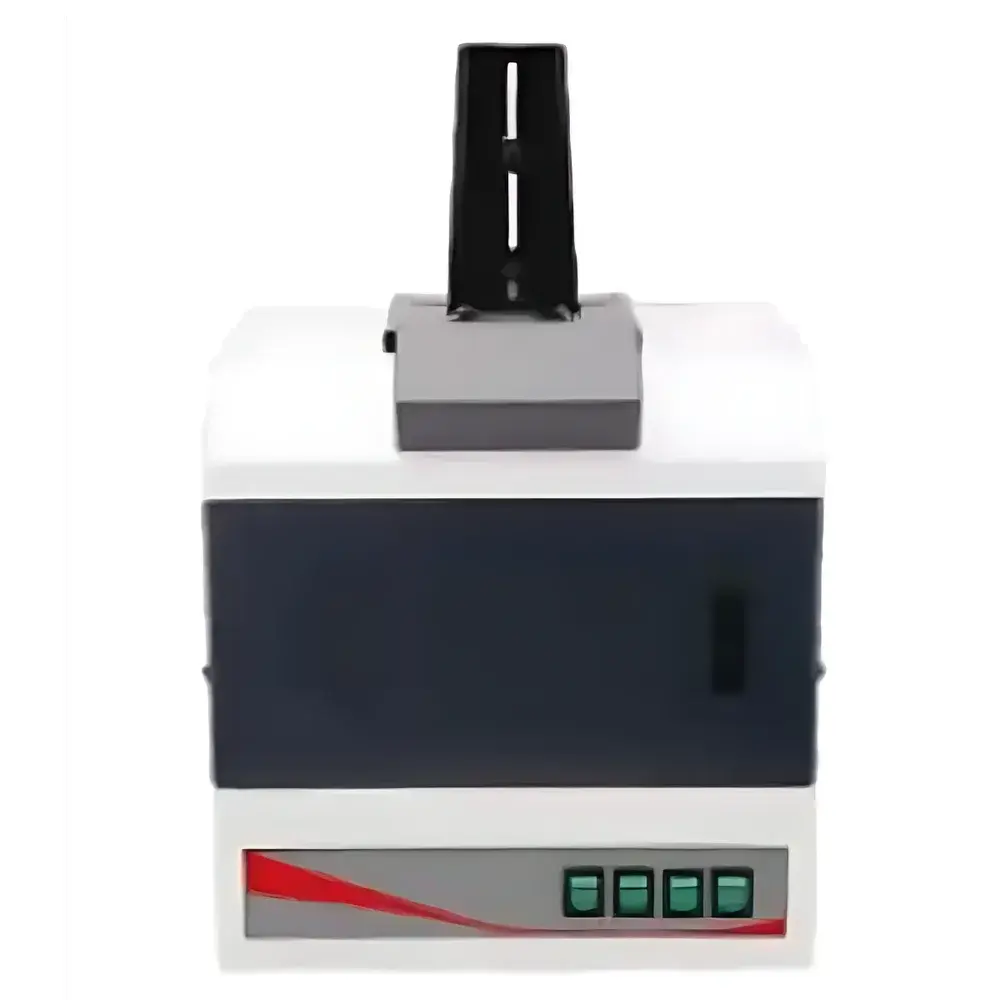
Jiapeng ZF1-II UV Transilluminator and Gel Cutter
| Brand | Jiapeng |
|---|---|
| Origin | Shanghai, China |
| Manufacturer Type | Authorized Distributor |
| Product Category | Domestic |
| Model | ZF1-II |
| Instrument Type | Darkroom-style |
| Wavelength Modes | Multi-wavelength |
| UV Transmission Wavelength | 302 nm |
| UV Reflection Wavelengths | 254 nm, 365 nm |
| Filter Type | Transparent short-wave cutoff filter |
| UV Lamp Count | 10 |
| UV Filter Dimensions | 200 × 150 mm |
| UV Transmission Area | 200 × 150 mm |
| UV Lamp Power | 8 W per lamp |
| Input Power | AC 220 V, 50/60 Hz |
| White Light Source | 40 W incandescent lamp |
| UV Intensity at 20 cm | 20 µW/cm² |
| Cut-out Tool Kit | 1 gel-cutting blade with 4 replaceable tips |
| Darkroom Dimensions (L×W×H) | 375 × 280 × 380 mm |
| Net Weight | 4.88 kg |
Overview
The Jiapeng ZF1-II UV Transilluminator and Gel Cutter is a purpose-built darkroom-style instrument engineered for safe, high-contrast visualization and precise excision of nucleic acid bands in agarose and polyacrylamide gels. It operates on the principle of ultraviolet-induced fluorescence: when ethidium bromide (EtBr), SYBR® Safe, or other DNA-intercalating fluorophores are excited by specific UV wavelengths, they emit visible light—typically orange-red—enabling rapid detection of DNA/RNA fragments post-electrophoresis. The ZF1-II integrates three discrete UV emission bands—302 nm for optimal transillumination of stained gels, and 254 nm and 365 nm for reflective-mode analysis of UV-absorbing compounds (e.g., tryptophan-containing proteins, aromatic metabolites) or UV-active markers—within a fully shielded enclosure. Its optical architecture includes a precision-matched short-wave cutoff filter that blocks >99% of non-target UV radiation while transmitting peak fluorescence signal, ensuring both operator safety and imaging fidelity.
Key Features
- Triple-wavelength UV system: 302 nm (transmission), 254 nm & 365 nm (reflection), enabling flexible assay design across nucleic acid and protein applications.
- Uniform 200 × 150 mm transmission field powered by ten 8 W UV lamps, delivering stable irradiance (20 µW/cm² at 20 cm distance) compliant with JJF 1936–2021—the national metrological verification regulation for UV transilluminators in China.
- Integrated darkroom with side-access ports and a lead-acrylic observation window that attenuates ≥99% of incident UV radiation, permitting real-time visual assessment without UV exposure.
- Dedicated DSLR mounting interface compatible with standard tripod threads and common camera bodies; supports time-lapse documentation and quantitative band intensity capture when paired with calibrated imaging software.
- Built-in 40 W white-light source for post-staining documentation under visible illumination, eliminating need for external lighting during gel photography.
- Patented mechanical design (Utility Model Patents No. ZL201220517513.6 and ZL201920792756.2) ensures structural rigidity, thermal stability, and long-term lamp alignment consistency.
Sample Compatibility & Compliance
The ZF1-II accommodates standard electrophoresis gels up to 200 × 150 mm (transmission) and 200 × 80 mm (reflection), including mini-gels, wide-format slab gels, and TLC plates. It supports common fluorescent dyes (EtBr, GelRed®, SYBR® Gold, Fast-Safe™) and native UV-absorbing analytes. While not certified to ISO/IEC 17025 or FDA 21 CFR Part 11 out-of-the-box, its performance aligns with ASTM D7217–17 (Standard Practice for UV Visualization of Nucleic Acids) and supports GLP-compliant workflows when integrated into validated laboratory procedures. All UV components meet IEC 62471 Photobiological Safety requirements for Risk Group 2 (moderate risk), and the darkroom enclosure satisfies EN 61010-1 safety standards for electrical equipment used in laboratories.
Software & Data Management
The ZF1-II is a hardware-only platform with no embedded firmware or proprietary software. It interfaces seamlessly with third-party image acquisition systems—including Image Lab™ (Bio-Rad), Quantity One® (Bio-Rad), AlphaView SA (ProteinSimple), and open-source tools such as Fiji/ImageJ—via standard USB or HDMI connections from externally mounted cameras. The fixed camera mount enables reproducible framing and consistent pixel-to-mm calibration. For audit-trail compliance, users may configure external PCs to log timestamped images with metadata (exposure time, lens focal length, lamp mode), satisfying basic GxP data integrity expectations where full 21 CFR Part 11 compliance is not mandated.
Applications
- DNA/RNA fragment sizing and quantification in agarose and PAGE gels.
- Verification of PCR amplification products and restriction digestion efficiency.
- Analysis of RFLP, AFLP, and DNA fingerprinting patterns.
- Detection of UV-absorbing compounds in thin-layer chromatography (TLC) and paper chromatography.
- Localization and excision of target bands for downstream cloning, sequencing, or mass spectrometry.
- Qualitative assessment of protein purity via tryptophan fluorescence under 254 nm reflection.
FAQ
Is the ZF1-II suitable for use with SYBR® Safe stain?
Yes. SYBR® Safe exhibits strong excitation maxima near 300 nm, making the 302 nm transmission mode highly effective for sensitive detection with reduced photodamage compared to shorter wavelengths.
Can the unit be operated continuously for extended periods?
The lamp array and ballast are rated for continuous duty up to 4 hours; intermittent operation (≤30 min ON / 5 min OFF) is recommended for optimal lamp longevity and thermal management.
Does it include a UV-blocking face shield?
No. The built-in observation window provides sufficient attenuation for brief visual checks, but ANSI Z87.1-rated UV-protective eyewear and gloves are required during manual gel handling or cutting.
What is the expected service life of the UV lamps?
Under normal usage (2–4 hrs/day), the 8 W low-pressure mercury lamps maintain ≥85% nominal output for approximately 1,500 operating hours before replacement is advised.
Is calibration traceable to national standards?
Yes. The device’s UV irradiance output was verified per JJF 1936–2021 using NIM-traceable radiometers, and the manufacturer participates in the drafting committee for this national metrological regulation.






