
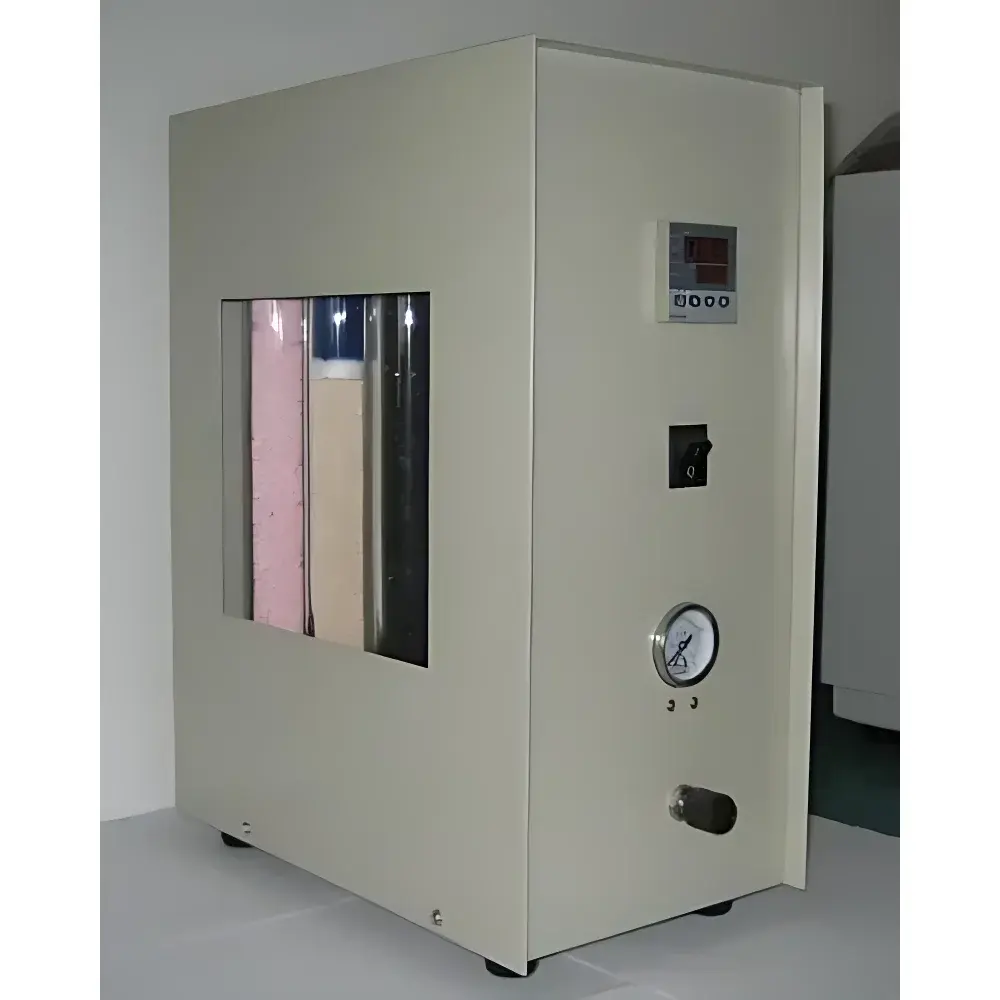
BF-4 Hydrocarbon Scrubber for GC Carrier Gas Purification
| Brand | Beifen Sanpu |
|---|---|
| Model | BF-4 |
| Type | Catalytic Hydrocarbon Removal Air Purifier |
| Origin | Beijing, China |
| Manufacturer | Beifen Sanpu Instrument Co., Ltd. |
| Input Hydrocarbon Concentration (e.g., CH₄) | <100 ppm |
| Output Hydrocarbon Concentration (e.g., CH₄) | <0.1 ppm |
| Inlet Pressure Range | 0–0.6 MPa |
| Flow Rate Capacity | 0–1000 mL/min |
| Catalyst Operating Temperature | 350 °C (max) |
| Furnace Temperature Control Range | 0–600 °C |
| Warm-up Time to Stability | <1 h |
| Ambient Operating Temperature | 0–40 °C |
| Relative Humidity Limit | <85 % RH |
| Power Supply | 220 V AC, 50 Hz |
Overview
The BF-4 Hydrocarbon Scrubber is a dedicated catalytic air purification system engineered for the generation of ultra-low-hydrocarbon carrier and zero-air streams in gas chromatography (GC), flame ionization detection (FID), and environmental air monitoring applications. It operates on the principle of high-efficiency catalytic oxidation: ambient or compressed air—containing trace hydrocarbons such as methane, ethane, propane, and volatile organic compounds (VOCs)—is passed over a proprietary high-activity metal oxide catalyst heated to a precisely controlled temperature of 350 °C. At this optimized thermal setpoint, hydrocarbons are quantitatively oxidized to CO₂ and H₂O without generating carbonaceous deposits or requiring frequent catalyst regeneration. The design adheres strictly to the performance requirements specified in Chinese national standard GB/T 15263–1994 and environmental monitoring method standard HJ/T 38–1999, both of which mandate hydrocarbon-free air (<0.1 ppm as methane) for blank calibration, detector baseline stability, and accurate quantitation in trace-level analysis.
Key Features
- Catalyst architecture optimized for low-temperature operation (350 °C), reducing energy consumption and enhancing long-term thermal stability compared to conventional 450–550 °C scrubbers
- Integrated precision temperature controller with digital PID regulation and real-time furnace monitoring across 0–600 °C range
- Robust stainless-steel reaction chamber and gas path components resistant to oxidation and moisture ingress
- Compatible with multiple inlet sources: oil-free diaphragm compressors, high-pressure air cylinders (up to 0.6 MPa), or laboratory central air systems
- Flow-rate agnostic performance: maintains <0.1 ppm residual hydrocarbon concentration across full 0–1000 mL/min operational range
- Fast stabilization profile: achieves steady-state purification performance within 60 minutes of cold start
- Front-panel LED indicators for power, heater status, and flow confirmation; no external software required for basic operation
Sample Compatibility & Compliance
The BF-4 is validated for use with ambient air, compressed dry air, and nitrogen-diluted synthetic air mixtures. It does not process liquid samples or reactive gases (e.g., Cl₂, NH₃, H₂S). Its output meets the hydrocarbon purity specifications required for compliance with ISO 8573-1 Class 1 compressed air quality for analytical instrumentation, and supports GLP/GMP-aligned laboratory practices where documented air purity is essential. While not certified to UL/CE for standalone safety listing, its electrical design conforms to IEC 61010-1:2010 for laboratory equipment. Documentation includes factory calibration report verifying inlet/outlet hydrocarbon reduction under standardized test conditions (100 ppm CH₄ at 500 mL/min).
Software & Data Management
The BF-4 is a hardware-only, microprocessor-controlled instrument with no embedded operating system or network interface. Temperature setpoint and status are displayed via local LED readout; no data logging, remote control, or USB/RS232 connectivity is provided. For laboratories requiring audit-trail capability, integration into facility-wide environmental monitoring systems (EMS) is achieved externally via analog 4–20 mA temperature feedback signal (optional accessory). All operational parameters—including warm-up time, pressure drop across catalyst bed, and thermal drift—are documented in the user manual and align with FDA 21 CFR Part 11 principles when paired with validated LIMS or ELN platforms that capture instrument usage logs.
Applications
- Zero-air generation for FID and PID detectors in ambient air quality analyzers (e.g., EPA Method TO-14/TO-15)
- Carrier gas purification in GC systems used for VOC speciation, petrochemical profiling, and residual solvent analysis (ICH Q2(R2))
- Blank air supply in laboratory calibration workflows requiring hydrocarbon-free baselines per HJ/T 38–1999
- Purified air source for FTIR gas cells, cavity ring-down spectrometers (CRDS), and laser-based methane sensors
- Support gas for thermal desorption units and purge-and-trap concentrators where background hydrocarbon interference must be minimized
FAQ
What hydrocarbon species does the BF-4 remove?
It effectively oxidizes saturated aliphatic hydrocarbons (C₁–C₆), including methane, ethane, propane, and butanes, as well as common aromatic traces (e.g., benzene, toluene) present in compressed air. Performance is verified using methane as the reference compound.
Can the BF-4 be used with nitrogen or synthetic air?
Yes—provided inlet gas contains ≤100 ppm total hydrocarbons and is free of catalyst poisons (e.g., sulfur compounds, silicones, halogenated organics). Nitrogen must be oil-free and dew-point controlled to prevent condensation in the heated zone.
How often does the catalyst require replacement?
Under typical lab use (8 h/day, 5 days/week), the catalyst maintains 0.15 ppm) indicates end-of-life.
Is the BF-4 compatible with ISO/IEC 17025 accredited testing?
Yes—when operated per manufacturer instructions and included in a documented air purification SOP, its performance data supports method validation and uncertainty budgeting per ISO/IEC 17025:2017 Clause 7.7.
Does it include pressure regulation or flow control?
No—the BF-4 accepts variable inlet pressure (0–0.6 MPa) and flow (0–1000 mL/min) but does not regulate either parameter. Users must install external pressure regulators and mass flow controllers upstream if precise delivery conditions are required.





