
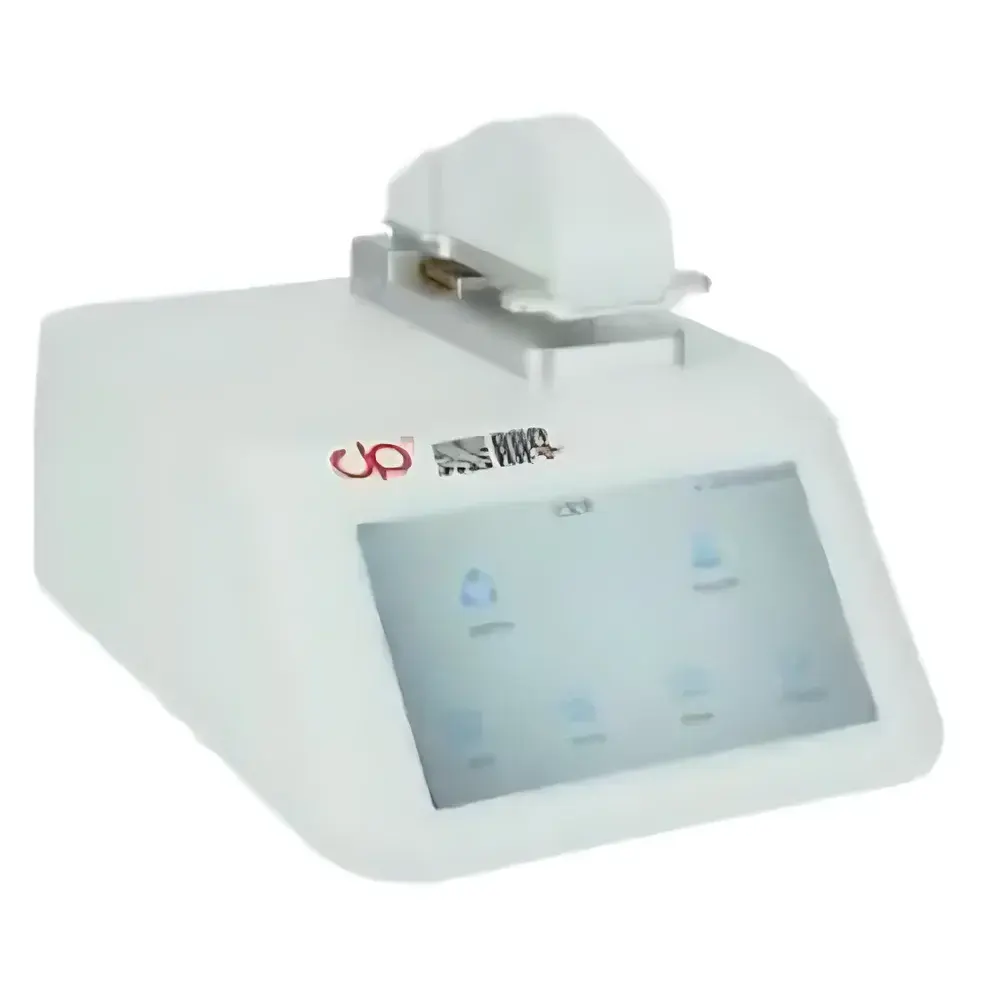
Jiapeng Nano-600 Ultra-Micro Nucleic Acid and Protein Analyzer
| Brand | Jiapeng |
|---|---|
| Origin | Shanghai, China |
| Model | Nano-600 |
| Sample Volume | 0.5–2.0 µL |
| Analytes | dsDNA, RNA, BSA |
| DNA Detection Range | 2–17,500 ng/µL (dsDNA) |
| Protein Detection Range | 0–440 mg/mL (BSA) |
| Wavelength Accuracy | ±1 nm |
| Measurement Time | ≤5 s |
| Wavelength Range | 185–910 nm |
| Absorbance Range (10-mm equivalent) | 0.02–300 A |
| Absorbance Precision | ±0.002 A |
| Absorbance Accuracy | ±1% (at 7.332 A, 260 nm) |
| Optical Path Lengths | 0.05 mm, 0.2 mm, 1.0 mm (auto-switching) |
| Light Source | Xenon flash lamp (rated lifetime ≥10 years) |
| Detector | 3648-pixel linear CCD array |
| Wavelength Resolution | ≤3 nm FWHM (at Hg 546 nm) |
| Power Supply | AC 220 V, 50/60 Hz |
| Dimensions (W×D×H) | 270 × 210 × 196 mm |
| Weight | 3.5 kg |
Overview
The Jiapeng Nano-600 Ultra-Micro Nucleic Acid and Protein Analyzer is a dual-mode, full-spectrum UV-Vis spectrophotometer engineered for rapid, precise quantification and purity assessment of nucleic acids and proteins using microvolume absorbance measurements. Based on the Beer–Lambert principle, it employs a high-stability xenon flash lamp and a 3648-pixel linear CCD array detector to deliver accurate, reproducible absorbance data across a broad spectral range (185–910 nm). Unlike conventional cuvette-based instruments, the Nano-600 integrates both microfluidic pedestal and standard 10-mm cuvette measurement modes—enabling seamless transition between ultra-low-volume analysis (as little as 0.5 µL) and higher-concentration or turbid sample evaluation via OD600 mode. Its optical path lengths (0.05 mm, 0.2 mm, and 1.0 mm) are automatically selected based on real-time absorbance feedback, eliminating manual dilution steps and minimizing user-induced variability. Designed for routine use in molecular biology labs, core facilities, and QC environments, the instrument meets foundational requirements for nucleic acid integrity screening (A260/A280, A260/A230) and protein concentration determination without requiring calibration curves.
Key Features
- 7-inch capacitive touchscreen running a purpose-optimized Android OS interface—no PC dependency, no warm-up time required
- Automated optical path switching (0.05 / 0.2 / 1.0 mm) ensures optimal dynamic range coverage across concentrations from 2 ng/µL to 17,500 ng/µL (dsDNA) and 0–440 mg/mL (BSA)
- Xenon flash lamp with >10-year operational lifetime; eliminates thermal drift and enables stable baseline performance over extended usage cycles
- Measurement completion in ≤5 seconds—including spectral acquisition, peak identification, and concentration calculation—outputting results directly in ng/µL or mg/mL
- Low-power auto-shutdown: light source deactivates after 5 minutes of inactivity, preserving lamp longevity and reducing energy consumption
- Reusable sample capability: minimal 0.5–2.0 µL volume requirement allows post-measurement recovery for downstream applications (e.g., PCR, sequencing library prep)
- Integrated data export via USB port or microSD card; optional external thermal printer support for GLP-compliant hardcopy reporting
Sample Compatibility & Compliance
The Nano-600 supports direct quantification of double-stranded DNA, single-stranded DNA, RNA, and common protein standards including bovine serum albumin (BSA), lysozyme, and immunoglobulin G (IgG). Its broad wavelength range (185–910 nm) accommodates absorbance measurements beyond nucleic acid/protein work—such as Bradford, Lowry, or BCA assay validation, dye-labeled oligonucleotide characterization, and small-molecule UV-Vis profiling. The instrument adheres to fundamental optical metrology principles aligned with ISO/IEC 17025 guidance for spectrophotometric validation. While not certified to FDA 21 CFR Part 11 out-of-the-box, its audit-ready data logs (timestamped absorbance spectra, user ID, instrument ID, and parameter settings) support traceability in GLP and GMP-aligned workflows when paired with controlled documentation practices.
Software & Data Management
The embedded Android platform delivers an intuitive graphical workflow: users select assay type (DNA, RNA, Protein, Custom), load sample, and initiate measurement with a single tap. Raw spectral data (absorbance vs. wavelength) and processed metrics (A260, A280, A230, ratios, concentration) are stored locally with automatic timestamping and user tagging. Export formats include CSV (for Excel or R analysis) and PDF (with embedded spectral plot and metadata). No proprietary software installation is required—data files are natively readable on Windows, macOS, and Linux systems. Firmware updates are delivered via USB drive, ensuring long-term compatibility and security maintenance without cloud dependency.
Applications
- Routine QC of extracted genomic DNA and total RNA prior to NGS library construction or RT-qPCR
- Verification of CRISPR guide RNA integrity and concentration in gene-editing workflows
- Quantification of purified recombinant proteins and antibody preparations in bioprocessing labs
- Monitoring of enzymatic reactions (e.g., DNase/RNase activity assays) via time-resolved A260 kinetics
- Validation of spectrophotometric assay reagents (e.g., Bradford dye stability, NADH oxidation rates)
- Teaching laboratories: hands-on instruction in UV-Vis spectroscopy fundamentals, extinction coefficient application, and nucleic acid purity interpretation
FAQ
Does the Nano-600 require daily calibration with standard solutions?
No. The xenon flash lamp and CCD detector architecture provide inherent photometric stability. Factory calibration is retained across operating conditions; only periodic verification using a certified neutral density filter or dsDNA standard is recommended per lab SOP.
Can the instrument measure samples containing detergents or chaotropic agents?
Yes—within limits. High concentrations of guanidine HCl (>4 M) or SDS (>0.1%) may cause scattering artifacts. For such samples, dilution into low-UV-absorbing buffers (e.g., 10 mM Tris-HCl, pH 8.0) is advised prior to pedestal-mode analysis.
Is the 0.05 mm path length suitable for highly concentrated protein samples?
Yes. The auto-path selection algorithm engages the 0.05 mm mode when absorbance at 280 nm exceeds ~1.5 A, extending the measurable upper limit to 440 mg/mL BSA without manual dilution.
How is data integrity ensured during transfer from device to LIMS?
All exported CSV files contain embedded metadata headers (instrument ID, firmware version, measurement date/time, operator ID, and full spectral data points), enabling unambiguous mapping and version control within laboratory information management systems.
What maintenance is required beyond routine cleaning of the quartz pedestal?
None. The solid-state optical design has no moving parts or consumable filters. Weekly isopropanol wipe-down of the pedestal surface and cuvette chamber suffices for sustained performance. Lamp replacement is not anticipated within the first decade of operation.



