
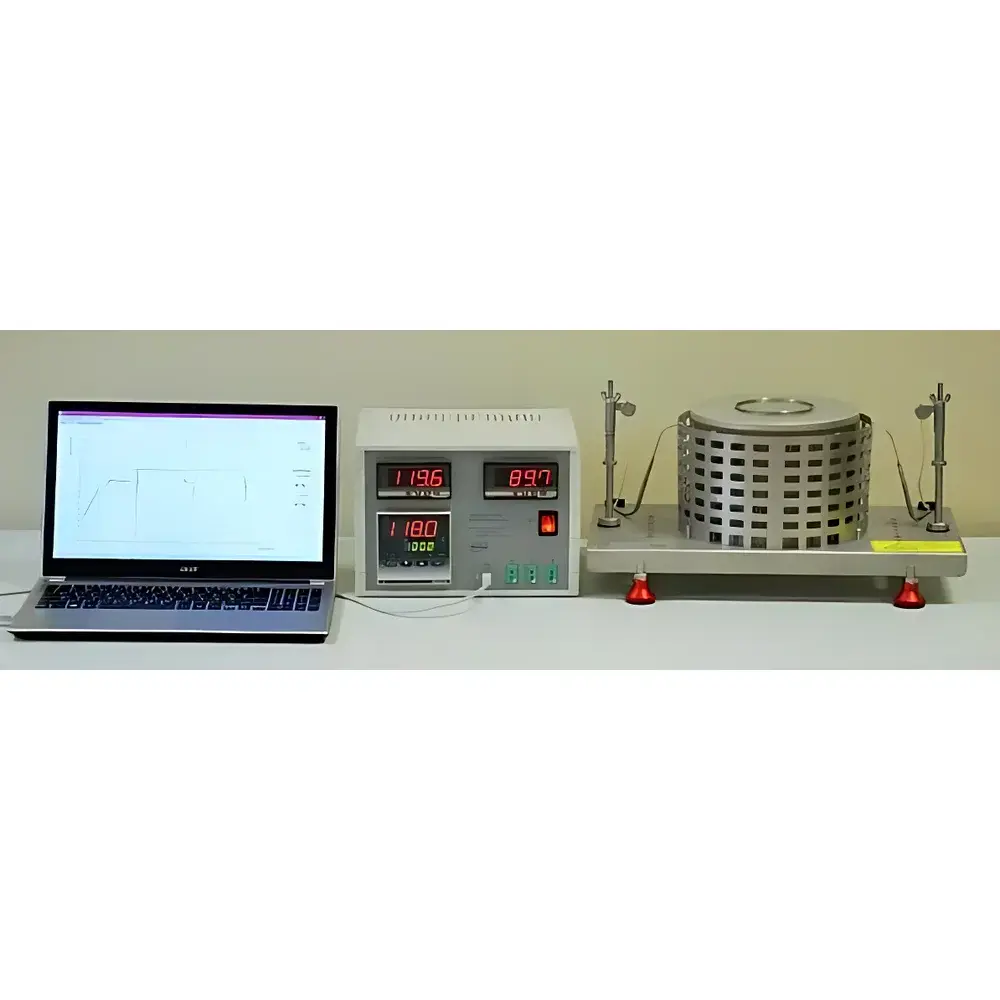
ANKO LIT3 Dust Layer Minimum Ignition Temperature Analyzer
| Origin | Poland |
|---|---|
| Manufacturer Type | Authorized Distributor |
| Origin Category | Imported |
| Model | LIT3 |
| Price Range | USD 27,000 – 68,000 |
| Standards Compliance | EN 50281-2-1, ASTM E2021, IEC 61241-2-1, ISO/IEC 80079-20-2:2016 |
| Heating Plate Material | Anodized Aluminum Alloy |
| Chamber Body Material | AISI 304 Stainless Steel |
| Temperature Sensors | Dual K-type Thermocouples (Heating Plate & Dust Layer) |
| Dust Ring Dimensions | Standard Ø100 mm, with optional heights of 5 mm, 12.5 mm, and 15 mm (custom heights available upon request) |
| Temperature Range | Ambient to 400 °C |
| Control Mode | PID-regulated Heating Plate Controller |
| Data Interface | USB 2.0 Serial Communication |
| Sampling Interval | Configurable from 1 second upward |
| Software | ANKO ReqTemp v3.2 Data Acquisition & Analysis Suite |
| Configuration | Single-unit Standard System |
Overview
The ANKO LIT3 Dust Layer Minimum Ignition Temperature Analyzer is a precision-engineered laboratory instrument designed for the standardized determination of the minimum ignition temperature (MIT) of dust layers under controlled thermal conditions. It operates on the fundamental principle of conductive heating: a defined layer of combustible particulate material is deposited onto a uniformly heated horizontal metal plate, and the lowest surface temperature at which sustained ignition (defined as ≥5 s of self-sustaining flame or glowing combustion) occurs is recorded. This method directly addresses the hazard potential of dust accumulation on hot surfaces—such as steam lines, bearings, or electrical enclosures—in industrial process environments. The LIT3 strictly implements internationally recognized test protocols, including EN 50281-2-1, ASTM E2021, IEC 61241-2-1, and ISO/IEC 80079-20-2:2016, ensuring data integrity for ATEX, IECEx, and NFPA 652 compliance documentation.
Key Features
- Thermally stable anodized aluminum heating plate with high thermal conductivity and uniform surface emissivity, minimizing radial temperature gradients across the test area.
- AISI 304 stainless steel heating chamber provides corrosion resistance, mechanical rigidity, and inertness toward reactive dusts—including metal powders, organic granules, and pharmaceutical intermediates.
- Dual independent K-type thermocouples: one embedded in the heating plate substrate for closed-loop PID control, and a second suspended at the dust–air interface to monitor actual layer surface temperature in real time.
- Modular stainless steel dust rings with precisely machined internal diameters (standard Ø100 mm) and interchangeable height inserts (5 mm, 12.5 mm, 15 mm), enabling systematic evaluation of layer thickness effects per ISO/IEC 80079-20-2 Annex C.
- PID temperature controller with ±0.5 °C stability over the full 25–400 °C operating range, supporting ramp-and-soak profiles and isothermal hold modes.
- USB 2.0 interface enables direct connection to Windows-based host PCs without external power adapters or proprietary interface cards.
Sample Compatibility & Compliance
The LIT3 accommodates a broad spectrum of dust types classified under UN GHS Category 1 and 2 combustible solids. Tested materials include but are not limited to aluminum, magnesium, and titanium powders; sugar, starch, and lactose; PVC and polyethylene fines; and catalyst residues from petrochemical refining. All hardware and procedural workflows conform to GLP-aligned documentation requirements. Test reports generated by ReqTemp software include timestamped raw thermocouple traces, operator ID, ambient humidity/temperature metadata, and audit-ready calibration logs—supporting FDA 21 CFR Part 11-compliant electronic records when deployed with validated system configurations.
Software & Data Management
ANKO ReqTemp v3.2 is a dedicated Windows application developed for MIT testing traceability and regulatory reporting. It supports real-time dual-channel temperature plotting, automatic ignition event detection (based on rate-of-rise thresholds and duration criteria), and export of CSV/Excel-compatible datasets. The software enforces user role-based access control (administrator, technician, reviewer), maintains immutable audit trails for all parameter changes and report generation events, and embeds digital signatures compliant with ISO/IEC 17025 clause 7.8.2. Calibration certificates for thermocouples and temperature controllers can be linked directly to test sessions, ensuring full metrological traceability to NIST-traceable standards.
Applications
- Hazard assessment for electrical equipment selection in Zone 21 and Zone 22 hazardous areas (per IEC 60079-10-2).
- Process safety management (PSM) documentation under OSHA 1910.119, including Dust Hazard Analysis (DHA) deliverables.
- Development and validation of hot-surface mitigation strategies—e.g., insulation specifications, cooling fin design, or maximum allowable surface temperatures for machinery.
- Supporting classification of dusts per ASTM E1226 for explosibility screening prior to full-scale explosion severity testing.
- Academic and industrial research into thermal decomposition kinetics and ignition delay modeling of heterogeneous particulate systems.
FAQ
What sample mass is required for a valid MIT test using the LIT3?
Typical dust layer mass ranges from 0.5 g to 3.0 g, depending on bulk density and target layer height. The Ø100 mm ring volume defines the geometric constraint; users must verify sufficient coverage to avoid edge effects per ASTM E2021 Section 7.3.
Can the LIT3 be used for layered mixtures (e.g., dust + fibrous contaminants)?
Yes—provided the mixture is homogenized and deposited uniformly. However, layered heterogeneity (e.g., stratified metal/organic interfaces) requires separate test series and explicit reporting in accordance with ISO/IEC 80079-20-2 Clause 6.4.2.
Is third-party calibration support available for the LIT3 system?
ANKO-certified service partners provide annual thermocouple verification, PID controller linearity checks, and chamber thermal mapping—traceable to EUROLAB-accredited laboratories and documented per ISO/IEC 17025.
Does ReqTemp software support automated report generation for regulatory submissions?
Yes. Predefined templates comply with ATEX Notified Body requirements (e.g., DEKRA, SGS), including mandatory fields for test standard reference, environmental conditions, operator signature, and uncertainty budget estimation per GUM (JCGM 100:2008).






