
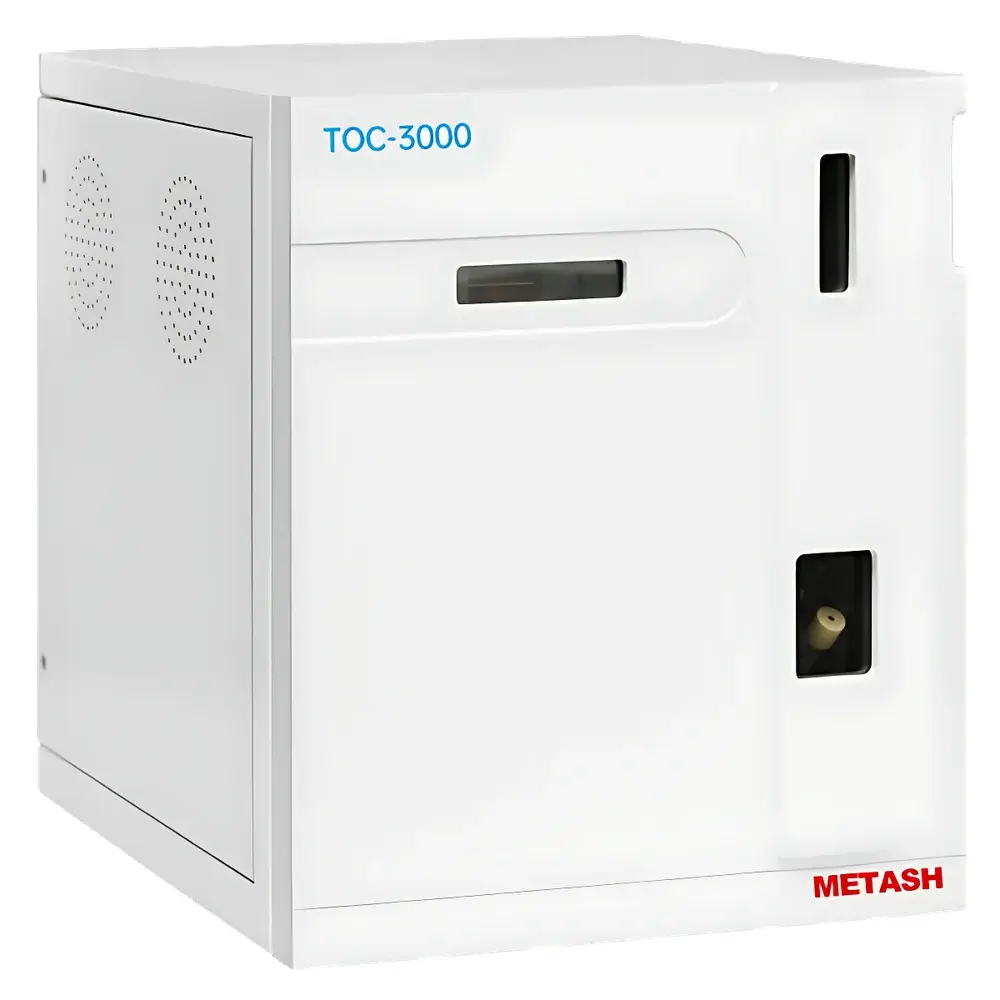
Metash TOC-3000 Total Organic Carbon Analyzer
| Brand | Metash Instruments |
|---|---|
| Origin | Shanghai, China |
| Manufacturer Type | Direct Manufacturer |
| Instrument Type | Laboratory TOC Analyzer |
| Model | TOC-3000 |
| Detection Principle | Non-Dispersive Infrared (NDIR) Absorption |
| Oxidation Method | UV/Persulfate Oxidation |
| Measurement Range | 0–10,000 ppm C |
| Accuracy | ≤5% |
| Resolution | 0.01 ppb C |
| Detection Limit | 5 ppb C |
| Repeatability | ≤3% |
| Sample Volume | Up to 20 mL |
| Carrier Gas Requirement | High-Purity Nitrogen |
| Power Supply | 220 V ±10%, 50/60 Hz |
| Software Options | Standard Control & Database Management / FDA 21 CFR Part 11 Compliant Audit Trail Edition |
| Optional Accessory | 20-Position Automated Sampler |
Overview
The Metash TOC-3000 is a laboratory-grade total organic carbon (TOC) analyzer engineered for high-precision quantification of organic carbon content in aqueous matrices—including ultrapure water, pharmaceutical process water, environmental surface water, wastewater effluents, and clean-in-place (CIP) rinse solutions. It operates on the fundamental principle of catalytic oxidation followed by non-dispersive infrared (NDIR) detection: dissolved organic carbon (DOC) and particulate organic carbon are first converted to carbon dioxide via synergistic UV irradiation and persulfate oxidation under acidic conditions; the resulting CO₂ is then stripped from solution, dried, and measured with high specificity using an NDIR detector calibrated against certified CO₂ standards. This dual-oxidation strategy ensures complete mineralization of recalcitrant compounds—including humic substances, low-molecular-weight organics, and chlorinated hydrocarbons—while maintaining robustness across diverse sample matrices and ionic strengths.
Key Features
- UV/persulfate oxidation system optimized for >98% oxidation efficiency across a broad range of organic structures, validated per ASTM D7573 and ISO 8245 protocols;
- Imported high-stability NDIR detector featuring thermally stabilized IR source and pyroelectric sensor, delivering long-term baseline stability and minimal drift (<0.5% FS/24 h);
- Precision liquid handling module with gravimetrically verified peristaltic pumping and volumetric injection (up to 20 mL), enabling trace-level analysis of ultrapure water (UPW) without dilution artifacts;
- Integrated electronic moisture removal system combined with replaceable hydrophobic membrane filters (0.2 µm PTFE), eliminating water vapor interference in the CO₂ gas stream;
- Embedded real-time flow control architecture with mass-flow-sensor feedback loops, compensating for pressure fluctuations and ensuring consistent carrier gas velocity (±0.5% setpoint);
- Fully modular mechanical design—oxidation chamber, NDIR cell, gas-drying unit, and fluidic manifolds—are independently serviceable, reducing mean time to repair (MTTR) and extending operational uptime;
- Dual-channel measurement capability for simultaneous TC (total carbon) and TIC (total inorganic carbon) determination, with automatic TOC calculation (TOC = TC − TIC) and optional NPOC (non-purgeable organic carbon) mode;
- Industrial-grade embedded control system running deterministic RTOS firmware, with redundant watchdog timers and hardware-level fault logging.
Sample Compatibility & Compliance
The TOC-3000 accommodates liquid samples with conductivity ≤5 µS/cm (ultrapure water) up to highly saline or suspended-solids-laden waters (≤1000 mg/L TSS), provided appropriate filtration and acidification are applied prior to analysis. It complies with key international regulatory frameworks: USP , EP 2.2.44, and JP 17 for pharmaceutical water testing; EPA Method 415.3 and ISO 8245 for environmental compliance monitoring; and ASTM D7573 for method validation. When configured with the audit trail-enabled software option, the system meets FDA 21 CFR Part 11 requirements—including role-based user authentication, electronic signatures, immutable audit logs, and full data lifecycle traceability—supporting GxP environments subject to GLP or GMP audits.
Software & Data Management
The proprietary Metash TOC Control Suite runs on Windows OS and provides centralized instrument control, real-time status visualization (oxidation temperature, gas flow, detector voltage, pressure), and automated calibration routines (zero, span, linearity). All raw and processed data—including chromatographic CO₂ peaks, integration parameters, QC check results, and instrument diagnostic logs—are stored in a relational SQLite database with configurable retention policies. Export formats include CSV, PDF analytical reports, and XML for LIMS integration. The 21 CFR Part 11-compliant version implements cryptographic hashing of records, time-stamped operator actions, and hierarchical access permissions aligned with ALCOA+ principles (Attributable, Legible, Contemporaneous, Original, Accurate, Complete, Consistent, Enduring, Available).
Applications
- Pharmaceutical manufacturing: UPW and WFI (water for injection) release testing per USP/EP monographs;
- Power generation: boiler feedwater and condensate monitoring to prevent corrosion and deposition;
- Microelectronics: semiconductor rinse water certification at sub-ppb sensitivity levels;
- Environmental laboratories: regulatory reporting for municipal wastewater discharge permits (e.g., NPDES);
- Research institutions: kinetic studies of organic pollutant degradation and carbon cycling in aquatic systems;
- Biotechnology: bioreactor harvest stream characterization and cleaning validation (CIP verification).
FAQ
What oxidation methods does the TOC-3000 support?
The instrument employs UV/persulfate oxidation as its primary method, optimized for broad-spectrum organic compound conversion. No high-temperature combustion or catalyst-based oxidation is used.
Is the NDIR detector field-calibratable?
Yes—calibration is performed using certified CO₂ standard gases (e.g., 100 ppm, 1000 ppm in N₂); the system supports multi-point linearity verification and automatic zero adjustment via CO₂-free nitrogen purge.
Can the TOC-3000 analyze solid or gaseous samples?
No—it is designed exclusively for aqueous liquid samples. Solid or gas-phase analysis requires sample dissolution or sparging into aqueous medium prior to injection.
What maintenance intervals are recommended?
UV lamp replacement every 12 months; persulfate reagent cartridge every 3 months (typical usage); NDIR optical window cleaning quarterly; membrane filter replacement after every 500 injections or when pressure differential exceeds 0.2 bar.
Does the system support remote diagnostics?
Yes—via secure TLS-encrypted Ethernet connection, authorized service engineers can perform firmware updates, log review, and sensor diagnostics under customer consent and IT policy compliance.
Related Products







