
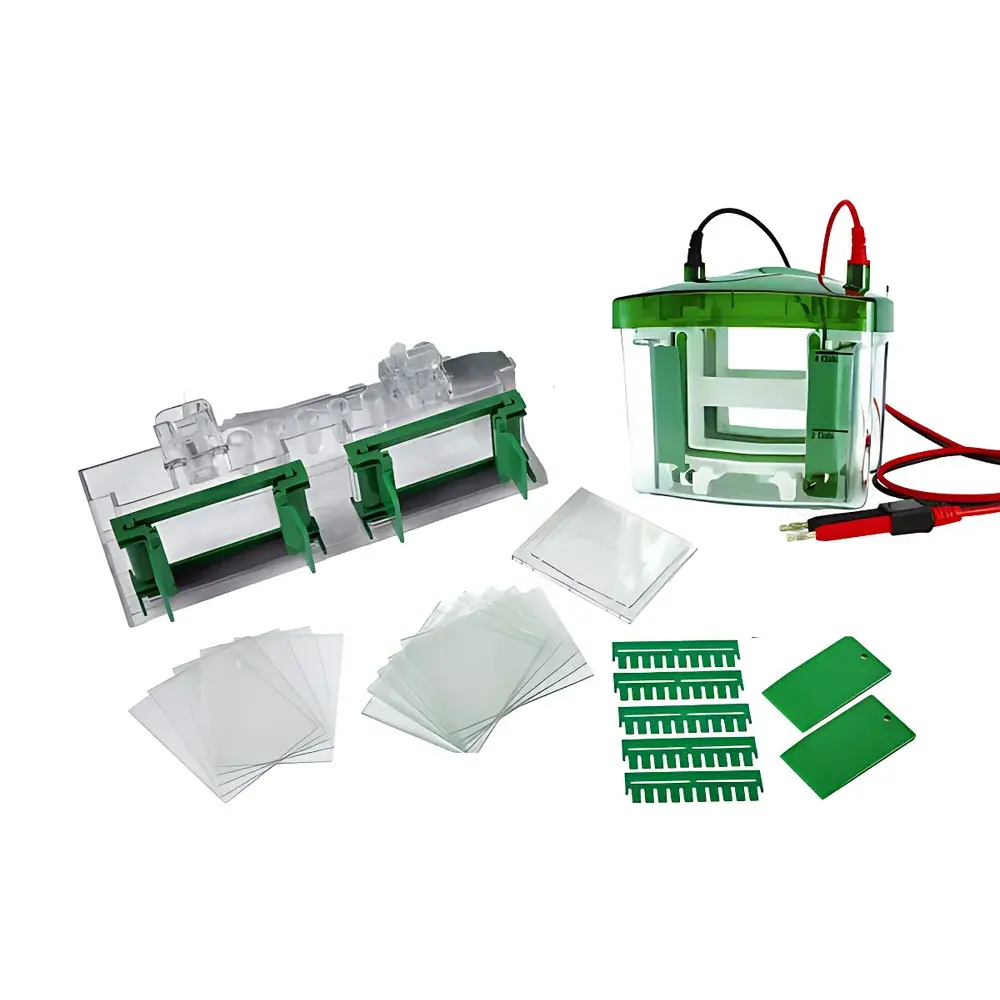
Keebio KEEBIO-VE180 Vertical Electrophoresis Tank
| Brand | Keebio |
|---|---|
| Origin | Shanghai, China |
| Model | KEEBIO-VE180 |
| Instrument Type | Vertical Electrophoresis Apparatus |
| Gel Dimensions (Hand-cast) | 83 × 73 mm |
| Gel Thickness Options | 0.75 mm / 1.0 mm / 1.5 mm (default: 1.0 mm) |
| Max Gel Capacity | 2 gels (standard), upgradable to 4 gels (optional) |
| Voltage Input | 220 V AC |
| External Dimensions | 170 × 120 × 120 mm |
| Electrode Material | 99.95% Pure Platinum |
| Weight | 2.56 kg |
| Compliance | CE-marked design principles |
| Sample Capacity | 1 gel unit per run (dual-gel configuration supported) |
Overview
The Keebio KEEBIO-VE180 Vertical Electrophoresis Tank is an engineered platform for high-fidelity SDS-PAGE, native PAGE, and isoelectric focusing (IEF) of proteins and nucleic acids in research and quality control laboratories. Designed around the fundamental principle of electrophoretic mobility—where charged biomolecules migrate through a polyacrylamide or agarose matrix under controlled electric field—the system delivers reproducible separation resolution for analytical and preparative applications. Its compact footprint and dual-gel capability support parallel sample processing without cross-contamination, while the integrated safety architecture—including lid-activated circuit interruption and precision electrode alignment—ensures operational consistency across routine and regulated environments.
Key Features
- Polymer construction: Rigid, optically transparent polycarbonate tank body molded in one piece to eliminate seam leakage and enable real-time visual monitoring of buffer level and electrophoretic front migration.
- Modular gel casting system: Integrated comb-and-spacer design with interchangeable thickness spacers (0.75 mm, 1.0 mm, 1.5 mm) and comb options (10- or 15-well) for flexible sample loading capacity and resolution tuning.
- Thermally stable casting accessories: Multi-use gel former fabricated from heat-resistant polymer (up to 135 °C), ensuring dimensional stability during acrylamide polymerization and eliminating warping-induced gel distortion.
- Optimized electrode assembly: Dual platinum-coated stainless steel electrodes (99.95% Pt purity) provide uniform current distribution, minimal electrolysis byproduct generation, and long-term corrosion resistance in Tris-Glycine, Tris-Tricine, and urea-based running buffers.
- Interlocked safety interface: Hinged lid incorporates mechanical microswitch that de-energizes the power circuit upon opening—compliant with IEC 61010-1 Class II electrical safety requirements.
- Standardized compatibility: Designed to interface seamlessly with Keebio’s VE186 semi-dry transfer apparatus, enabling direct electroblotting without gel handling or orientation errors.
Sample Compatibility & Compliance
The KEEBIO-VE180 accommodates both hand-poured and pre-cast gels (86 × 68 mm format), supporting common electrophoretic formats including denaturing SDS-PAGE, non-denaturing native gels, two-dimensional electrophoresis (2-DE) first-dimension IEF strips, and gradient gels. It is routinely deployed in academic proteomics labs, biopharmaceutical QC units, and clinical research settings where adherence to GLP documentation standards is required. While not FDA 510(k)-cleared as a medical device, its construction materials meet USP Class VI biocompatibility criteria for indirect contact with biological samples. The system supports audit-ready operation when paired with validated power supplies compliant with 21 CFR Part 11 data integrity requirements.
Software & Data Management
As a benchtop electrophoresis hardware platform, the KEEBIO-VE180 operates independently of proprietary software. However, it integrates transparently into digital lab ecosystems via standard imaging systems (e.g., ChemiDoc, Azure Biosystems, UVP) for post-run densitometric analysis. Gel images acquired using calibrated UV transilluminators or blue-light excitation sources can be imported into open-format analysis packages—including ImageLab (Bio-Rad), AlphaView SA (ProteinSimple), and Fiji/ImageJ—for molecular weight estimation, band quantification, and comparative profiling. All physical parameters (gel dimensions, thickness, comb configuration) are logged manually or via LIMS-compatible templates to satisfy traceability needs under ISO/IEC 17025 Clause 7.7.
Applications
- Protein molecular weight determination and purity assessment in recombinant expression workflows.
- Post-translational modification screening (e.g., phosphorylation, glycosylation) via mobility shift assays.
- Nucleic acid fragment analysis (100–5,000 bp) in restriction digest verification and PCR product validation.
- Antibody subunit characterization under reducing and non-reducing conditions.
- Stability-indicating assays for therapeutic protein formulations under accelerated stress conditions.
- Training platform for undergraduate and graduate electrophoresis instruction—optimized for low reagent consumption and rapid setup turnaround.
FAQ
Can the KEEBIO-VE180 accommodate pre-cast gels from major suppliers?
Yes—it accepts standard mini-gel formats (86 × 68 mm), including Bio-Rad Mini-PROTEAN®, Thermo Fisher Novex®, and Lonza NuPAGE® gels, with minor adjustment of the gel positioning frame.
Is the system compatible with constant voltage, constant current, or constant power modes?
The tank itself is passive hardware; output mode depends entirely on the external power supply unit selected—fully compatible with all three regulation modes when used with programmable electrophoresis power supplies.
What maintenance is required for long-term electrode performance?
Rinse electrodes thoroughly with deionized water after each run and store dry; periodic polishing with 0.5 µm alumina slurry restores surface conductivity without compromising Pt layer integrity.
Does the unit include documentation for IQ/OQ qualification?
A basic User Manual and Factory Test Report are supplied; full GMP-compliant Installation Qualification (IQ) and Operational Qualification (OQ) protocols must be developed internally or by a qualified third-party service provider.
Can two gels of different thicknesses be run simultaneously?
No—uniform thermal dissipation requires identical gel thicknesses within a single run to prevent uneven migration and band distortion.
Related Products



