
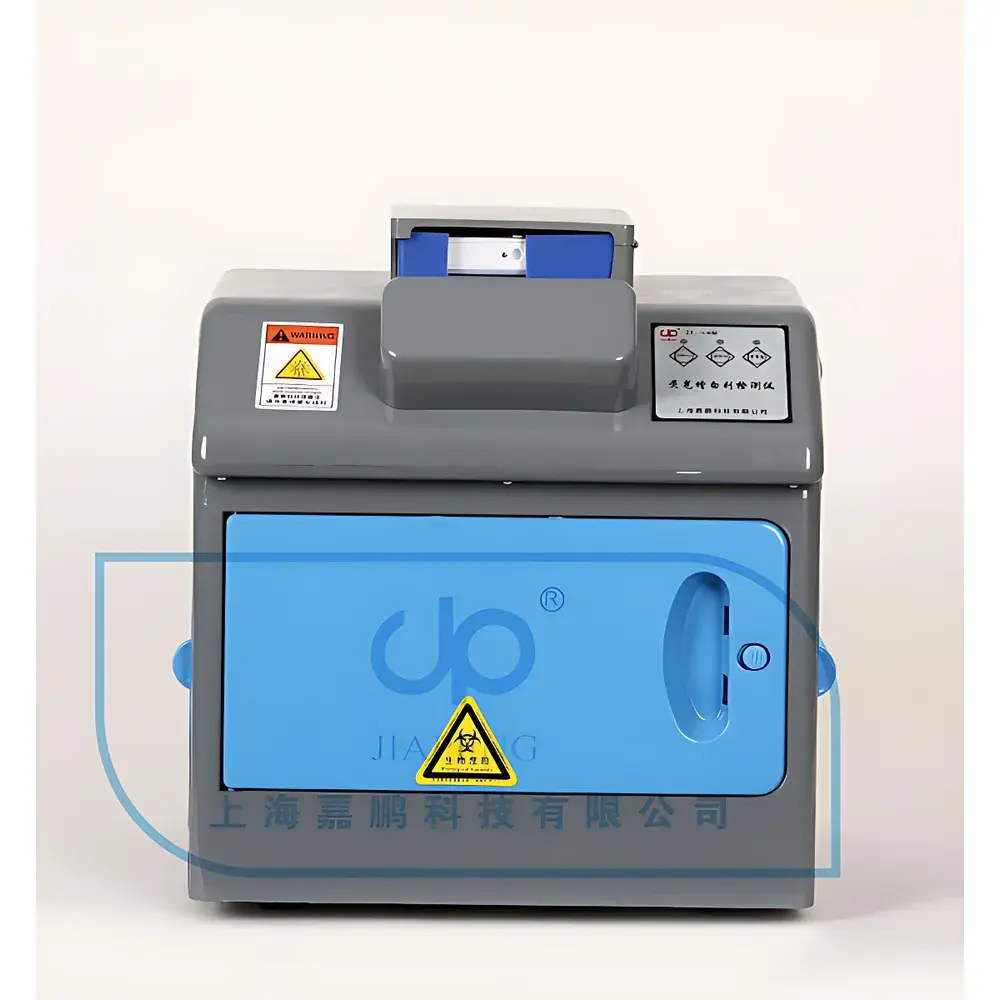
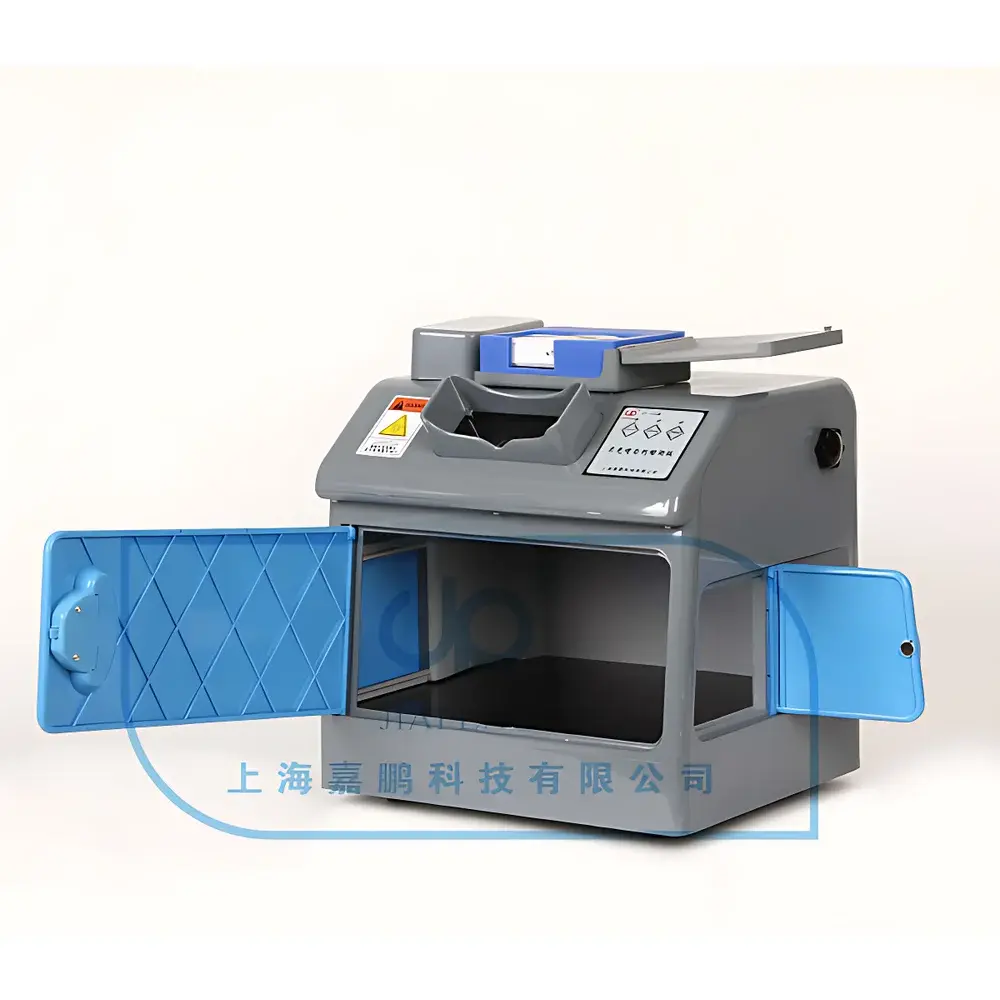
Jiapeng ZF-108 Dual-Wavelength UV Transilluminator for Fluorescent Whitening Agent (FWA) Detection
| Brand | Jiapeng |
|---|---|
| Origin | Shanghai, China |
| Manufacturer Type | Authorized Distributor |
| Product Category | Domestic |
| Model | ZF-108 |
| Price Range | USD 280–700 |
| Instrument Type | Darkroom-style |
| Wavelength Options | 254 nm and 365 nm |
| UV Filter Size | 200 × 50 mm |
| UV Lamps | 2 × 20 W |
| Power Consumption | 20 W |
| Display | LCD with Chinese interface |
| Control System | Microcontroller-based |
| UV Lamp Angle | Adjustable |
| UV Intensity at 20 cm | ≥20 µW/cm² |
| Built-in Rechargeable Battery | 4800 mAh |
| Dimensions (L×W×H) | 310 × 200 × 300 mm |
| Weight | 3 kg |
| Compliance | NY/T 1257–2006 (Detection of Fluorescent Substances in Edible Fungi) |
Overview
The Jiapeng ZF-108 Dual-Wavelength UV Transilluminator is a purpose-built darkroom instrument engineered for rapid, on-site qualitative detection of fluorescent whitening agents (FWAs) and other UV-excitable contaminants in food, agricultural commodities, packaging materials, and biological samples. It operates on the principle of ultraviolet-induced fluorescence: when exposed to short-wave (254 nm) or long-wave (365 nm) UV radiation, FWAs—commonly added illegally to enhance visual whiteness in mushrooms, flour, honey, paper cups, and edible oils—emit characteristic visible fluorescence under controlled viewing conditions. The ZF-108 is not a quantitative spectrophotometer but a standardized screening tool aligned with the Chinese agricultural industry standard NY/T 1257–2006, which specifies visual fluorescence assessment protocols for edible fungi. Its fully enclosed darkroom architecture eliminates ambient light interference, ensuring high-contrast observation while incorporating ergonomic safety features—including a UV-blocking observation window—to protect operator eyesight during routine field or lab use.
Key Features
- Darkroom-style enclosure with dual access ports (left/right side openings) for safe, gloved sample handling without UV exposure
- Dual-wavelength UV excitation: independently switchable 254 nm (for detecting aromatic hydrocarbons and certain mycotoxins) and 365 nm (optimized for common optical brighteners such as stilbene derivatives)
- Two high-output 20 W UV lamps with precision-aligned 200 × 50 mm bandpass filters, delivering uniform irradiance across the viewing area
- Adjustable lamp angle mechanism enables optimization of illumination geometry for varied sample thicknesses and surface reflectivity
- Microcontroller-based system with Chinese-language LCD interface for intuitive parameter selection, mode switching, and battery status monitoring
- Integrated rechargeable 4800 mAh Li-ion battery supports >4 hours of continuous operation—enabling true portable deployment in customs checkpoints, cold storage facilities, or rural inspection stations
- AC/DC dual-power design: operates from standard 220 V AC mains or internal battery, eliminating dependency on fixed power infrastructure
Sample Compatibility & Compliance
The ZF-108 is validated for direct visual inspection of solid and semi-solid matrices including fresh and dried mushrooms (e.g., Lentinula edodes, Agaricus bisporus), wheat flour, honeycomb honey, chocolate coatings, edible oil residues, eggshells, paper-based food containers, and polyethylene packaging films. Its detection workflow complies strictly with NY/T 1257–2006, which defines standardized sample preparation (e.g., homogenization, solvent extraction where applicable), UV exposure duration (typically 30–60 s), and interpretation criteria (presence/absence of blue-white fluorescence under 365 nm). While not certified to ISO/IEC 17025 or FDA 21 CFR Part 11, the instrument’s consistent output and documented operational parameters support GLP-aligned recordkeeping when paired with external digital documentation (e.g., timestamped image capture via connected camera). It is not intended for clinical diagnostics or regulated pharmaceutical release testing.
Software & Data Management
The ZF-108 itself does not include embedded software or network connectivity. However, its integrated camera interface (via standard USB 2.0 or analog video output) allows seamless integration with third-party imaging platforms. Users commonly connect it to Windows-based systems running open-source tools such as ImageJ or commercial gel documentation suites (e.g., Bio-Rad Quantity One, Azure Sapphire). Captured images—stored locally on PC or external SSD—can be annotated with metadata (date, operator ID, sample ID) and archived in structured folders compliant with internal QA documentation requirements. For audit readiness, laboratories may implement manual logbooks or electronic lab notebooks (ELNs) to cross-reference physical observations with image files—satisfying basic traceability expectations under GMP-adjacent food safety frameworks.
Applications
- Routine surveillance of FWA adulteration in dried edible fungi at processing plants and border inspection posts
- Field verification of illegal bleaching in flour and starch-based products prior to retail distribution
- Pre-shipment screening of honey and sugar syrups for synthetic optical brighteners used to mask fermentation or dilution
- Verification of UV-fluorescent ink migration in food-grade paper cups and molded fiber trays
- Preliminary assessment of fungal contamination in stored grains using native autofluorescence patterns under 254 nm
- Educational use in food science curricula for demonstrating non-invasive contaminant screening principles
FAQ
Is the ZF-108 suitable for quantitative analysis of FWA concentration?
No. It is a qualitative screening device based on visual fluorescence intensity comparison. Quantification requires HPLC-FLD or LC-MS/MS per GB 5009.291–2023.
Does the instrument comply with international regulatory standards such as EU Regulation No. 1333/2008?
It supports detection methods referenced in national Chinese standards (NY/T 1257–2006) but is not pre-certified for EU, FDA, or Health Canada regulatory submissions.
Can the UV filter be replaced with custom wavelengths?
The 200 × 50 mm bandpass filters are factory-installed for 254 nm and 365 nm; replacement requires OEM-specified components and recalibration.
What maintenance is required for long-term reliability?
UV lamps should be replaced every 1,000–1,500 operating hours; filters must be cleaned weekly with lint-free ethanol wipes to prevent transmission loss.
Is battery charging time specified in the manual?
Full recharge from depletion takes approximately 5–6 hours using the supplied 12 V DC adapter; battery health degrades after ~300 charge cycles.




