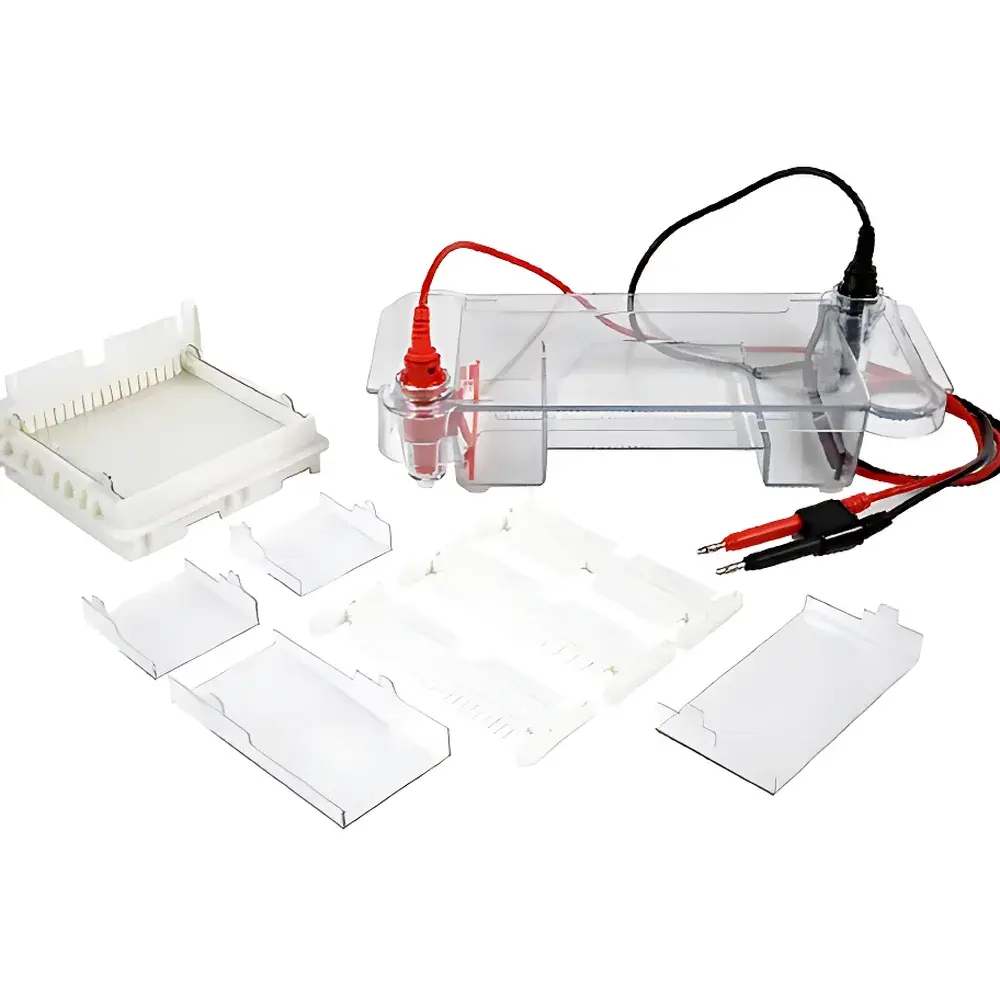
Keebio KEEBIO-HE120 Horizontal Electrophoresis Tank
| Brand | Keebio |
|---|---|
| Origin | Shanghai, China |
| Model | KEEBIO-HE120 |
| Gel Dimensions | 60×60 mm, 120×60 mm, 120×120 mm (max) |
| Sample Capacity | Up to 2 gels simultaneously |
| Voltage Input | 220 V AC |
| Buffer Volume Capacity | 660 mL |
| Electrode Material | 99.95% pure platinum |
| Housing Material | Injection-molded polycarbonate |
| Weight | 1.2 kg |
| External Dimensions | 310 × 155 × 70 mm |
| Comb Options | 8 types (1.0 mm, 1.5 mm, 2.0 mm thickness |
| Max Loading Volume per Well | 15–550 µL (depending on comb configuration) |
| Gel Casting | Compatible with multi-purpose casting trays (no tape sealing required) |
| Thermal Stability of Casting Tray | Up to 135 °C |
Overview
The Keebio KEEBIO-HE120 Horizontal Electrophoresis Tank is a precision-engineered system designed for routine nucleic acid and protein separation under standard agarose or polyacrylamide gel electrophoresis (AGE/PAGE) conditions. It operates on the fundamental principle of electrophoretic mobility—where charged biomolecules migrate through a porous matrix under an applied electric field, with separation resolution governed by molecular size, charge density, and buffer conductivity. The unit supports both analytical and preparative workflows, enabling clear band visualization, downstream excision, and subsequent extraction or blotting. Its horizontal configuration ensures uniform field distribution across the gel surface, minimizing edge effects and thermal gradients—critical for reproducible migration patterns and high-resolution band separation in applications ranging from PCR product verification to plasmid DNA profiling.
Key Features
- Injection-molded polycarbonate tank body ensures structural integrity, chemical resistance to common electrophoresis buffers (e.g., TAE, TBE, SB), and optical clarity for real-time monitoring of dye front progression.
- Patented button-actuated lid mechanism enables one-handed, tool-free access—reducing operational downtime and minimizing accidental buffer spillage during gel loading or post-run inspection.
- Multi-purpose casting tray system—fabricated from heat-resistant polymer (stable up to 135 °C)—eliminates the need for sealing with tape or wax, streamlining gel preparation and reducing contamination risk.
- Horizontal platform with vertically aligned reference datum ensures precise centering of gels relative to electrode alignment, enhancing current homogeneity and mitigating lateral band distortion.
- High-purity (99.95%) platinum electrodes provide stable, low-resistance current conduction over extended run durations, with superior corrosion resistance against oxidative buffer degradation at elevated voltages.
- Modular comb system includes eight interchangeable configurations—covering 1.0 mm, 1.5 mm, and 2.0 mm thicknesses and tooth counts from 2 to 25—to accommodate diverse sample volumes (15–550 µL per well) and resolution requirements.
Sample Compatibility & Compliance
The KEEBIO-HE120 accommodates standard agarose concentrations (0.7–3.0%) and native/denaturing polyacrylamide gels (4–20%). Its maximum gel footprint of 120 × 120 mm supports high-throughput screening, while dual-gel capability (two 60 × 60 mm or one 120 × 60 mm gel per run) improves laboratory efficiency. All materials comply with ISO 10993-5 (biological evaluation of medical devices — cytotoxicity) and meet RoHS Directive 2011/65/EU restrictions on hazardous substances. The design facilitates integration into GLP-compliant environments when paired with validated power supplies and documented SOPs—supporting traceability in academic, clinical diagnostics, and QC labs subject to internal audit or external accreditation (e.g., CAP, CLIA, ISO/IEC 17025).
Software & Data Management
As a standalone electrophoresis tank, the KEEBIO-HE120 does not incorporate embedded firmware or digital connectivity. However, it is fully compatible with industry-standard imaging systems—including UV transilluminators (302 nm and 365 nm), gel documentation stations, and chemiluminescence imagers—enabling quantitative densitometry via third-party software such as ImageLab (Bio-Rad), AlphaView SA (ProteinSimple), or Fiji/ImageJ. Users may maintain electronic run logs compliant with 21 CFR Part 11 requirements by recording parameters (voltage, duration, buffer lot, gel composition) in LIMS or ELN platforms. Optional barcode-labeled combs and pre-cast gel identifiers further support sample tracking integrity.
Applications
- Routine DNA fragment analysis (e.g., restriction digests, PCR amplicons, CRISPR editing validation)
- RNA integrity assessment (RIN estimation via 18S/28S rRNA band ratio)
- Plasmid DNA conformational analysis (supercoiled vs. linear vs. nicked forms)
- Preparative electrophoresis for gel extraction prior to cloning or sequencing library construction
- Protein electrophoresis under non-denaturing conditions (e.g., native PAGE for enzyme activity assays)
- Educational laboratory instruction in molecular biology and biochemistry curricula
FAQ
Is the KEEBIO-HE120 compatible with ethidium bromide and SYBR Safe staining?
Yes—the polycarbonate housing is chemically resistant to both intercalating dyes and common destaining solutions, provided standard handling protocols are followed.
Can I use this unit with a constant-current power supply?
Yes—it is designed for compatibility with standard DC power supplies delivering up to 500 V output; optimal performance is achieved within 50–200 V range for most agarose applications.
What is the recommended buffer volume for full coverage of a 120 × 120 mm gel?
660 mL ensures complete submersion and adequate thermal dissipation; buffer depth should be maintained at ≥3 mm above the gel surface throughout electrophoresis.
Are replacement combs available separately?
Yes—Keebio offers all eight comb configurations as consumable spares, with part numbers traceable via distributor inventory systems.
Does the unit include a built-in cooling system?
No—heat dissipation relies on ambient convection and buffer volume; for extended high-voltage runs (>120 min), external recirculation or chilled buffer baths are recommended to maintain temperature stability below 25 °C.
Related Products