
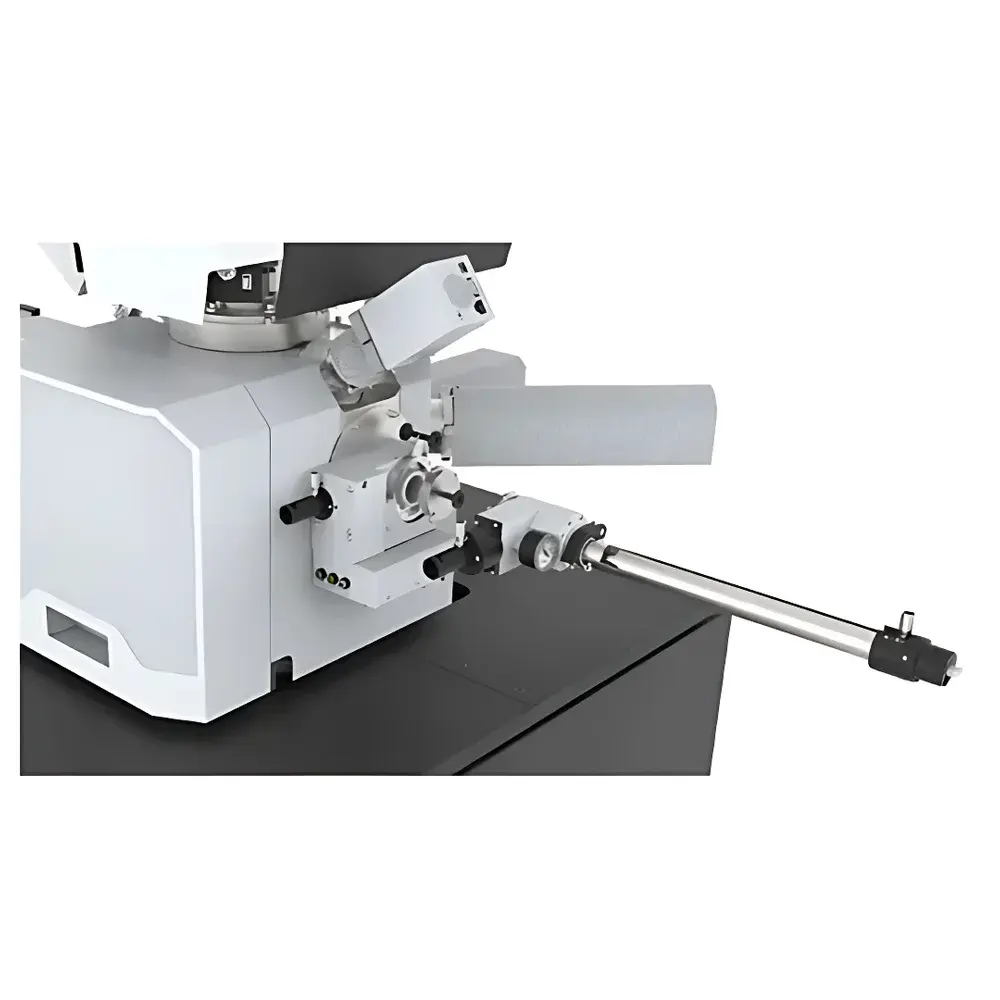
Thermo Fisher Scientific CleanConnect™ Inert Gas/Vacuum Protected Sample Transfer System
| Brand | Thermo Fisher Scientific |
|---|---|
| Origin | USA |
| Manufacturer Type | Authorized Distributor |
| Origin Category | Imported |
| Model | CleanConnect™ |
| Pricing | Upon Request |
Overview
The Thermo Fisher Scientific CleanConnect™ Inert Gas/Vacuum Protected Sample Transfer System is an engineered solution for the safe, contamination-free handling and transfer of air-sensitive materials into electron microscopy (EM) instruments. Designed specifically for applications where exposure to ambient oxygen, moisture, or CO₂ induces rapid surface degradation—such as lithium metal anodes, sulfide-based solid electrolytes, perovskites, MOFs, and cryo-sensitive catalysts—CleanConnect enables seamless integration between inert-atmosphere gloveboxes and high-vacuum EM platforms. Its core operational principle relies on dual-mode protection: vacuum pumping for initial degassing followed by sustained positive-pressure inert gas (typically argon or nitrogen) purging within a sealed transfer chamber. This eliminates oxidative passivation, hydrolytic decomposition, or carbonate formation during transit—preserving native surface chemistry and microstructure prior to imaging or analysis. Unlike conventional atmospheric transfer rods, CleanConnect maintains sample integrity across the full workflow—from glovebox loading through SEM, DualBeam FIB-SEM, and TEM sample insertion—without requiring system modifications or auxiliary vacuum pumps.
Key Features
- Integrated vacuum architecture compatible with Thermo Scientific SEM and DualBeam systems—no external pump required; achieves base vacuum in ≤60 seconds.
- Dual-mode operation: rapid vacuum evacuation followed by continuous inert gas pressurization (≥10 hours at stable positive pressure).
- Real-time pressure monitoring via integrated analog/digital gauge for precise process verification and traceability.
- Modular, ergonomic design with separable transfer chamber and rod—enables direct docking with standard glovebox antechambers without retrofitting.
- Hardware interlocks prevent simultaneous valve opening and chamber venting, ensuring operator safety and procedural integrity.
- Full software integration with Thermo Scientific SmartSEM and AutoTEM platforms—including automated beam blanking, stage retraction, chamber purge, and GIS retraction (where applicable).
- Compatible with cryogenic stages: supports transfer of samples directly onto liquid nitrogen-cooled stages in DualBeam systems to mitigate ion-beam-induced thermal damage during milling.
Sample Compatibility & Compliance
CleanConnect accommodates specimens up to 25 mm in diameter and 15 mm in thickness, with built-in height gauging to verify clearance before insertion. It is validated for use with Thermo Scientific Apreo, Quanta, Talos, and Helios series instruments. The system complies with ISO 14644-1 Class 5 cleanroom handling protocols when operated within certified gloveboxes, and its hardware/software interlock architecture aligns with IEC 61508 functional safety requirements for laboratory equipment. For regulated environments (e.g., battery R&D under GLP or pre-commercial QA), CleanConnect supports audit-ready workflows: all vacuum cycles, pressure logs, and system status events are timestamped and exportable via instrument software—facilitating 21 CFR Part 11-compliant data archiving when paired with Thermo Scientific’s compliant software suite.
Software & Data Management
CleanConnect operates via both manual three-button hardware control and deep software integration. When deployed on instruments running SmartSEM v5.5+ or AutoTEM v3.2+, it triggers synchronized actions including automatic beam shutdown, stage return-to-home, chamber flush sequences (user-definable: 1–5 cycles, pressure setpoint adjustable from 0.1 to 1.0 bar), and GIS retraction. All operational parameters—including vacuum ramp time, final pressure, inert gas dwell duration, and valve actuation timestamps—are logged in the instrument’s native acquisition database. Export formats include CSV and XML, enabling traceability integration with LIMS or ELN platforms. No proprietary drivers or third-party middleware are required; communication occurs over standard Ethernet/IP using Thermo’s internal device protocol stack.
Applications
CleanConnect is indispensable for advanced energy materials characterization: lithium-metal anodes, charged graphite, Na–S cathodes, and sulfide solid electrolytes require sub-ppm O₂/H₂O isolation to avoid SEI overgrowth or Li₂CO₃ formation prior to SEM/FIB imaging. In DualBeam workflows, it enables artifact-free cross-sectioning of air-sensitive interfaces (e.g., electrode/electrolyte boundaries) and preparation of TEM lamellae from pristine material volumes. Coupled with Thermo Scientific’s Xenon Plasma FIB (Xe-PFIB) and cryo-transfer stages, CleanConnect supports atomically resolved TEM of lithium compounds—validated by HRTEM imaging showing intact Li–C and Li₂CO₃ phase distribution without surface oxidation artifacts. Beyond batteries, it serves perovskite photovoltaics, Mg–Al alloys prone to oxide nucleation, and unsaturated MOF frameworks where structural collapse occurs within seconds of air exposure.
FAQ
Is CleanConnect compatible with non-Thermo electron microscopes?
CleanConnect is engineered for native integration with Thermo Scientific SEM and DualBeam platforms; compatibility with third-party instruments requires custom vacuum interface engineering and is not supported under warranty.
Can CleanConnect be used for cryo-EM sample transfer?
While CleanConnect itself is not a cryogenic transfer system, it fully supports loading samples onto cryo-stages inside DualBeam systems and maintains inert atmosphere during transfer—enabling subsequent cryo-FIB milling at –178 °C.
What inert gases are supported?
Argon and nitrogen are validated; helium may be used but requires pressure calibration due to higher diffusivity.
Does CleanConnect support automated sample exchange in multi-instrument labs?
Yes—its modular chamber design allows shared use across multiple Thermo instruments via standardized docking interfaces, enabling cross-platform correlation studies without repeated glovebox access.
How is system performance verified post-installation?
Thermo provides factory calibration certificates for pressure sensors and vacuum leak rates (<1×10⁻⁹ mbar·L/s); routine verification uses residual gas analysis (RGA) or water vapor sensors integrated into glovebox exhaust lines.





