
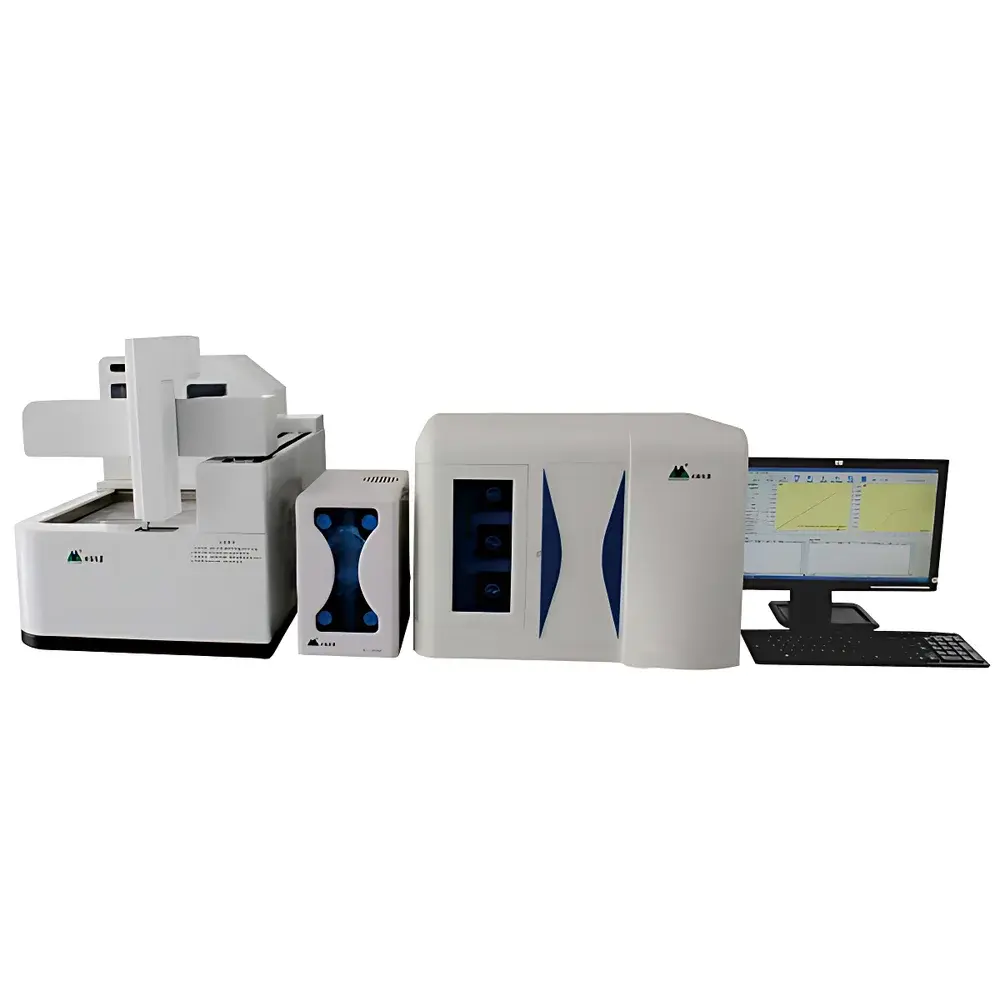
BEIYU GMA3386M Gas-Phase Molecular Absorption Spectrometer
| Brand | BEIYU TECHNOLOGIES |
|---|---|
| Origin | Shanghai, China |
| Manufacturer Type | Direct Manufacturer |
| Instrument Type | Laboratory Benchtop Analyzer |
| Model | GMA3386M |
| Measurement Principle | Gas-Phase Molecular Absorption Spectrometry (GPMAS) coupled with standardized chemical oxidation and stoichiometric quantification |
| Measurement Range | < 5.0 mg/L (as KMnO₄) |
| Detection Limit | 0.08 mg/L |
| Accuracy | ±3% RSD |
| Analysis Time per Sample | 1–4 min |
| Batch Capacity | 30 samples |
| Wavelength Accuracy | ±0.2 nm |
| Wavelength Repeatability | ±0.1 nm |
| Temperature Control Precision | ±0.1 °C |
| Baseline Drift | 0.0002 A |
| Baseline Noise | 0.0001 A |
| Injection Flow Accuracy | ±0.1% |
| Compliance | GB 11892–1989, HJ/T 197–2005 |
Overview
The BEIYU GMA3386M Gas-Phase Molecular Absorption Spectrometer is a fully automated benchtop analytical system engineered for precise, high-throughput determination of permanganate index (CODMn) in water matrices—complementing its native capability to quantify ammonia nitrogen, total nitrogen, sulfide, nitrate nitrogen, nitrite nitrogen, and Kjeldahl nitrogen via gas-phase molecular absorption spectrometry. Unlike conventional titrimetric or colorimetric methods, the GMA3386M implements a two-stage physicochemical workflow: first, thermal acid digestion of water samples strictly following the procedural requirements of Chinese National Standard GB 11892–1989; second, quantitative reaction of residual potassium permanganate with sodium nitrite, followed by selective detection of generated nitric oxide (NO) gas in the optical cell using UV absorption at 214.4 nm. This indirect, stoichiometric approach eliminates subjective endpoint judgment, minimizes operator intervention, and ensures traceable compliance with regulatory method frameworks. The instrument operates on a closed-loop gas-phase separation principle: analyte-specific gaseous species are liberated from the liquid phase under controlled pH and temperature, swept into a quartz absorption cell by inert carrier gas, and quantified via Beer–Lambert law-based absorbance measurement—delivering inherent immunity to sample turbidity, color, and particulate interference.
Key Features
- Fully integrated “digestion–analysis” automation: No manual reagent addition, no endpoint titration, no post-analysis calculation—results auto-calculated and reported.
- Multi-channel precision syringe pump system: Each reagent (H2SO4, NaNO2, etc.) delivered through dedicated fluidic pathways to prevent cross-contamination.
- High-stability optical platform: Dual-beam design with wavelength accuracy ±0.2 nm and repeatability ±0.1 nm; baseline drift < 0.0002 A over 30 min.
- Thermal control module with ±0.1 °C precision across digestion and reaction zones—critical for reproducible KMnO4 decomposition kinetics.
- Intelligent liquid-level monitoring: Real-time dual-threshold electronic sensors trigger audible/visual alerts for low/high reagent or waste levels.
- Dedicated cleaning reservoir with programmable rinse cycles between samples—prevents carryover and maintains inter-sample integrity.
- Optimized sampling needle geometry: Minimizes residual volume and cross-wetting between sequential injections.
- Batch processing capacity: Up to 30 samples unattended; average cycle time 4 minutes per sample including digestion, reaction, gas transfer, and data acquisition.
Sample Compatibility & Compliance
The GMA3386M accepts raw, filtered, or centrifuged water samples—including surface water, groundwater, drinking water, wastewater effluents, and industrial process streams—without requirement for pre-filtration or decolorization. Its gas-phase detection mechanism inherently rejects matrix effects from suspended solids (< 100 NTU), chromophores (absorbance up to 2.0 AU at 400 nm), and common ions (Cl− ≤ 300 mg/L, NO3− ≤ 50 mg/L). Method validation adheres to GB 11892–1989 for permanganate index and HJ/T 197–2005 for nitrite nitrogen quantification—the latter forming the analytical basis for residual oxidant assessment. While not certified to ISO/IEC 17025 or EPA Method 4500-P (Mn) out-of-the-box, the system supports full audit trail generation, user access control, and electronic signature readiness—enabling laboratories to align workflows with GLP, ISO 17025, or FDA 21 CFR Part 11 requirements when paired with validated LIMS integration.
Software & Data Management
The embedded Windows-based control software provides real-time monitoring of digestion temperature profiles, reagent consumption logs, optical signal stability metrics, and per-sample QC flags (e.g., baseline deviation, peak shape asymmetry). All raw absorbance spectra, calibration curves (linear range 0.08–4.8 mg/L), and calculated results are stored with timestamp, operator ID, and instrument configuration metadata. Data export complies with ASTM E1382-compliant CSV and PDF report formats. Audit trail functionality records all parameter modifications, method changes, and result overrides—retained for ≥18 months unless purged per institutional retention policy. Remote diagnostics and firmware updates are supported via secure HTTPS interface.
Applications
- Regulatory monitoring of permanganate index in municipal drinking water source protection programs.
- Wastewater treatment plant performance evaluation—tracking organic load reduction across primary, secondary, and tertiary stages.
- Environmental impact assessments for industrial discharge permits requiring CODMn reporting.
- Research laboratories studying biodegradable organic matter dynamics in aquatic ecosystems.
- Quality control in pharmaceutical water systems where low-level oxidizable carbon must be verified against pharmacopoeial limits (e.g., USP ).
- Simultaneous multi-parameter analysis: One instrument platform supports routine testing of NH3-N, NO2−-N, NO3−-N, TN, and CODMn without hardware modification.
FAQ
Does the GMA3386M require daily recalibration?
No—calibration is performed during initial setup and after major maintenance. Routine verification uses certified reference materials (CRMs) traceable to NIM (China National Institute of Metrology); calibration stability is confirmed weekly per internal SOP.
Can the instrument analyze seawater or high-salinity samples?
Yes—with dilution and matrix-matched calibration. Chloride interference is mitigated by the gas-phase separation step; validation data show acceptable recovery (92–105%) for samples with salinity ≤ 15 g/L when using NaNO2 correction protocols.
Is method validation documentation provided?
Yes—each shipment includes a Factory Validation Report covering linearity, LOD/LOQ, precision (RSD ≤ 2.8%), spike recovery (89–103%), and robustness testing per ISO/IEC 17025 Annex B guidelines.
What maintenance intervals are recommended?
Quarterly optical alignment verification, semiannual pump tubing replacement, and annual carrier gas filter exchange—documented in the included Preventive Maintenance Logbook.
How is data integrity ensured during power interruption?
The system features non-volatile memory for active method parameters and ongoing run status; upon restart, it resumes analysis from the last completed step without data loss.







