
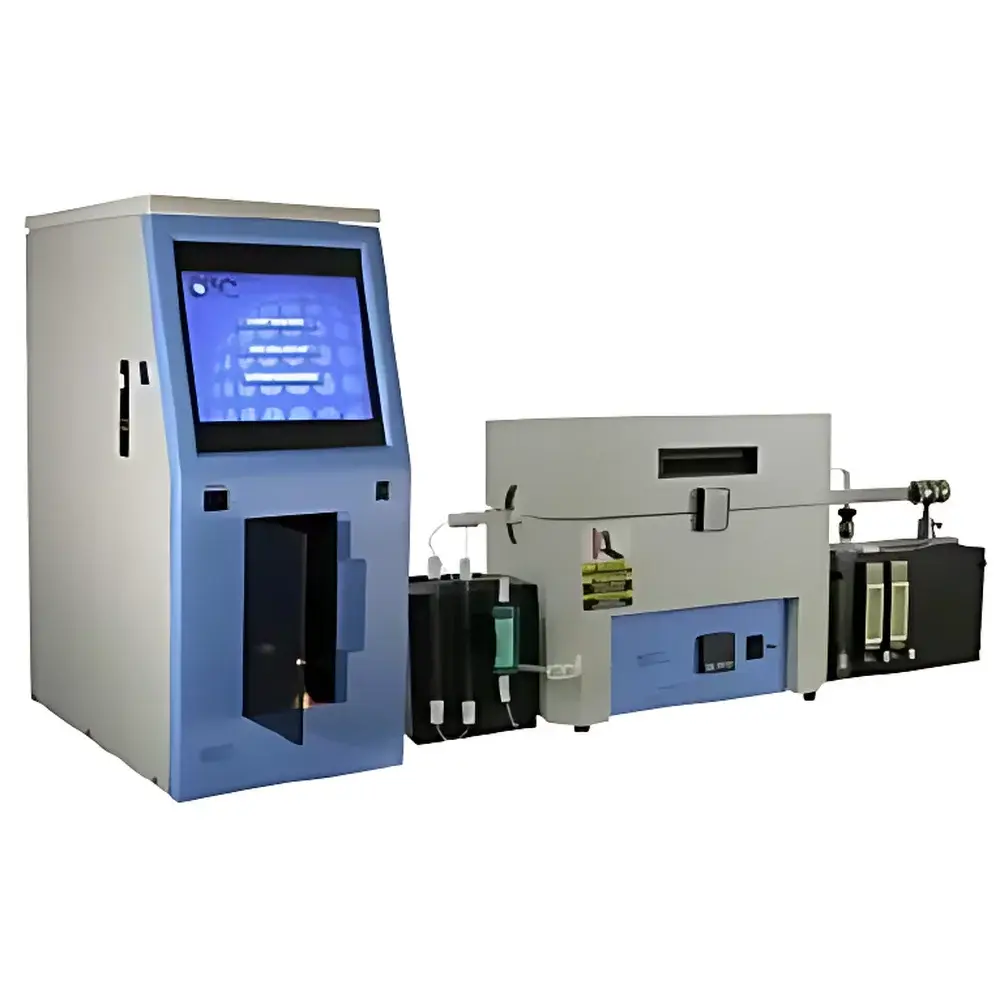
UIC CM120 Total Carbon Analyzer for Solids
| Brand | UIC (USA) |
|---|---|
| Origin | USA |
| Model | CM120 |
| Detection Principle | High-Temperature Catalytic Combustion + Potentiometric CO₂ Detection |
| Temperature Range | Up to 1100 °C |
| Carbon Range | 1 µg – 10,000 µg (0.1 ppm – 100 wt%) |
| Resolution | 0.01 µg absolute carbon |
| Linearity | Full dynamic range without user calibration |
| Sample Forms | Solids, slurries, particulate-laden liquids, powders, soils, sediments, coals, sulfurs |
| Compliance | ASTM D7573, ISO 20538, USP <281>, EPA Method 9060A (adapted), GLP-ready audit trail support |
Overview
The UIC CM120 Total Carbon Analyzer is a benchtop combustion-based elemental analyzer engineered for precise, interference-resistant quantification of total carbon (TC) in heterogeneous solid and semi-solid matrices. It operates on the principle of high-temperature catalytic oxidation—samples are combusted quantitatively at up to 1100 °C in a purified oxygen stream, converting all organic and inorganic carbon species to CO₂. The evolved CO₂ is then delivered to the proprietary CM5015 potentiometric detector, which measures CO₂ concentration via a solid-state electrochemical cell based on Faraday’s law of electrolysis. Unlike NDIR or IR-based systems, this potentiometric method eliminates baseline drift, requires no routine calibration with standards, and delivers intrinsic linearity across five orders of magnitude—from trace-level (1 µg C) to stoichiometric (100 wt% C) concentrations. The system is designed for walk-away operation in regulated environments, supporting full traceability per FDA 21 CFR Part 11 when paired with validated software configurations.
Key Features
- Automated high-temperature combustion furnace (CM5300) with programmable ramp profiles and stable 1100 °C maximum operating temperature
- Dual-stage combustion gas conditioning: pre-combustion scrubber removes ambient O₂ impurities; post-combustion scrubber eliminates SOₓ, NOₓ, halides, and H₂O vapor prior to CO₂ detection
- CM5015 CO₂ analyzer with 0.01 µg absolute carbon resolution and verified ±0.2% RSD for certified reference materials (e.g., NIST SRM 2710a, 2711a)
- No user calibration required—factory-calibrated sensor with documented stability over 12 months under normal use
- Sample introduction via reusable platinum or ceramic boats; compatible with tin capsules for volatile or low-mass samples
- Onboard data handling: stores up to 50 sample records with mass, area, volume, or dilution factors; supports unit selection (µg C, % C, ppm C, mg/g)
- Floppy disk interface (3.5″) for raw data export; ASCII-compatible output for LIMS integration
Sample Compatibility & Compliance
The CM120 accommodates a broad spectrum of challenging matrices without pretreatment: soils, sediments, sludges, coal, sulfur, geological cores, biomass ash, catalyst residues, and suspended particulate matter in aqueous suspensions. Its robust combustion architecture and selective gas clean-up enable reliable TC determination even in high-sulfur or chloride-rich samples where conventional IR detectors suffer from spectral overlap or detector poisoning. The system conforms to methodological frameworks referenced in ASTM D7573 (standard test method for total carbon in soil), ISO 20538 (soil quality—determination of total carbon), and EPA Method 9060A (total organic carbon in solids). When operated with electronic logbooks and password-protected method files, it satisfies GLP and GMP documentation requirements—including audit trail generation, user access control, and electronic signature capability (when validated with compliant software).
Software & Data Management
Data acquisition and reporting are managed through the embedded CM5015 controller firmware. Users define analysis sequences—including ignition delay, oxidation time (typically 5–7 min), and cooling intervals—via intuitive front-panel navigation. Each analysis logs timestamp, sample ID, mass, measured µg C, and calculated % C. Results display numerically and may be exported in tab-delimited format for downstream statistical analysis (e.g., JMP, Minitab, Python pandas). While the base configuration uses floppy disk storage, optional RS-232 or USB-to-serial adapters enable real-time streaming to laboratory PCs. For regulated labs, UIC provides IQ/OQ documentation packages and validation protocols aligned with USP Analytical Instrument Qualification principles.
Applications
- Environmental laboratories quantifying carbon sequestration potential in agricultural soils and landfill cover materials
- Coal and coke producers verifying carbon content per ASTM D3172 and ISO 6874
- Geochemical research groups analyzing carbon speciation in sedimentary rock cores and meteorite fragments
- Wastewater treatment facilities monitoring TC in digested sludge per EPA 40 CFR Part 136
- Materials science labs assessing carbon retention in ceramic precursors or activated carbons
- Pharmaceutical manufacturing for residual carbon verification in excipient-grade calcium carbonate or magnesium stearate
FAQ
Does the CM120 require daily calibration with standard reference materials?
No. The potentiometric CO₂ sensor is factory-calibrated and maintains linearity without recalibration across its full 1–10,000 µg range. Routine verification using a single check standard (e.g., 500 µg sucrose) is recommended weekly per ISO/IEC 17025.
Can the CM120 analyze liquid samples directly?
Yes—particulate-laden liquids (e.g., wastewater slurry, ink suspensions) may be dried and analyzed as solids, or introduced via sealed tin boats with controlled evaporation prior to combustion. Homogeneous aqueous solutions require acidification and sparging to remove inorganic carbon before TC measurement.
What maintenance is required for the combustion furnace?
The CM5300 furnace requires quarterly inspection of quartz tube integrity and annual replacement of the catalytic oxidant bed (UIC P/N CM5300-CAT). Scrubber cartridges (pre- and post-combustion) should be replaced after ~200 analyses or when pressure drop exceeds 15 psi.
Is the system compatible with modern LIMS platforms?
Yes—ASCII-formatted output files generated via floppy disk or serial interface are parseable by most LIMS vendors. UIC provides a documented communication protocol (RS-232, 9600 baud, N81) for custom API integration.
How is compliance with 21 CFR Part 11 ensured?
The CM120 itself is hardware-only and does not store electronic signatures. However, when operated with validated third-party data acquisition software (e.g., LabArchives ELN or Thermo Fisher SampleManager), full Part 11 compliance—including audit trails, role-based access, and electronic signatures—is achievable through documented configuration and periodic review.






