
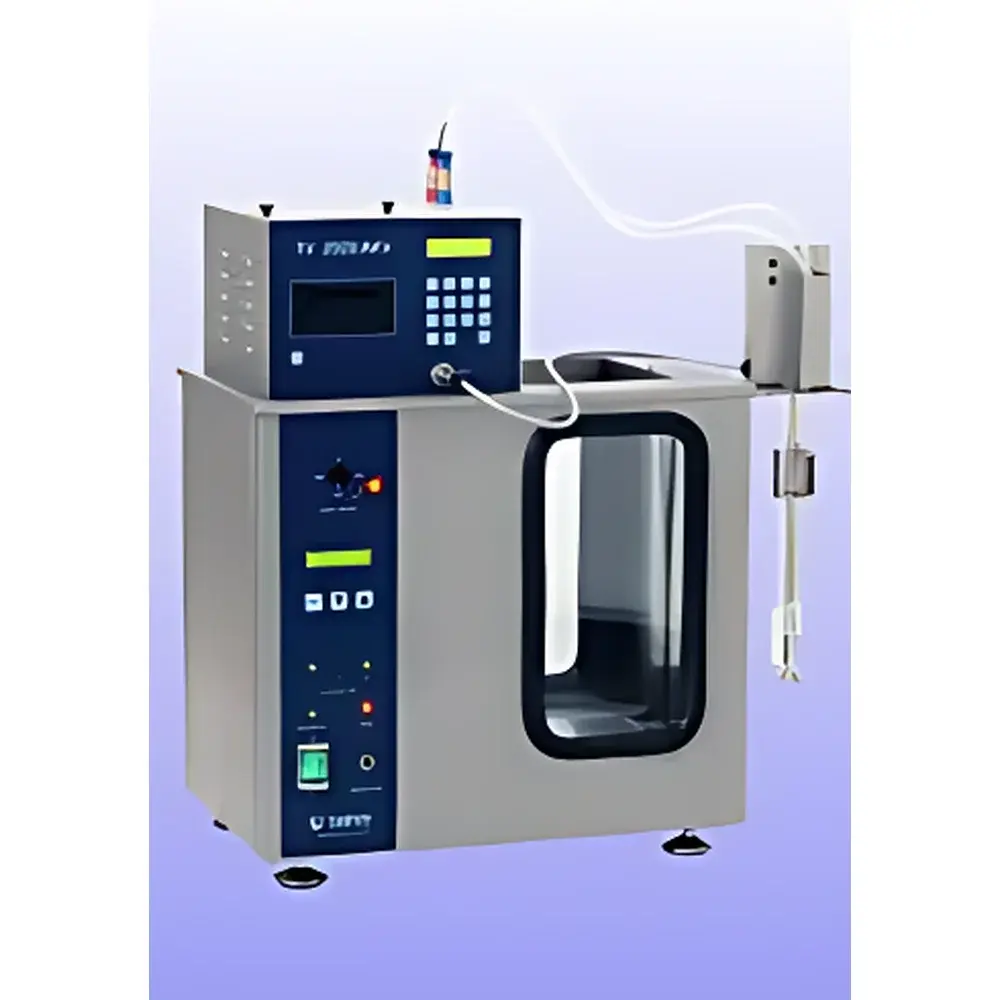
TV2000AKV Automatic Kinematic Viscosity Tester
| Origin | Netherlands |
|---|---|
| Model | TV2000AKV |
| Temperature Range | Ambient +5 °C to 130 °C |
| Temperature Stability | ±0.01 °C |
| Temperature Uniformity | ±0.01 °C |
| Temperature Resolution | ±0.1 °C |
| Timing Accuracy | ±0.01 s |
| Max Timer Duration | 9999.99 s |
| Bath Capacity | 20 L |
| Heating Power | 200 / 1000 / 1500 W (triple-zone) |
| Construction Materials | AISI 304 stainless steel and PTFE |
| Safety Compliance | CE Directive |
| Dimensions (L×W×H) | 285 × 465 × 585 mm |
| Weight | 40 kg |
| Total Power Consumption | 2800 W |
| Optical Detection | Dual infrared sensors |
| Capillary Types Supported | Ubbelohde and Cannon-Fenske |
| Viscosity Range | 0.3 – 10,000 cSt |
| Calibration Storage | Up to 10 capillary constants |
| Optional Chiller Compatibility | TLC2 (enables 10 °C operation) |
| Standards Compliance | ASTM D445, ASTM D446, IP 71 |
Overview
The TV2000AKV Automatic Kinematic Viscosity Tester is a precision-engineered instrument designed for laboratories requiring high-reproducibility kinematic viscosity measurements in accordance with internationally recognized petroleum testing standards. Based on the capillary efflux principle, it determines kinematic viscosity (in centistokes, cSt) by precisely measuring the time required for a fixed volume of liquid to flow under gravity through a calibrated glass capillary tube—typically an Ubbelohde or Cannon-Fenske viscometer—immersed in a thermally stabilized bath. The system employs dual infrared optical sensors to detect meniscus passage at upper and lower timing marks, eliminating operator-dependent visual reading errors. Temperature control is central to measurement integrity: the TV2000AKV integrates triple-zone heating elements (200 W, 1000 W, and 1500 W), a microprocessor-based PID controller, and high-uniformity thermal architecture to maintain bath stability and uniformity within ±0.01 °C across its full operating range (ambient +5 °C to 130 °C). When paired with the optional TLC2 recirculating chiller, the system extends low-temperature capability down to 10 °C—critical for evaluating low-viscosity base oils, jet fuels, and cold-flow formulations.
Key Features
- Triple-zone heating system (200 W / 1000 W / 1500 W) ensures rapid thermal equilibration and precise power modulation for both ramp-up and steady-state operation
- Dual infrared optical sensors provide non-contact, repeatable meniscus detection with timing resolution of 0.01 seconds and maximum timer capacity of 9999.99 seconds
- 20-liter stainless steel (AISI 304) bath vessel with PTFE-coated internal surfaces minimizes contamination risk and supports long-term chemical resistance to hydrocarbon solvents and cleaning agents
- Integrated safety architecture includes mechanical high-limit thermostat, electronic overtemperature protection, real-time heater monitoring, and CE-compliant electrical design
- Large front-access viewing window (130 × 165 mm) enables unobstructed visual verification of capillary filling and flow behavior during method validation or troubleshooting
- Onboard microprocessor with LCD interface stores up to 10 user-defined capillary constants, enabling seamless switching between multiple viscometer calibrations without manual recalculations
- Modular test head compatibility: supports both Ubbelohde and Cannon-Fenske capillaries via dedicated accessory kits (Cat. No. 00T0840 and 00T0890)
Sample Compatibility & Compliance
The TV2000AKV is validated for transparent and translucent colored liquids—including mineral oils, synthetic lubricants, diesel fuels, aviation turbine fuels (Jet A-1, JP-8), biodiesel blends (B5–B20), and hydraulic fluids. It excludes opaque or highly particulate suspensions that may obstruct optical detection or clog capillary bores. All operational parameters and calibration procedures conform strictly to ASTM D445 (Standard Test Method for Kinematic Viscosity of Transparent and Opaque Liquids), ASTM D446 (Specifications for Glass Capillary Kinematic Viscometers), and IP 71 (Determination of Kinematic Viscosity of Petroleum Products). The instrument’s temperature control performance meets ISO 17025 requirements for accredited testing laboratories, and its hardware architecture supports GLP-compliant audit trails when integrated with external LIMS or validated data acquisition software.
Software & Data Management
While the TV2000AKV operates as a standalone benchtop unit with embedded firmware, its RS-232 or optional USB interface enables bidirectional communication with external PCs running laboratory data management systems. Raw timing data, bath temperature logs, and user-entered capillary constants can be exported in CSV format for post-processing, statistical analysis (e.g., repeatability per ASTM D445 Section 13), or integration into electronic lab notebooks (ELN). For regulated environments, the system supports 21 CFR Part 11 compliance when deployed with validated third-party software that provides electronic signatures, audit trail generation, and role-based access control—though native firmware does not include built-in e-signature functionality.
Applications
- Quality control of finished lubricants and base stocks in refinery and additive manufacturing facilities
- Viscosity grading of engine oils per SAE J300 and gear oils per SAE J306
- Specification conformance testing for aviation fuels (ASTM D1655 Annex A1) and marine distillate fuels (ISO 8217)
- Research and development of low-temperature fluid formulations, including bio-based hydraulic fluids and refrigeration lubricants
- Method transfer and cross-laboratory correlation studies under ISO/IEC 17043 proficiency testing schemes
- Calibration verification of secondary reference viscometers using NIST-traceable standard oils
FAQ
Does the TV2000AKV support automatic sample loading or rinsing?
No—the instrument requires manual sample introduction into the capillary and post-test cleaning. It is a semi-automated system focused on precision timing and thermal control, not full sample handling automation.
Can I use ASTM-certified capillaries from other manufacturers?
Yes, provided they are dimensionally compliant with ASTM D446 specifications for Ubbelohde or Cannon-Fenske types and their certified constants are entered manually or imported via the calibration storage function.
Is the bath fluid specified or restricted?
The system is compatible with standard silicone oil baths (e.g., Dow Corning 200 Fluid, viscosity grade 50–100 cSt) and high-temperature heat transfer fluids rated for continuous operation up to 130 °C; water is not recommended above 60 °C due to evaporation and corrosion risks.
What maintenance is required for long-term accuracy?
Routine verification includes periodic calibration of the bath temperature sensor against a traceable platinum resistance thermometer (PRT), optical sensor alignment check using alignment rods, and capillary inspection for etching or residue buildup—recommended every 6 months or after 500 test cycles.
Is remote monitoring or network connectivity available?
The base model includes RS-232 serial output; Ethernet or Wi-Fi modules are not factory-installed but can be added via third-party industrial protocol converters compatible with Modbus RTU or ASCII command sets.







