
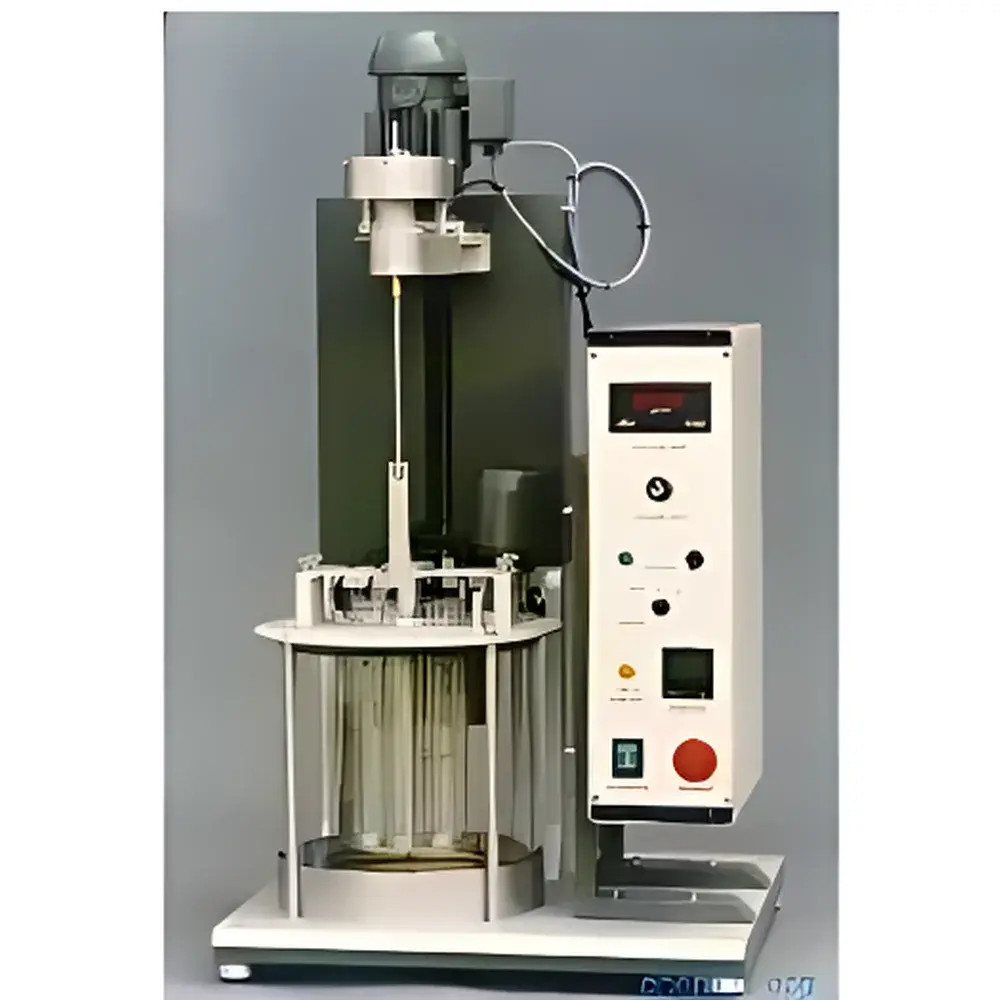
Swiss-made 200-Series Hydrogenation Reactor
| Origin | Switzerland |
|---|---|
| Supplier Type | Authorized Distributor |
| Origin Category | Imported Instrument |
| Model | 200-Series |
| Price | Upon Request |
| Temperature Range | −10 °C to +80 °C |
| Temperature Accuracy | ±0.1 °C (external 4-wire Pt100 probe) |
| Pressure Range | Up to 200 bar (2,900 psi) |
| Pressure Accuracy | ±0.5% FS (DMS diaphragm sensor) |
| Total Volume | 450 mL |
| Recommended Liquid Fill Volume | ≤200 mL |
| Stirring Speed | 100–1,000 rpm (on/off control) |
| Optical Viewport | Sapphire window with wide-angle field of view |
| Illumination | Halogen/LED light source with fiber-optic delivery |
| Camera Resolution | 440,000 pixels (RGB/YC format) |
| Dimensions (W×D×H) | 120 × 80 × 35 cm |
| Weight | ~40 kg (excluding PC) |
| Power Supply | 230 V, 50 Hz, 2200 W |
Overview
The Swiss-made 200-Series Hydrogenation Reactor is an engineered benchtop system designed for controlled catalytic hydrogenation studies under elevated pressure and temperature. It operates on the principle of sealed-vessel gas–liquid heterogeneous reaction kinetics, enabling real-time monitoring of hydrogen uptake, catalyst behavior, and reaction homogeneity in research-scale hydrogenation processes. The reactor integrates precision thermal management via dual-zone jacketed temperature control, high-fidelity pressure transduction, and optical access for in situ visual observation—making it suitable for mechanistic investigations of hydrogenation inhibitors, catalyst deactivation pathways, and kinetic profiling under dynamically varying thermodynamic conditions. Its architecture complies with fundamental safety requirements for high-pressure gas-handling systems per ISO 4762 and EN 13445-3, with pressure containment certified to 200 bar working pressure.
Key Features
- Stainless-steel reactor vessel and head with integrated double-jacket temperature control for precise thermal regulation between −10 °C and +80 °C
- Magnetic drive stirring system (100–1,000 rpm) ensuring leak-tight operation without shaft seals
- Sapphire viewport with anti-reflective coating and fiber-optic illumination for high-contrast optical observation
- Digital imaging module (440,000-pixel RGB/YC resolution) synchronized with automated image capture and time-lapse video recording
- Redundant safety design: mechanical interlock requiring single-operator activation, quick-connect fittings compliant with DIN 2817 standards
- Modular control architecture supporting up to six parallel reactors via centralized Hydrate 2.0 software platform
- Automatic restart functionality with non-volatile state retention following power interruption—ensuring data continuity during extended experiments
Sample Compatibility & Compliance
The 200-Series accommodates standard organic solvents (e.g., methanol, ethyl acetate, THF), aqueous suspensions, and heterogeneous catalyst slurries (Pd/C, PtO₂, Raney Ni). Maximum liquid fill volume is limited to 200 mL to maintain adequate headspace for H₂ gas phase equilibration and safe pressure buildup. All wetted components are electropolished 316L stainless steel or sapphire, ensuring chemical resistance and minimizing surface adsorption artifacts. The system supports GLP-compliant experimental execution: audit-trail-enabled software logging (per FDA 21 CFR Part 11 requirements), timestamped parameter recording (T, P, rpm, image frames), and exportable raw data in CSV and AVI formats. Pressure sensors are traceably calibrated to NIST standards; temperature probes meet ASTM E230 Class A tolerances.
Software & Data Management
Hydrate 2.0 is a Windows-based application (compatible with Windows 2000 and later) providing centralized supervision of multiple reactors. It enables fully programmable ramp/soak temperature profiles, pressure hold sequences, and synchronized stirring protocols. Image acquisition is configurable by time interval or event trigger (e.g., pressure deviation >5 bar). All captured images and videos are embedded with metadata (timestamp, T, P, rpm, reactor ID) and stored in hierarchical project folders. Data export supports batch conversion to TIFF/MP4 for integration into third-party analysis tools (e.g., ImageJ, MATLAB, ChemDraw). Software validation documentation—including IQ/OQ protocols and electronic signature implementation—is available upon request for regulated laboratory environments.
Applications
- Quantitative evaluation of hydrogenation inhibitor efficacy under dynamic reaction conditions
- Optimization of inhibitor concentration thresholds to suppress over-reduction or side reactions
- In-process quality control of hydrogenation batches in pharmaceutical intermediate synthesis
- Thermal stability assessment of supported metal catalysts under pressurized H₂ atmosphere
- Visual correlation of bubble dynamics, phase separation, and solid dispersion with kinetic rate profiles
- Method development for PAT (Process Analytical Technology)-enabled continuous hydrogenation workflows
FAQ
Is the reactor compatible with corrosive reagents such as HCl or HBr in solution?
The standard 316L stainless-steel construction is not recommended for prolonged exposure to halogen acids above pH 2; optional Hastelloy C-276 lining is available for highly corrosive media.
Can the system operate unattended for 72+ hours?
Yes—provided ambient cooling capacity meets thermal dissipation requirements (2200 W max load) and uninterruptible power supply (UPS) support is implemented per local electrical codes.
Does the camera support real-time particle size tracking?
The base imaging module provides static and time-lapse visualization; quantitative particle analysis requires optional add-on software with calibration using NIST-traceable microsphere standards.
What safety certifications does the unit carry?
CE marking per PED 2014/68/EU (Pressure Equipment Directive), EMC Directive 2014/30/EU, and RoHS 2011/65/EU; full test reports available under NDA.
Is remote monitoring possible via Ethernet or Wi-Fi?
Hydrate 2.0 supports TCP/IP communication over LAN; remote desktop access is permitted within secure institutional networks meeting ISO/IEC 27001 guidelines.





