
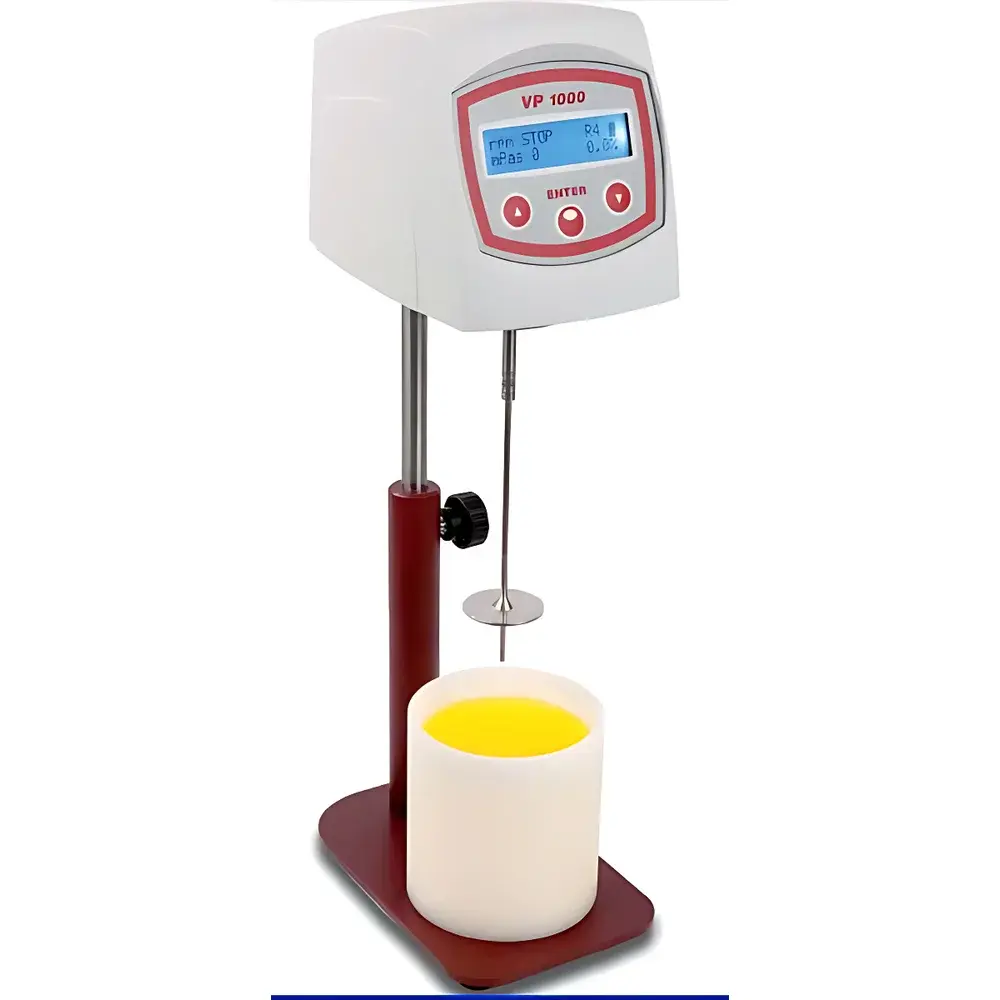
VP1000M Portable Rotational Viscometer (Imported, Spain-Manufactured)
| Origin | Spain |
|---|---|
| Manufacturer Type | Authorized Distributor |
| Origin Category | Imported |
| Model | VP1000M |
| Pricing | Available Upon Request |
| Power Supply | 4 × AA alkaline batteries (6 V, 1900 mAh) or optional Ni-MH rechargeables (6 V, 2500 mAh) |
| Operating Duration | 24–30 hours continuous use |
| Weight | 1.8 kg |
| Ingress Protection Rating | IP20 |
| Display | Backlit dual-line LCD |
| Auto Power-Off | Yes |
| Accuracy | ±2% of full scale |
| Repeatability | ±1% |
| Standard Spindles | R2–R7 (R1 optional) |
| Sample Container | Dedicated cylindrical cup with centering anchor system |
| Viscosity Range (R2–R7) | 200–200,000 mPa·s (model-dependent |
| e.g., VP1020M @ 20 rpm | 200–200,000 mPa·s |
| VP1050M @ 50 rpm | 80–80,000 mPa·s) |
| Optional R1 Range | Down to 50 mPa·s (e.g., 50–500 mPa·s at 20 rpm) |
Overview
The VP1000M Portable Rotational Viscometer is an engineered solution for rapid, field-capable viscosity assessment in industrial process environments, quality control laboratories, and R&D settings. Designed and manufactured in Spain to align with Brookfield-standard rotational viscometry principles, the instrument operates on the Couette flow principle—measuring torque required to rotate a spindle at a defined angular velocity within a fluid sample. This method delivers direct quantification of dynamic (absolute) viscosity in millipascal-seconds (mPa·s), traceable to international metrological standards. Its compact architecture (1.8 kg), integrated centering anchor system, and battery-powered operation enable deployment beyond fixed lab benches—supporting on-site validation in chemical production lines, pharmaceutical cleanrooms, food processing facilities, ceramic slurry preparation areas, and ink formulation labs. The device complies with ISO 2555 and ASTM D2196 test methodologies for single-point and multi-speed viscosity profiling.
Key Features
- True portable design with ergonomic housing and integrated carrying case—no external power supply or PC connection required for basic operation
- Backlit dual-line LCD display showing real-time spindle speed (rpm), selected spindle identifier (R2–R7), measured viscosity (mPa·s), % full-scale reading, and battery status
- Centering anchor mechanism ensures precise coaxial alignment of the standard measurement cup, minimizing eccentricity-induced shear gradient errors during rotation
- Auto power-off function activates after 10 minutes of inactivity, preserving battery life across extended shifts (24–30 h runtime with alkaline cells)
- Calibration-certified out-of-the-box; includes NIST-traceable calibration certificate valid for initial verification under GLP-compliant workflows
- IP20-rated enclosure suitable for controlled indoor environments including ISO Class 7/8 cleanrooms and non-hazardous manufacturing zones
Sample Compatibility & Compliance
The VP1000M accommodates Newtonian and mildly non-Newtonian fluids across diverse industrial matrices—including aqueous polymer solutions, suspensions, emulsions, molten thermoplastics (within thermal limits), and low-to-medium viscosity coatings. Its standardized cylindrical sample cup (supplied) enables reproducible fill volume (typically 15–20 mL), while the R2–R7 spindle set covers a practical operational range from 200 mPa·s to 200,000 mPa·s depending on model variant and selected speed. Optional R1 spindle extends low-end capability to 50 mPa·s. All measurements adhere to ISO 2555 (viscosity determination using rotational viscometers) and ASTM D2196 (standard test methods for rheological properties of non-Newtonian materials). For regulated environments, the instrument supports audit-ready documentation when used with validated procedures per FDA 21 CFR Part 11 (when paired with compliant data logging software).
Software & Data Management
While the VP1000M operates autonomously via its onboard interface, optional USB or Bluetooth-enabled data transfer modules allow synchronization with proprietary desktop software (e.g., ViscoLink™ Suite). This software enables time-stamped data export (CSV/TXT), customizable report generation, trend analysis across batches, and compliance with electronic record requirements under 21 CFR Part 11 when configured with user authentication, audit trail, and electronic signature modules. Raw viscosity values are stored with metadata including date/time stamp, spindle ID, rotational speed, temperature (if external probe connected), and operator ID—facilitating full traceability in GMP/QbD frameworks.
Applications
- Real-time QC checks of solvent-based adhesives, inks, and paint formulations during production
- Batch release testing of oral suspensions and topical gels in pharmaceutical manufacturing
- Consistency monitoring of dairy-based sauces, dressings, and plant-based alternatives in food processing
- Rheological screening of ceramic slips and glazes prior to spray drying or casting
- Field verification of lubricant degradation or contamination in maintenance operations
- Educational use in university materials science and chemical engineering laboratories for hands-on rheology instruction
FAQ
Is the VP1000M suitable for measuring non-Newtonian fluids?
Yes—the instrument captures apparent viscosity at discrete shear rates defined by spindle geometry and rotational speed. For comprehensive flow curve analysis, sequential measurements across multiple speeds (e.g., 20/30/50/60 rpm) are recommended.
Can it be used in temperature-controlled environments?
The base unit is rated for ambient operation (10–40 °C). For temperature-dependent studies, optional Peltier-controlled sample jackets or external circulating baths compatible with the standard cup geometry may be employed.
Does it support GLP/GMP documentation requirements?
When operated with validated procedures and paired with compliant data acquisition software featuring audit trail, electronic signatures, and secure user access controls, the system meets core GLP and GMP documentation expectations.
What maintenance is required?
Routine cleaning of spindles and cup with appropriate solvents; periodic verification using standard reference oils (e.g., Cannon-Manning series); annual recalibration recommended per ISO/IEC 17025 guidelines.
Is technical support available globally?
Yes—authorized distributors provide multilingual application support, remote troubleshooting, and access to certified calibration services through accredited regional laboratories.



