
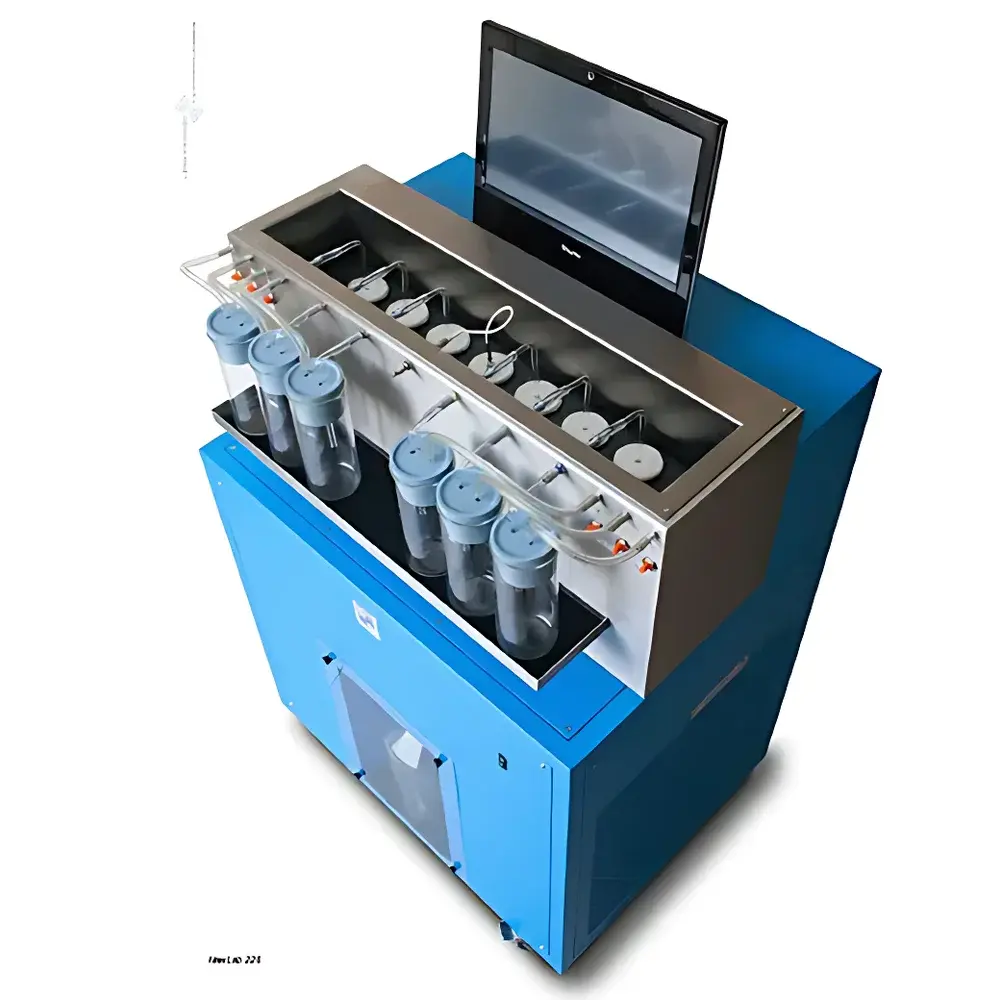
Linetechnic LTFT-NewLab 226 Automated Diesel Low-Temperature Flow Test Analyzer
| Brand | Linetechnic |
|---|---|
| Origin | Switzerland |
| Model | 226 (ASTM D4539 Compliant) |
| Cooling Range | +80 °C to −45 °C |
| Temperature Accuracy | ±0.1 °C |
| Temperature Resolution | 0.06 °C |
| Vacuum Control | Precisely regulated at 20 kPa |
| Sample Capacity | 6 × 300 mL positions |
| Cooling Rate | 1 °C/h |
| Pass Criterion | ≥180 mL filtrate collected within 60 s under vacuum |
| Temperature Sensor | PT100 Class A |
| Built-in Control System | AMD Geode800 CPU, 12″ TFT touchscreen (1024 × 768), 60,000-test storage capacity |
| Refrigerant | CFC-free compressor system |
Overview
The Linetechnic LTFT-NewLab 226 Automated Diesel Low-Temperature Flow Test Analyzer is an ASTM D4539–compliant instrument engineered for precise, repeatable assessment of diesel fuel filtration behavior under controlled sub-ambient conditions. It implements the Low-Temperature Flow Test (LTFT) methodology—a standardized cold-flow performance evaluation that simulates real-world diesel engine fuel filter clogging during cold-start and low-temperature operation. Unlike empirical cloud or pour point measurements, LTFT directly quantifies functional filterability by subjecting conditioned fuel samples to a defined vacuum-driven filtration challenge across a precisely ramped temperature gradient. The analyzer cools six independent 300 mL sample vessels at a rigorously maintained rate of 1 °C per hour while applying a stable 20 kPa vacuum via a micro-pump and electronic pressure regulator. At each temperature step, filtration time and volume are monitored optically via integrated grating sensors; passage is confirmed only when ≥180 mL is collected within 60 s. The lowest temperature satisfying this criterion defines the LTFT pass temperature—widely adopted by refineries, additive manufacturers, and OEM fuel specification teams as a predictive indicator of in-service operability.
Key Features
- Full automation with embedded industrial-grade control system: AMD Geode800 CPU, 12″ high-visibility TFT touchscreen (1024 × 768 resolution), and intuitive graphical user interface enabling real-time monitoring of cooling profile, vacuum status, filtration timing, and temperature stability.
- Integrated CFC-free refrigeration unit delivering stable cooling from +80 °C down to −45 °C, with temperature accuracy of ±0.1 °C and resolution of 0.06 °C—validated against PT100 Class A reference probes mounted directly in sample bath and filtration path.
- Six parallel sample positions with independent thermal management, enabling statistically robust replicate testing or multi-formulation screening within a single run cycle.
- Patented vacuum regulation architecture: dual-stage electronic control (micro-pump + vacuum stabilizer) ensures consistent 20 kPa differential pressure across all test vessels, critical for inter-laboratory reproducibility per ASTM D4539 Section 7.3.
- Optical filtration endpoint detection using calibrated light grating sensors, eliminating operator subjectivity and ensuring objective, time-stamped pass/fail determination at each temperature interval.
- Comprehensive safety subsystem: pressure-controlled single-phase compressor supervision, thermally actuated jacket switching for rapid thermal recovery, and integrated overload protection on all motorized components.
Sample Compatibility & Compliance
The LTFT-NewLab 226 is validated for use with conventional diesel fuels (EN 590, ASTM D975), biodiesel blends (B5–B20), hydrotreated vegetable oil (HVO), and additive-treated formulations. Its mechanical and thermal design conforms to IEC 61000-6-2 (immunity) and IEC 61000-6-4 (emissions) standards. All measurement procedures strictly adhere to ASTM D4539-21 (“Standard Test Method for Low-Temperature Flow Test (LTFT) for Diesel Fuels”), including requirements for temperature ramp control, vacuum calibration, and filtration timing tolerance. Data acquisition and instrument logs support audit-ready documentation for GLP and GMP environments; full traceability is ensured via timestamped test records, sensor calibration history, and firmware version logging.
Software & Data Management
The onboard operating system supports up to 60,000 complete test records, each storing raw temperature/time/vacuum data, filtration volume curves, pass/fail flags, and operator metadata. Export formats include CSV and PDF reports compliant with internal QA workflows. Two USB 2.0 ports and a 10/100 Mbps Ethernet interface enable secure network integration with LIMS platforms or centralized data repositories. Firmware updates are delivered via encrypted USB key or authenticated LAN push, maintaining system integrity in regulated environments. Audit trail functionality—including user login history, parameter change logs, and report generation timestamps—meets baseline expectations for FDA 21 CFR Part 11–aligned documentation where electronic records are retained.
Applications
- Evaluation of cold-flow improver (CFI) additive efficacy across temperature gradients, supporting formulation optimization and dosage validation.
- Batch release testing of winter-grade diesel to verify compliance with regional specifications (e.g., EN 15940, DIN 51601).
- Root-cause analysis of field-reported filter plugging incidents by correlating LTFT pass temperatures with fuel composition and storage history.
- Research into paraffin crystallization kinetics and wax morphology effects on filter media interaction under dynamic cooling conditions.
- Interlaboratory method transfer studies requiring high inter-operator repeatability and minimal manual intervention.
FAQ
What standard does the LTFT-NewLab 226 implement?
It fully complies with ASTM D4539-21, including all procedural, instrumentation, and reporting requirements specified in the standard.
Can the instrument test biodiesel blends?
Yes—it is validated for B5 through B20 blends and hydrotreated renewable diesel, provided samples meet ASTM D7467 or EN 14214 compositional limits.
How is temperature uniformity across the six sample positions verified?
Each position is equipped with an individual PT100 Class A probe; factory calibration includes spatial mapping at −20 °C, −30 °C, and −40 °C to confirm ≤±0.15 °C inter-position deviation.
Is remote diagnostics supported?
Yes—via secure SSH-enabled LAN connection, authorized service engineers can perform firmware verification, sensor diagnostics, and log review without physical access.
Does the system support 21 CFR Part 11 compliance?
While the base configuration provides full audit trail capability, formal Part 11 validation requires site-specific IQ/OQ documentation and role-based electronic signature implementation, available as an optional service package.





