
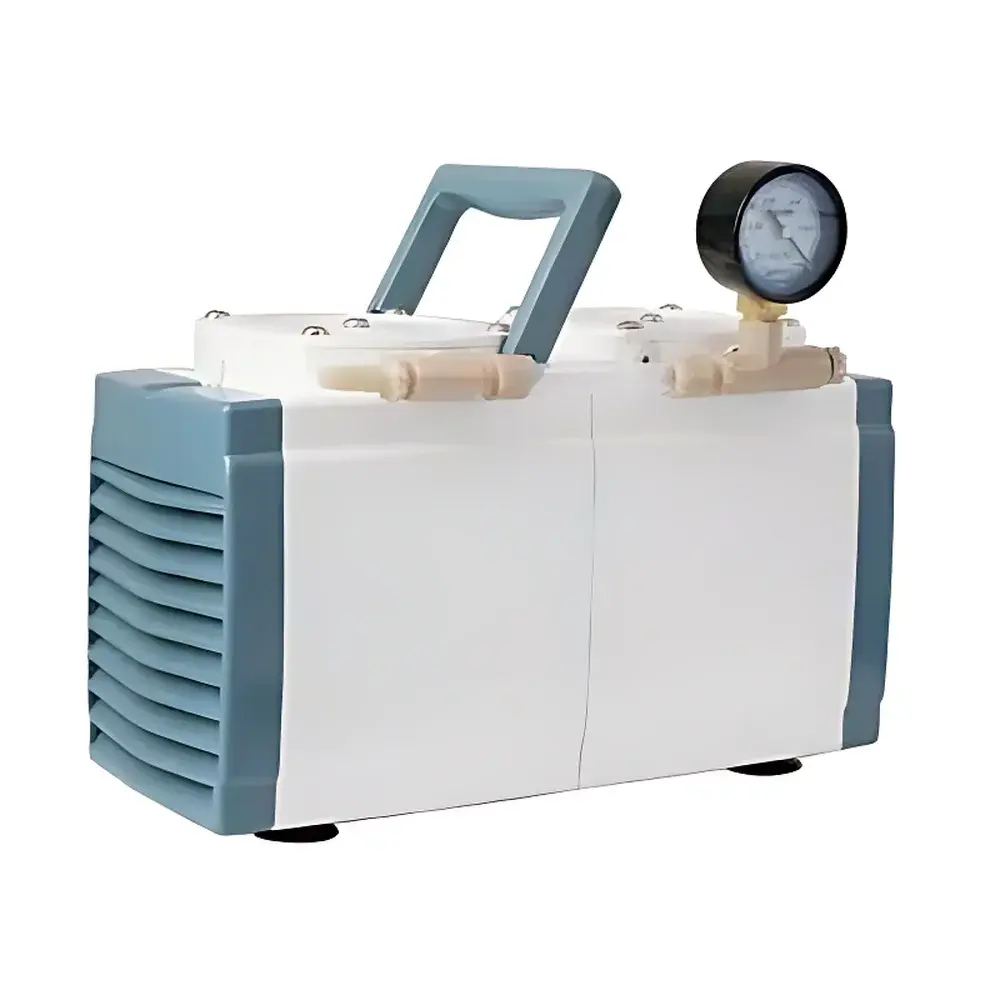
JINTENG GM-1.0A Dual-Mode Diaphragm Vacuum Pump
| Brand | JINTENG |
|---|---|
| Origin | Tianjin, China |
| Model | GM-1.0A |
| Pump Type | Diaphragm Pump |
| Ultimate Vacuum | 200 mbar |
| Maximum Positive Pressure | 0.08 MPa (40 psi) |
| Flow Rate | 60 L/min |
| Motor Power | 160 W |
| Noise Level | <55 dB(A) |
| Operating Temperature Range | 7–40 °C |
| Pump Head Temperature | <60 °C |
| Inlet/Outlet Port Diameter | Ø6 mm |
| Dimensions (L×W×H) | 300×160×235 mm |
| Weight | 9 kg |
| Cooling | Self-contained Air-Cooling System |
| Compliance | CE-marked for laboratory use per IEC 61010-1 |
Overview
The JINTENG GM-1.0A Dual-Mode Diaphragm Vacuum Pump is an oil-free, compact laboratory pump engineered for precision vacuum generation and controlled positive-pressure delivery in analytical and preparative workflows. Based on reciprocating diaphragm actuation—where a flexible elastomeric membrane displaces gas without lubricants or sliding metal-to-metal contact—the GM-1.0A eliminates hydrocarbon contamination risks and ensures clean, dry gas transfer. Its dual-mode architecture enables seamless switching between vacuum aspiration (e.g., filtration, solvent evaporation, degassing) and regulated positive-pressure applications (e.g., sample purging, membrane pressurization, inert gas blanketing). Designed for continuous operation under ambient conditions (7–40 °C), the unit integrates a passive air-cooling pathway that maintains diaphragm and motor thermal stability below 60 °C—even during extended 24-hour duty cycles. This makes it suitable for integration with HPLC sample injectors, rotary evaporators, solid-phase extraction manifolds, and benchtop gas chromatography auxiliary systems where purity, reliability, and footprint efficiency are critical.
Key Features
- Oil-free diaphragm technology ensures zero hydrocarbon carryover—essential for trace-level analysis, pharmaceutical QC, and food safety testing where sample integrity must be preserved.
- Dual-mode functionality: switchable between vacuum mode (ultimate pressure 200 mbar) and positive-pressure mode (max 0.08 MPa / 40 psi) via integrated valve configuration—no external regulators required.
- High-flow capacity of 60 L/min at atmospheric inlet pressure supports rapid filtration of large-volume aqueous or organic samples across 0.22 µm or 0.45 µm membranes.
- Aluminum alloy housing provides structural rigidity, electromagnetic shielding, and efficient heat dissipation while maintaining a lightweight (9 kg), portable form factor (300×160×235 mm).
- Low-noise operation (<55 dB[A]) enables deployment in shared lab spaces, QA/QC suites, and teaching laboratories without acoustic interference.
- Self-cooling airflow path and low-friction diaphragm kinematics minimize thermal drift and mechanical wear—extending service life beyond 10,000 hours under typical usage profiles.
Sample Compatibility & Compliance
The GM-1.0A is compatible with standard laboratory tubing (ID 6 mm), glassware adapters, and modular vacuum manifolds used in ASTM D854 (soil density), ISO 7739 (vacuum filtration of suspensions), and USP (particulate matter testing). Its oil-free construction meets ISO 8573-1 Class 0 requirements for compressed air purity when operated in positive-pressure mode. The device complies with IEC 61010-1 for electrical safety in laboratory environments and carries CE marking for conformity with EU Low Voltage and EMC directives. While not validated for GMP manufacturing environments, its design supports GLP-aligned documentation practices—including logbook entries for runtime, pressure setpoints, and maintenance intervals.
Software & Data Management
The GM-1.0A operates as a standalone analog instrument with manual pressure regulation via front-panel needle valves. It does not incorporate digital controllers, data logging, or communication interfaces (e.g., RS-232, USB, or Ethernet). For labs requiring audit-ready records, integration with external pressure transducers (e.g., Validyne DP15) and data acquisition systems (e.g., LabVIEW or MATLAB-based DAQ platforms) is supported via its stable, pulse-free flow output. Optional analog output modules (0–5 V or 4–20 mA) can be retrofitted for centralized monitoring in multi-pump installations.
Applications
- Vacuum-assisted filtration of biological suspensions, cell lysates, and environmental water samples using Buchner funnels or vacuum filtration bottles.
- Positive-pressure-driven inert gas purging of NMR tubes, glovebox antechambers, and reaction vessels prior to air-sensitive synthesis.
- Supporting rotary evaporation systems by providing consistent vacuum levels across solvent boiling point ranges (e.g., ethyl acetate, hexane, methanol).
- Automated solid-phase extraction (SPE) manifold actuation where programmable pressure gradients improve cartridge conditioning and elution reproducibility.
- Forensic evidence drying stations requiring non-oxidizing, low-particulate airflow for latent fingerprint development.
- Calibration of differential pressure sensors and leak-testing fixtures in metrology labs.
FAQ
Is the GM-1.0A certified for use in explosion-proof environments?
No—it lacks ATEX or IECEx certification and is intended only for general laboratory use in non-hazardous areas.
Can this pump handle corrosive vapors such as HCl or Cl₂?
Not without optional chemically resistant diaphragm kits (e.g., PTFE-reinforced EPDM); standard configuration is rated for ambient air and common solvents only.
What maintenance intervals are recommended?
Diaphragm inspection every 6 months under continuous use; filter element replacement every 3 months if used with particulate-laden streams.
Does the pump include an integrated vacuum gauge?
No—external analog or digital gauges must be installed downstream for process monitoring.
Is the GM-1.0A compatible with vacuum ovens or freeze dryers?
Yes, provided the ultimate vacuum requirement is ≥200 mbar; for deeper vacuums (<10 mbar), a secondary high-vacuum pump (e.g., turbomolecular or diffusion) is required.
Related Products



