
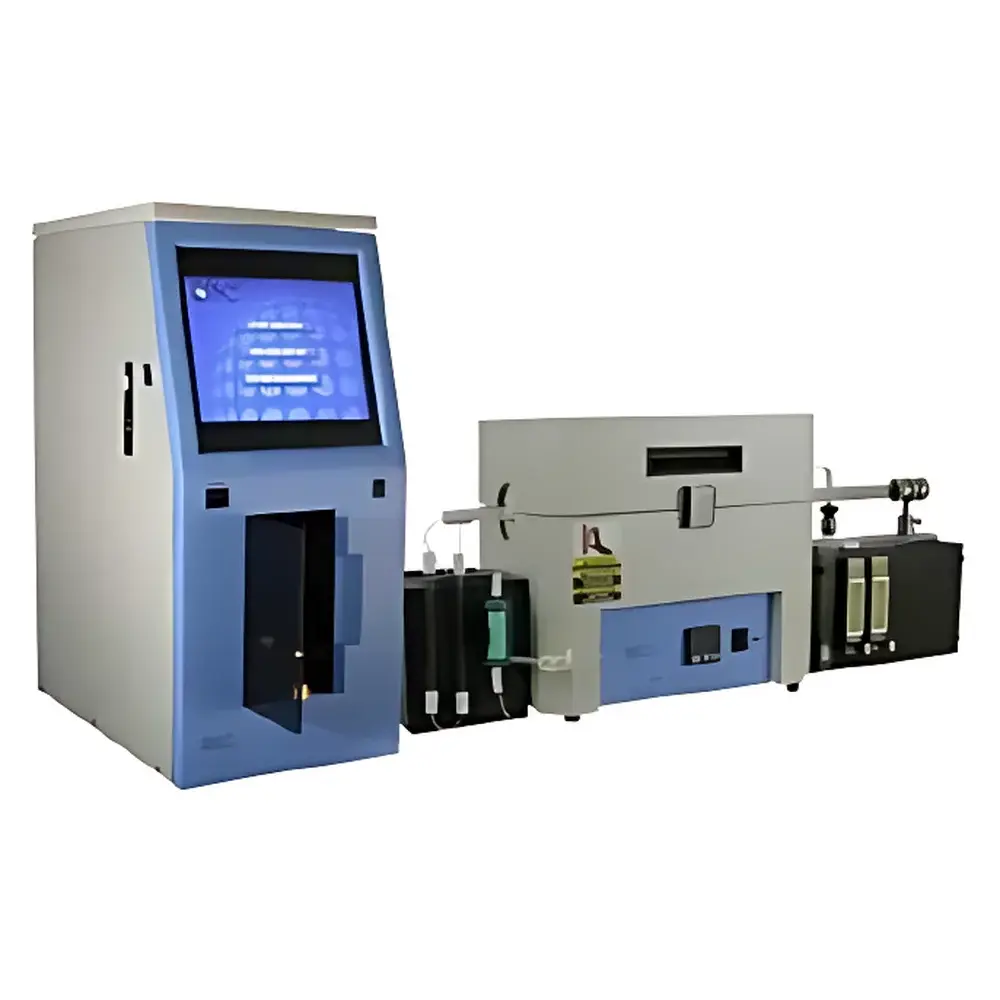
UIC CM120 Total Carbon Analyzer
| Brand | UIC (USA) |
|---|---|
| Origin | USA |
| Model | CM120 |
| Detection Principle | Potentiometric CO₂ Titration |
| Temperature Range | Up to 1100 °C |
| Carbon Quantification Range | 1–10,000 µg absolute carbon |
| Linearity | Full-scale 0–100% CO₂ |
| Resolution | 0.01 µg carbon |
| Sample Types | Solids, liquids, slurries, heterogeneous waste, carbon-rich matrices |
| Compliance | Designed for ASTM D7582, ISO 29541, USP <281>, and GLP-compliant workflows |
| Data Storage | Integrated SD card logging |
| Analysis Time | 5–7 min per sample |
| Interference rejection | Post-combustion scrubbers for SOₓ, NOₓ, H₂O, halides |
Overview
The UIC CM120 Total Carbon Analyzer is a high-precision, combustion-based elemental analyzer engineered for the accurate quantification of total carbon (TC) in carbon-dense and heterogeneous materials. Unlike infrared (IR)-based CO₂ detectors—whose accuracy degrades significantly in the presence of water vapor, sulfur oxides, or nitrogen oxides—the CM120 employs a robust potentiometric titration method grounded in Faraday’s law of electrolysis. This electrochemical detection principle enables direct, absolute measurement of CO₂ generated during high-temperature oxidative combustion, eliminating the need for routine calibration, standardization, or correction factors. The system delivers trace-level sensitivity (1 µg absolute carbon) up to full-scale 100% CO₂, with a linear dynamic range spanning six orders of magnitude (1–10,000 µg C). Its architecture is purpose-built for demanding applications where matrix complexity, particulate load, or extreme carbon concentration (e.g., >90% w/w in graphite or carbon black) preclude reliable IR-based analysis.
Key Features
- Patented potentiometric CO₂ detection (CM5015 module): No user calibration; intrinsic linearity across 0–100% CO₂; resolution of 0.01 µg carbon
- Programmable horizontal furnace (CM5300): Heats to 1100 °C with precise ramp/soak control; accommodates platinum or ceramic boats for solid, slurry, or powdered samples
- Dual-stage gas purification: Pre-combustion scrubber removes contaminants from carrier oxygen; post-combustion scrubber eliminates SOₓ, NOₓ, halides, and moisture prior to CO₂ detection
- Universal sample compatibility: Validated for carbon fibers, activated carbons, coal, coke, sewage sludge, geological sediments, sulfur-rich wastes, and mixed-phase industrial residues
- GLP-ready data handling: Onboard SD card storage; capacity for 50 sample records with customizable metadata (mass, area, volume); audit-trail-capable reporting
- Operator-efficient workflow: Intuitive interface; minimal training required; average analysis time of 5–7 minutes per sample
Sample Compatibility & Compliance
The CM120 is explicitly validated for solid, liquid, and multiphase samples with carbon content ranging from sub-ppm (1 µg C) to 100% w/w. Its robust combustion design tolerates high-ash, high-sulfur, and thermally unstable matrices without detector saturation or carryover. Methodologically aligned with ASTM D7582 (for coal), ISO 29541 (carbon in solid recovered fuels), and USP (organic carbon in pharmaceutical water systems), the instrument supports regulatory submission workflows under FDA 21 CFR Part 11 when paired with validated software and electronic signature protocols. All critical parameters—including furnace temperature profile, gas flow rates, titration endpoint thresholds, and data acquisition timestamps—are logged with immutable metadata, satisfying GLP/GMP documentation requirements for QC laboratories and contract research organizations.
Software & Data Management
The CM5015 CO₂ analyzer integrates a dedicated embedded controller with non-volatile memory and removable SD card support. Users define up to 50 sample entries per batch, assigning unique IDs, masses, dilution factors, or surface-area normalization values. Real-time titration curves are displayed during analysis, and final TC results are computed using stoichiometric conversion (12 g C ≡ 44 g CO₂) without empirical correction. Output units are selectable (µg C, % w/w, mg/g, ppm, or mmol C). Batch reports include statistical summaries (mean, SD, RSD), raw titration data, and system diagnostic logs. Exported CSV files are compatible with LIMS integration and third-party statistical packages (e.g., JMP, Minitab). Firmware updates are performed via SD card, ensuring long-term compliance with evolving data integrity standards.
Applications
- Quality control of carbon fiber precursors and finished composites in aerospace and automotive manufacturing
- Carbon content verification in electrode materials (graphite anodes, carbon blacks) for lithium-ion battery production
- Environmental monitoring of total organic carbon (TOC) in contaminated soils, dredged sediments, and municipal sludge
- Fuel characterization in coal-fired power plants and coke oven operations per ASTM D3176 and ISO 625
- Research on carbon sequestration materials, biochars, and pyrolyzed biomass feedstocks
- Regulatory testing of sulfur- and chlorine-containing wastes under EPA SW-846 Method 9060A (modified)
FAQ
Does the CM120 require daily calibration or standardization?
No. The potentiometric detection system is inherently absolute and drift-stable; no calibration gases, reference standards, or zero/span adjustments are required between analyses.
Can the CM120 analyze liquid samples directly?
Yes—liquids may be introduced via weighed aliquots in quartz boats or absorbed onto inert substrates (e.g., acid-washed quartz wool); no derivatization or digestion is needed.
How does the system handle sulfur-rich samples like coal or rubber?
Integrated pre- and post-combustion scrubbers chemically remove SO₂ and SO₃ before CO₂ reaches the detector, preventing signal suppression or electrode poisoning.
Is the instrument compliant with 21 CFR Part 11 for regulated labs?
The hardware and firmware support audit trails, electronic signatures, and data integrity controls; full Part 11 compliance requires site-specific validation of the complete software environment and procedural SOPs.
What maintenance is required for long-term operation?
Annual inspection of furnace insulation, replacement of consumables (scrubber cartridges, quartz components), and verification of titration cell electrolyte levels—no optical alignment or detector recalibration is necessary.






