
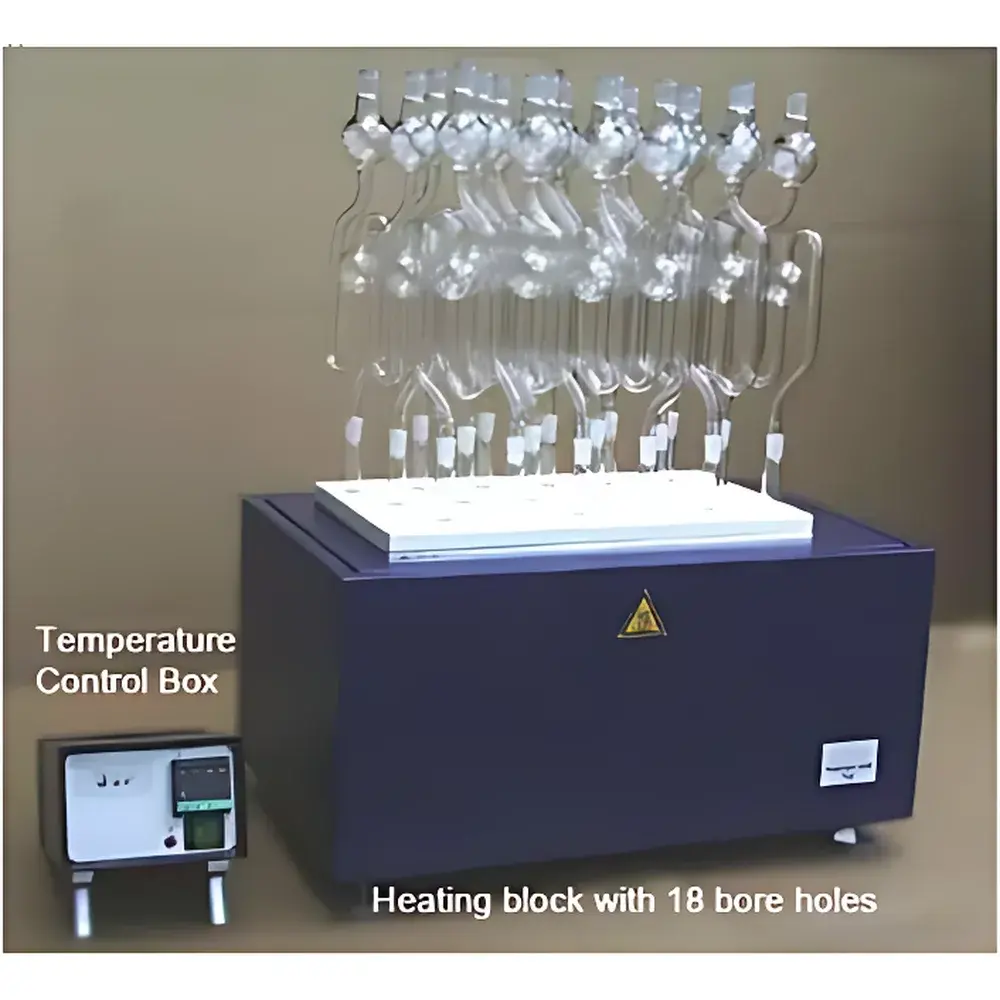
R&P Beckmann-Junk Stability Analyzer
| Brand | R&P |
|---|---|
| Origin | Germany |
| Manufacturer Status | Authorized Distributor |
| Origin Category | Imported |
| Model | Beckmann-Junk Method |
| Price Range | USD 27,000 – 68,000 |
Overview
The R&P Beckmann-Junk Stability Analyzer is a precision-engineered thermal stability assessment system designed exclusively for the quantitative evaluation of chemical stability in energetic materials. It operates on the internationally recognized Beckmann-Junk method (DIN 51739, STANAG 4147, NATO AOP-32), which relies on controlled thermal decomposition under standardized conditions to quantify nitrogen oxide (NOx) evolution from nitrocellulose, nitro compounds, and single- or double-base propellants. The instrument subjects precisely weighed samples to isothermal heating at either 120 °C or 132 °C for defined durations (typically 40–120 min), and measures the volumetric yield of gaseous nitrogen oxides—primarily NO2—collected in dual-sphere absorption flasks. This volumetric endpoint directly correlates with the material’s inherent decomposition kinetics and serves as a critical pass/fail metric in propellant qualification, lot acceptance testing, and long-term storage surveillance per MIL-STD-202, DEF STAN 00-13, and ISO 11925-2 compliance frameworks.
Key Features
- Modular aluminum heating block with ISO-certified thermal insulation, enabling uniform heat distribution across all 18 sample positions
- Precise temperature control via PID-regulated digital controller (separate control unit), maintaining ±0.1 °C stability over the full operating range (ambient to 135 °C)
- Integrated PT100 platinum resistance thermometer for real-time, traceable temperature monitoring and feedback
- Dual-safety architecture: hardware-based overtemperature cutoff set at 150 °C, plus software-enforced upper limit enforcement
- Digitally displayed actual and setpoint temperatures with 0.1 °C resolution
- Optimized sample geometry support: 18 cylindrical sample tubes (Ø19.0 ± 0.5 mm × 270 ± 2 mm) with spherical caps, seated in 19.75 ± 0.2 mm diameter × 200 ± 0.2 mm deep wells
- Dedicated illumination system featuring low-glare fluorescent lamps calibrated to enhance visual detection of brownish NO2 vapor in absorption flasks—critical for manual titration endpoint confirmation
- Rigid, adjustable lamp mount ensuring reproducible optical alignment during colorimetric assessment
- Compliant power interface: 230 V AC / 50 Hz, 2400 VA nominal load; 2 m reinforced power cable with IEC 60320 C13 connector
Sample Compatibility & Compliance
The analyzer accommodates standard nitrocellulose formulations (e.g., NC-11, NC-12), nitroglycerin-based double-base propellants, nitroguanidine composites, and other thermally labile nitroaromatics. All tube dimensions, heating profiles, and collection protocols adhere strictly to DIN 51739 (Petroleum and related products — Determination of stability of nitrocellulose by the Beckmann-Junk method), ASTM D5630 (Standard Test Method for Nitrocellulose Stability), and NATO AOP-32 Annex B. Instrument design supports GLP-compliant operation when paired with documented SOPs, calibration logs (traceable to NIST or DAkkS-accredited standards), and operator training records. Temperature controller firmware retains audit trails for setpoint changes and runtime events.
Software & Data Management
While the core Beckmann-Junk method is analog in execution (volumetric gas collection + iodometric titration), the analyzer integrates digital temperature logging capability via optional RS-485/Modbus RTU output (available upon request). When connected to validated laboratory data management systems (LIMS), time-stamped temperature profiles, operator IDs, and run metadata can be archived in accordance with 21 CFR Part 11 requirements. Calibration certificates for PT100 sensors and thermal uniformity mapping reports are supplied with each unit to satisfy ISO/IEC 17025 accreditation needs.
Applications
- Stability screening of newly synthesized propellant batches prior to ballistic testing
- Accelerated aging studies for shelf-life prediction of military-grade explosives
- Comparative analysis of stabilizer efficacy (e.g., diphenylamine, ethyl centralite) in nitrocellulose matrices
- Regulatory submission testing for UN Class 1.1–1.4 hazard classification
- Quality assurance in production facilities manufacturing smokeless powder and rocket motor grains
- Forensic examination of degraded energetic materials in post-incident investigations
FAQ
What standards does the R&P Beckmann-Junk Stability Analyzer comply with?
It conforms to DIN 51739, ASTM D5630, STANAG 4147, NATO AOP-32, and ISO 11925-2 for thermal stability assessment of nitrocellulose and related propellants.
Is temperature calibration traceable to national standards?
Yes—each unit ships with a DAkkS-accredited calibration certificate for the integrated PT100 sensor, valid for 12 months from date of issue.
Can the instrument operate continuously at 132 °C for extended periods?
Yes—the heating block and insulation system are rated for continuous operation up to 135 °C with thermal drift <0.05 °C/hour under steady-state conditions.
Are replacement sample tubes and dual-sphere absorption flasks available as consumables?
Yes—R&P supplies certified glassware sets (ISO 3585 borosilicate, annealed, individually inspected) with dimensional verification reports.
Does the system require external gas supply or vacuum source?
No—all tests are conducted under ambient atmospheric pressure; gas evolution is measured volumetrically using water displacement or calibrated burette systems.





