
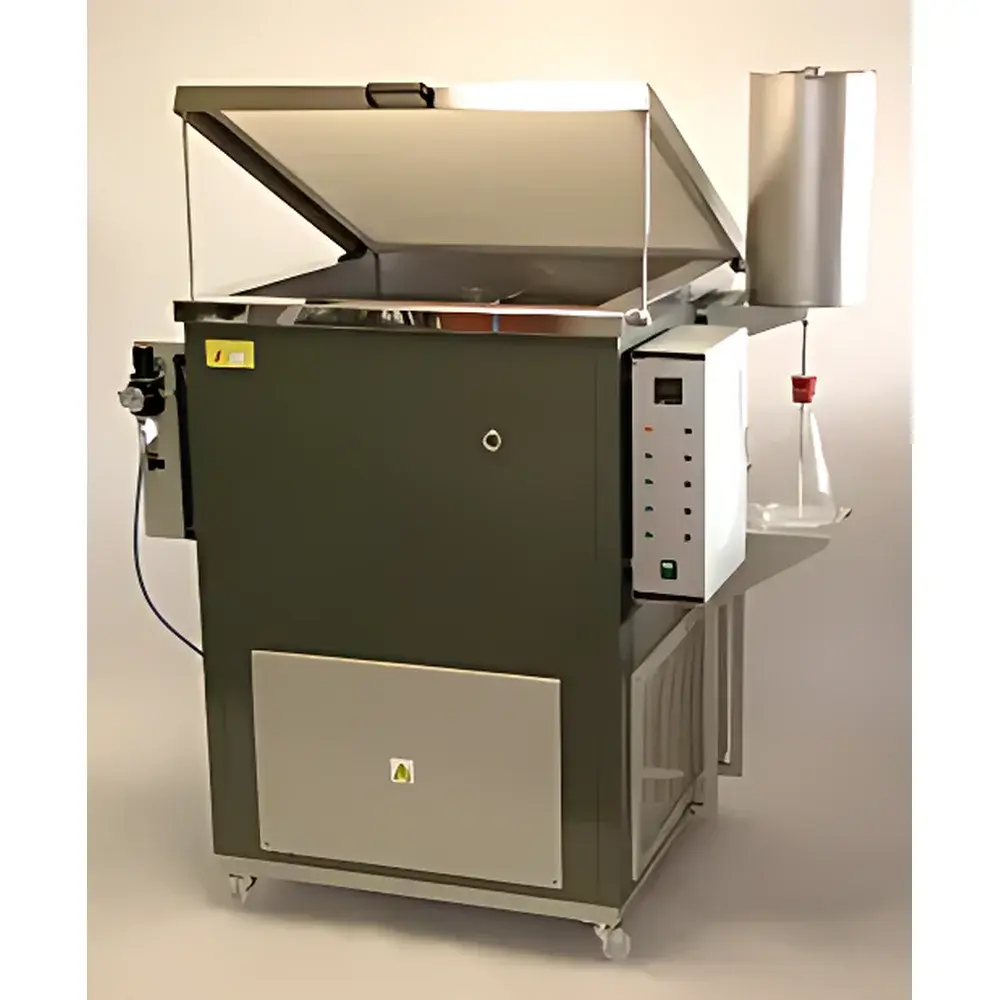
English Product Name
| Origin | Italy |
|---|---|
| Manufacturer Type | Authorized Distributor |
| Origin Category | Imported |
| Model | AD1748 |
| Pricing | Upon Request |
| Power Supply | 220 V / 50 Hz, 1500 W |
| Dimensions (L×W×H) | 850 × 750 × 1100 mm |
| Weight | 140 kg |
| Temperature Control Accuracy | ±0.5 °C at 48.9 °C |
| Temperature Resolution | 0.1 °C |
| Rotational Speed | 0.33 rpm |
| Air Flow Range | 0–1200 L/h (calibrated glass rotameter, 250 mm scale) |
| Air Pressure Range | 0–400 kPa (adjustable regulator with analog gauge) |
| Water Level Control | Automatic (optional AD1748-A00) |
| Air Diffusion | 20 alumina-based air diffusers in circular array |
| Compliance | ASTM D1748, IP 366 |
Overview
The Anton Paar AD1748 Humidity-Controlled Rust Characteristics Tester is a precision-engineered instrument designed to evaluate the rust-inhibiting performance of petroleum products—particularly turbine oils, hydraulic fluids, and lubricating oils—under standardized humid conditions. It operates on the principle of controlled atmospheric corrosion testing, where test specimens (typically polished steel strips) are immersed in the sample oil and exposed to a regulated humid air stream at a defined temperature (typically 48.9 °C per ASTM D1748). The system maintains a stable water-saturated air environment through integrated humidity generation, precise thermal regulation, and uniform air diffusion—enabling reproducible assessment of rust formation over prescribed durations (e.g., 24 h or 48 h). Its vertical architecture minimizes footprint while optimizing thermal stability and mechanical symmetry during rotation, ensuring consistent film thickness and interfacial exposure across all test coupons.
Key Features
- Stainless-steel chamber with ceramic-coated structural components for long-term resistance to moisture-induced degradation and chemical exposure.
- Vertical rotary platform driven by a gear-reduced motor, delivering constant 0.33 rpm rotation to ensure uniform oil film distribution and dynamic air–oil–metal interface interaction.
- Integrated stainless-steel water bath with drain valve, level-sensing float mechanism (standard), and optional automatic water-level regulation (AD1748-A00).
- Pt100 RTD sensor coupled with microprocessor-based PID temperature controller; digital display with 0.1 °C resolution and ±0.5 °C stability at 48.9 °C.
- Dual safety circuitry: independent overtemperature cutoff and low-water-level shutdown to prevent dry-heating or thermal runaway.
- Circular diffuser assembly comprising 20 alumina nozzles, engineered to deliver laminar, low-velocity humid air flow across the specimen surface without turbulence-induced splashing or uneven condensation.
- Modular air supply subsystem including particulate filter, pressure regulator, calibrated 0–400 kPa analog gauge, high-accuracy 250-mm glass rotameter (0–1200 L/h), and optional built-in air pump (AD1748-A01).
- Double-layer cotton gasketed lid to minimize ambient moisture ingress while permitting passive vapor exchange in accordance with test protocol requirements.
Sample Compatibility & Compliance
The AD1748 is validated for use with standard ASTM D1748 and IP 366 test procedures, supporting evaluation of rust-preventive additives in mineral- and synthetic-based lubricants. It accommodates standard 76 mm × 12.7 mm × 1.5 mm polished steel test strips (ASTM A29 Grade 1010), mounted horizontally on the rotating stage. The instrument’s design ensures full compliance with GLP documentation requirements: temperature logs, runtime tracking, and air-flow verification can be recorded manually or interfaced via external data acquisition systems. While not inherently 21 CFR Part 11 compliant, its operational traceability—combined with optional calibration tools (CAL001/CAL002 PT100 simulators)—supports audit-ready validation under ISO/IEC 17025-accredited laboratory environments.
Software & Data Management
The AD1748 operates as a standalone hardware platform with no embedded software or touchscreen interface. All control logic resides in the microprocessor-based thermostat module, which provides real-time digital temperature readout and alarm status indication. For laboratories requiring electronic recordkeeping, optional third-party data loggers may be connected to the Pt100 output or auxiliary relay contacts to capture time-stamped temperature, runtime, and fault events. Calibration certificates for the rotameter and RTD probe are supplied with each unit; traceable recalibration services are available through Anton Paar’s global service network. Firmware updates are not applicable—hardware-level stability ensures long-term method equivalence across instrument lifecycles.
Applications
This tester is routinely deployed in refinery QC labs, lubricant formulation centers, and independent testing facilities to assess: rust inhibition efficacy of additive packages; batch-to-batch consistency of finished turbine oils; oxidative stability impact on corrosion protection; and comparative performance of biodegradable hydraulic fluids under ASTM-defined humidity stress. It also supports research into water-in-oil emulsion behavior, interfacial tension effects on metal passivation, and synergistic interactions between rust inhibitors and demulsifiers. Its robust mechanical design and adherence to legacy test standards make it suitable for regulatory submissions requiring historical method continuity.
FAQ
Does the AD1748 include an integrated air compressor?
No—the base configuration requires an external compressed air source. An optional internal air pump (AD1748-A01) is available as an add-on module.
Can the instrument be operated at temperatures other than 48.9 °C?
Yes—while optimized for the ASTM D1748 reference temperature, the PID controller supports setpoints from ambient to 60 °C, subject to validation per internal SOPs.
Is the water level regulation system mandatory?
No—it is optional (AD1748-A00); manual refilling via the bath faucet is fully supported and commonly used in routine testing.
What maintenance intervals are recommended for the air filtration system?
The particulate filter should be inspected weekly and replaced every 3 months under continuous operation; the rotameter glass tube requires periodic cleaning with isopropanol to maintain flow accuracy.
Are replacement test strips and calibration standards supplied by Anton Paar?
Anton Paar supplies the instrument only; certified steel strips and reference oils must be sourced from ASTM-accredited material suppliers (e.g., Precision Scientific, Petrotest).



