
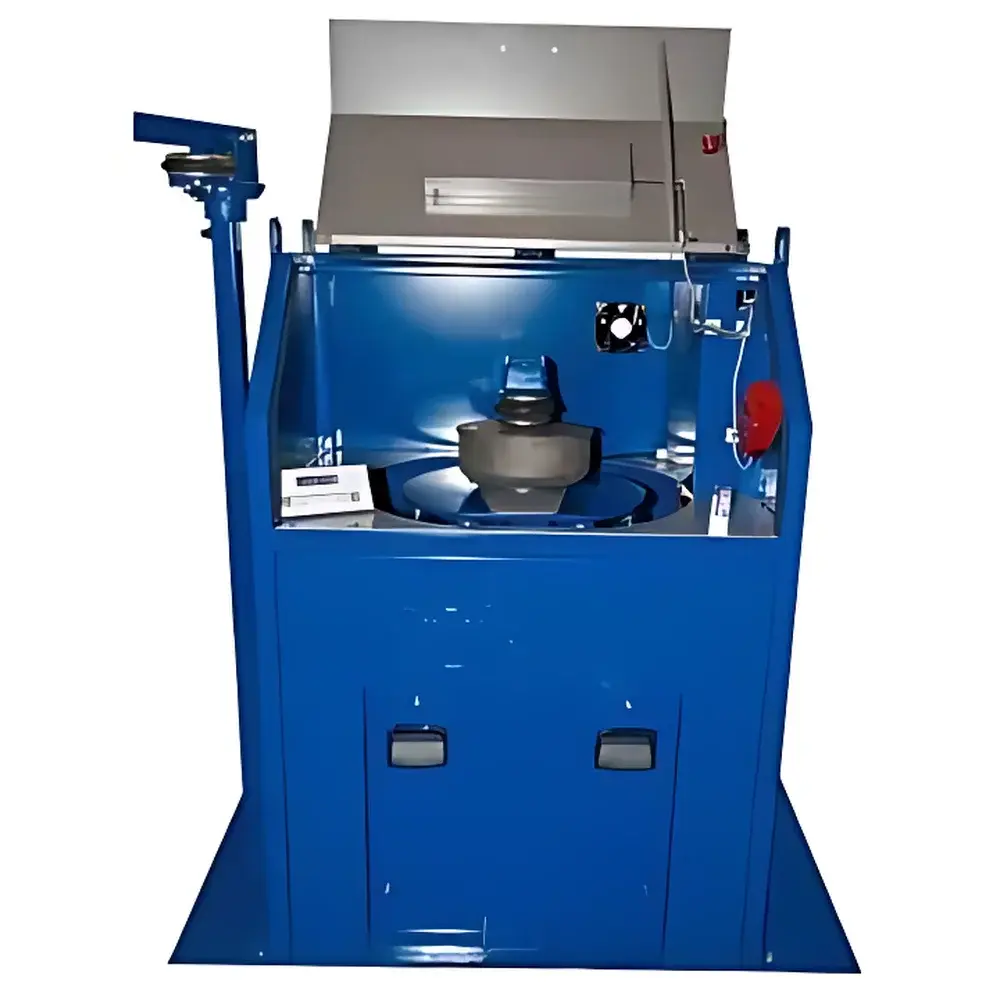
Leyman LM2000-P Vibratory Disc Grinder
| Origin | Netherlands |
|---|---|
| Manufacturer Type | Authorized Distributor |
| Origin Category | Imported |
| Model | LM2000-P |
| Instrument Type | Vibratory Disc Grinder |
| Sample Applicability | Hard and Brittle Solids |
| Feed Size | < 20 mm |
| Final Particle Size | < 38 µm |
| Output Granularity | < 0.01 mm |
| Batch Capacity | 50 mL – 2000 mL |
Overview
The Leyman LM2000-P Vibratory Disc Grinder is an industrial-grade, high-energy mechanical comminution system engineered for rapid, reproducible size reduction of hard, brittle, and refractory materials. Operating on the principle of vibratory disc grinding, it utilizes controlled high-frequency oscillation (up to 900 rpm) to drive a rotating grinding disc against stationary concentric grinding rings—generating combined compressive, impact, and shear forces within the grinding chamber. This mechanism enables efficient particle size reduction without significant thermal load or phase alteration, making it especially suitable for preparation of analytical samples where structural integrity and chemical homogeneity are critical. Designed for laboratory and pilot-scale applications, the LM2000-P delivers consistent sub-38 µm output from feed material up to 20 mm in maximum dimension—meeting stringent requirements for X-ray fluorescence (XRF), infrared (IR) spectroscopy, and geochemical analysis workflows.
Key Features
- High-efficiency vibratory disc architecture with dual concentric grinding rings and a single hardened steel grinding disc—optimized for energy transfer and wear resistance.
- Adjustable amplitude and rotational speed (0–900 rpm) to fine-tune grinding intensity for diverse material hardness profiles—from quartz and feldspar to ferroalloys and sintered ceramics.
- Batch processing capability ranging from 50 mL to 2000 mL, supporting both small-volume precision prep and larger throughput needs without compromising fineness uniformity.
- Robust stainless-steel grinding chamber with sealed design to prevent cross-contamination and ensure operator safety during dry or slurry-based grinding.
- Integrated vibration damping system and low-noise enclosure compliant with ISO 5349-1 for hand-arm vibration exposure limits.
- No external cooling required; thermally stable operation maintains sample integrity for heat-sensitive matrices such as sulfides or hydrated minerals.
Sample Compatibility & Compliance
The LM2000-P is validated for grinding hard, brittle, and moderately abrasive solids—including coal, iron ore, blast furnace slag, Portland cement clinker, cast iron, tungsten carbide, alumina ceramics, and geological reference materials. It supports both dry grinding and wet grinding in aqueous or organic suspensions. All contact parts comply with ASTM E1772 for laboratory equipment construction materials, and the unit meets CE Machinery Directive 2006/42/EC and RoHS 2011/65/EU requirements. For regulated environments (e.g., ISO/IEC 17025-accredited labs), the grinder’s mechanical repeatability and documented process parameters support traceable sample preparation SOPs aligned with ISO 13320 (laser diffraction) and ISO 10119 (mineralogical sample preparation) standards.
Software & Data Management
While the LM2000-P operates via analog control interface (digital tachometer + mechanical timer), its operational parameters—including speed setpoint, runtime, and batch volume—are fully loggable in lab information management systems (LIMS) when integrated via optional 4–20 mA analog output or RS-485 Modbus RTU protocol. The device supports GLP-compliant documentation through external electronic lab notebooks (ELNs), enabling audit-ready records of grinding conditions per sample batch. No proprietary software is required; configuration and calibration data adhere to vendor-provided technical specifications and are compatible with FDA 21 CFR Part 11–enabled platforms when paired with validated third-party acquisition modules.
Applications
- Preparation of homogeneous powders for XRF and ICP-OES analysis of metallurgical slags, ores, and alloys.
- Routine pulverization of cement and concrete aggregates to <38 µm for Blaine surface area testing (ASTM C204).
- Production of IR-transparent KBr pellets requiring ultra-fine, low-agglomeration particle distributions.
- Geochemical sample homogenization prior to leaching or fusion procedures under ISO 12743 and USP .
- Particle size standardization in quality control labs serving ceramic, refractory, and advanced materials manufacturing.
FAQ
What types of materials are unsuitable for the LM2000-P?
Soft, fibrous, elastic, or highly ductile materials—such as polymers, rubber, or copper metal chips—are not recommended due to insufficient brittleness for effective vibratory fracture.
Can the LM2000-P be used for cryogenic grinding?
No. The system is not equipped with liquid nitrogen ports or thermal insulation; it is designed for ambient-temperature operation only.
Is the grinding chamber interchangeable between dry and wet modes?
Yes. The stainless-steel chamber and sealing gaskets are chemically resistant to water, ethanol, and common solvents; however, thorough cleaning and drying are required between mode transitions.
How often does the grinding disc require replacement?
Under typical use with siliceous or metallic samples, the hardened disc maintains dimensional stability for ≥500 operational hours; wear inspection is advised every 100 hours via micrometer measurement per ISO 14644-1 cleanroom maintenance protocols.
Does the LM2000-P meet explosion-proof requirements for volatile solvent grinding?
Not by default. ATEX-certified versions are available upon request with modified motor housings and static-dissipative components—subject to additional lead time and validation documentation.



