
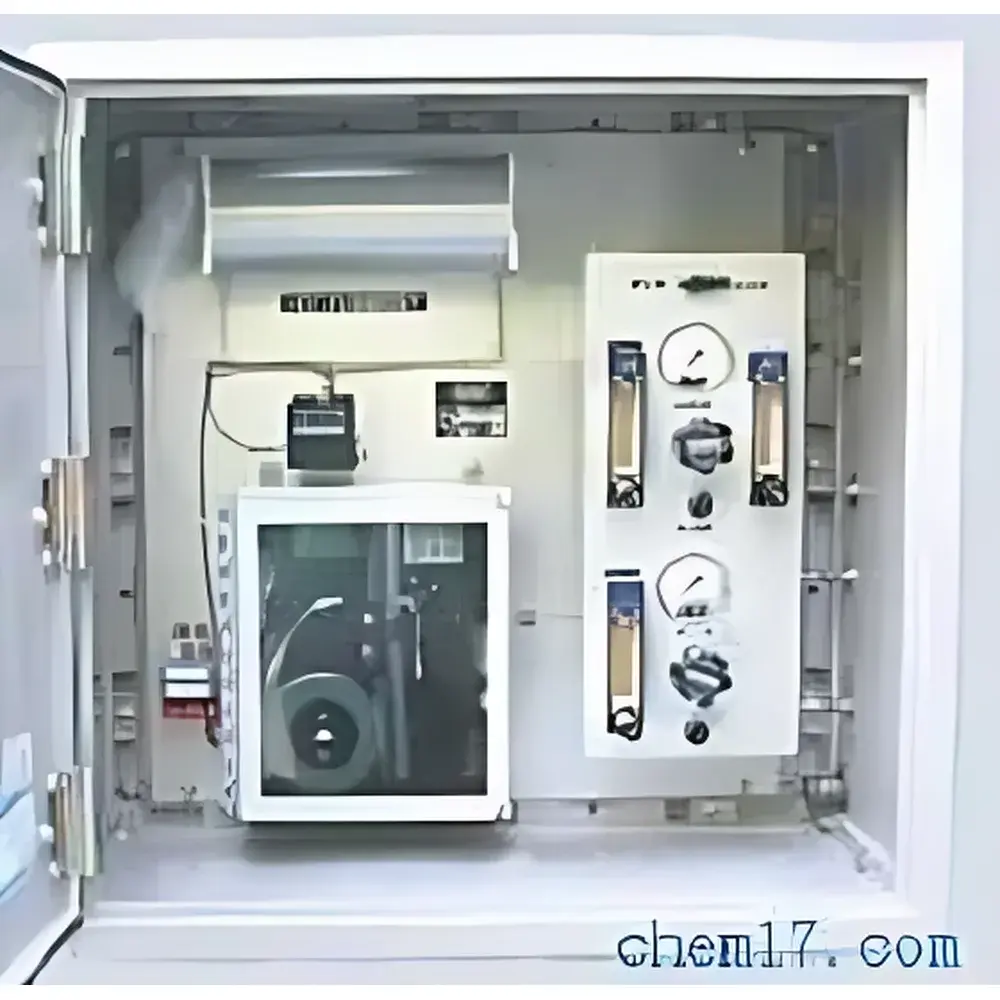
Thermo Scientific 1600 Online Total Sulfur Analyzer
| Origin | France |
|---|---|
| Manufacturer Type | Authorized Distributor |
| Origin Category | Imported Instrument |
| Model | 1600 |
| Pricing | Available Upon Request |
| Power Supply | 220 V / 50 Hz |
| Operating Temperature | 5–50 °C |
| Storage Temperature | –10–70 °C |
| Sulfur Detection Range | 1 ppb to 100 wt% (user-configurable) |
| Resolution | 1 ppb |
| Accuracy | ±2% of full scale |
| Repeatability | ±1% of full scale |
| Linearity | ±1% of full scale |
| Drift | <1% FS/24 h |
| Temperature Coefficient | 0.01% / °C |
| Analysis Time | <1 s per measurement |
| Interference Resistance | None (non-dispersive UV fluorescence principle) |
| Alarm Outputs | Solid-state 30 mA @ 24 V DC or mechanical relay 5 A @ 220 V AC (NO/NC configurable) |
| Display | 128 × 64 pixel monochrome LCD |
| Analog Output | Standard 4–20 mA (single channel), optional dual 4–20 mA |
| Optional Accessories | Auto-calibration module, heated sample probe & flow regulator, chemiluminescence trigger interface, data logger, process heater & temperature controller, RS-232/RS-485 serial interface, signal junction box |
| Hazardous Area Certification Options | Class I, Div. 2, Groups A–D (1700-series enclosure) |
| Dimensions (W×D×H) | 127 × 30 × 76 cm |
| Weight | 90 kg |
Overview
The Thermo Scientific 1600 Online Total Sulfur Analyzer is a continuous emission monitoring system engineered for real-time quantification of total sulfur content in liquid and gaseous hydrocarbon streams. It operates on the principle of ultraviolet fluorescence (UVF), where sulfur-containing compounds—after high-temperature oxidative combustion at ≥1000 °C—are converted to excited-state SO₂ molecules. Upon relaxation, these molecules emit characteristic UV photons (λ ≈ 300–400 nm), which are detected by a low-noise photomultiplier tube. This method ensures elemental specificity for sulfur without cross-sensitivity to nitrogen, chlorine, or hydrocarbons—critical for refinery feedstock screening, hydrotreater effluent monitoring, and finished fuel compliance verification against ASTM D5453, ISO 20846, and U.S. EPA Method PS-15. Designed for integration into distributed control systems (DCS) or programmable logic controllers (PLC), the 1600 delivers sub-second analytical response with trace-level resolution, supporting regulatory reporting under Tier II and EU Fuel Quality Directive (2009/30/EC). Its robust architecture accommodates variable pressure, viscosity, and particulate load typical of crude assay lines, FCC off-gas, or LPG streams.
Key Features
- UV fluorescence detection with zero chemical interference—no quenching agents or reagent consumption required
- User-defined dynamic range spanning 1 ppb to 100 wt%, enabling seamless transition from ultra-low-sulfur diesel (ULSD) to sour crudes
- Stability-critical thermal management: furnace temperature maintained within ±1 °C; optical chamber actively temperature-compensated
- Dual alarm output architecture supporting both safety instrumented systems (SIS) and process control loops
- Modular hardware design compliant with IEC 61508 SIL-2 functional safety requirements when configured with certified relays
- Embedded diagnostics including lamp intensity monitoring, detector gain tracking, and combustion efficiency validation
Sample Compatibility & Compliance
The 1600 accepts liquid samples (viscosity ≤ 100 cSt at 40 °C) and gases (up to 1 MPa pressure) via standardized 1/4″ Swagelok fittings. Integrated sample conditioning includes particulate filtration (5 µm absolute), moisture removal (Peltier-cooled condenser), and pressure regulation (0.1–1.0 bar gauge). All wetted parts are constructed from Hastelloy C-276 and fused silica to resist sulfidic corrosion. The analyzer meets EN 61000-6-2 (immunity) and EN 61000-6-4 (emissions) for industrial environments. Hazardous area variants carry ATEX Directive 2014/34/EU certification (II 2G Ex d IIB T4 Gb) and UL/cUL Class I, Div. 1 approval. Data integrity complies with FDA 21 CFR Part 11 requirements when paired with Thermo’s optional audit-trail-enabled software package.
Software & Data Management
The embedded firmware supports Modbus TCP/IP and HART 7 protocols for native DCS integration. Local configuration and trend review are accessible via the front-panel LCD or optional web interface (HTTPS-enabled). Raw concentration values, diagnostic flags, and calibration logs are timestamped with UTC synchronization. Historical data export follows CSV/ASCII format compatible with LIMS platforms such as LabWare LIMS or Thermo Fisher SampleManager. Optional Thermo Scientific Insight™ software provides automated calibration scheduling, drift correction modeling, and statistical process control (SPC) charting aligned with ISO 9001 clause 8.5.1.
Applications
- Continuous monitoring of desulfurized naphtha and kerosene in hydrotreating units
- Real-time verification of sulfur speciation in fluid catalytic cracking (FCC) gasoline blenders
- Compliance testing for marine fuel (IMO 2020 sulfur cap: 0.50 wt%) at bunkering terminals
- Quality assurance of sulfur-free solvents used in pharmaceutical excipient synthesis
- Research-grade kinetic studies of sulfur removal catalysts under varying H₂ partial pressures
FAQ
Does the 1600 require daily calibration?
No—calibration interval is determined by application severity and regulatory scope. Under stable refinery conditions, quarterly multi-point calibration using NIST-traceable standards suffices. Auto-calibration kits extend intervals to six months.
Can it measure organosulfur compounds without prior separation?
Yes. UVF detects total sulfur regardless of molecular structure (e.g., mercaptans, sulfides, thiophenes, sulfoxides) after complete oxidative conversion to SO₂.
Is the analyzer compatible with sour gas containing H₂S above 10,000 ppm?
Yes, provided sample dilution is applied upstream; the standard combustion zone handles up to 5,000 ppm H₂S directly. Higher concentrations require certified dilution modules meeting API RP 14C requirements.
What maintenance tasks are required quarterly?
Replacement of quartz combustion tube (if exposed to >500 ppm vanadium), cleaning of UV window with spectroscopic-grade methanol, and verification of ozone generator output stability.
How is data security enforced during remote access?
SSHv2 encryption, role-based user authentication (RBAC), and write-protected audit trails prevent unauthorized modification of calibration parameters or historical records.






