
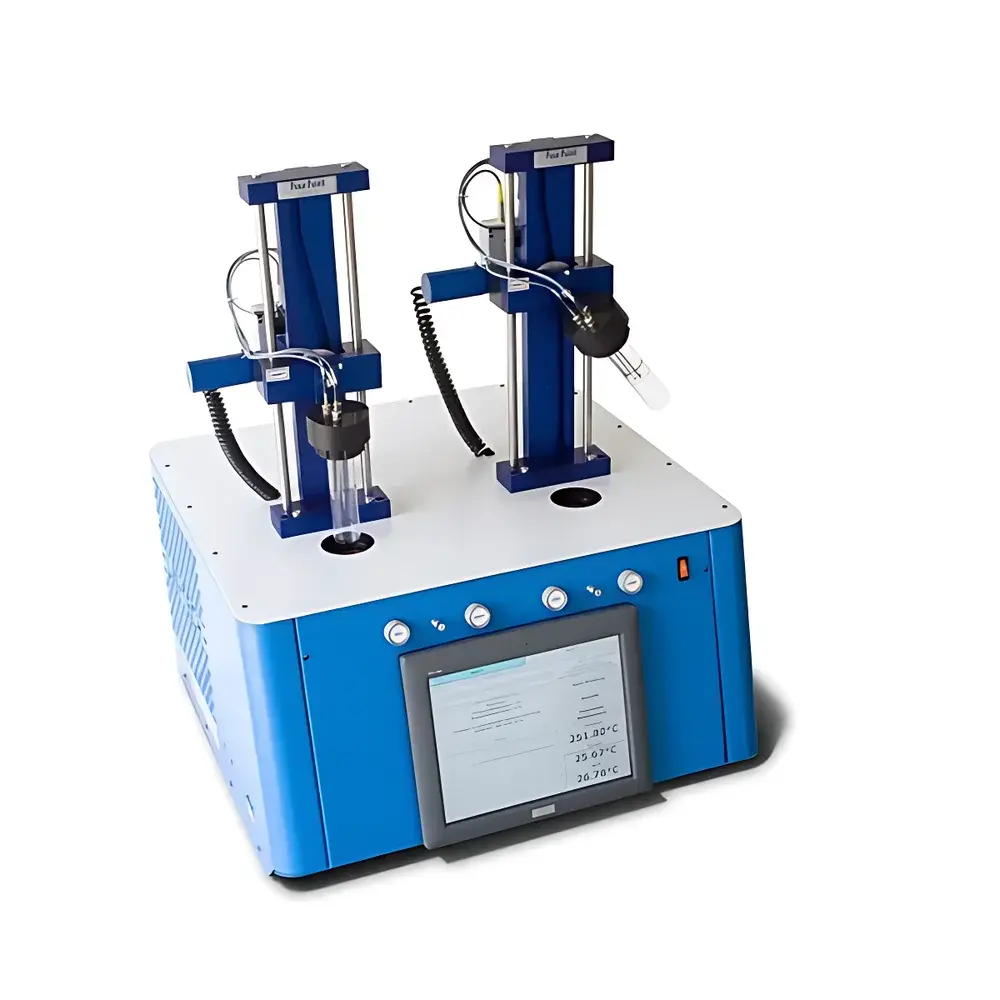
Linetechnic NewLab 300/2 Automatic Pour Point Analyzer
| Brand | Linetechnic |
|---|---|
| Origin | Switzerland |
| Model | NewLab 300/2 |
| Temperature Range | +80 °C to –80 °C |
| Cooling System | Dual-stage compressor |
| Temperature Sensor | PT100 Class A |
| Temperature Resolution | 0.06 °C |
| Temperature Accuracy | ±0.1 °C |
| Standards Compliance | ASTM D97, D5950, D5853 |
| Sample Capacity | Dual PT100 surface probes, standardized test tube per ASTM/IP/ISO |
| Software | LabLink (Windows-compatible), supports up to 10 analysis heads, LIMS- and Excel-compatible data export, audit-trail-capable calibration logging |
Overview
The Linetechnic NewLab 300/2 Automatic Pour Point Analyzer is a precision-engineered instrument designed for the standardized determination of the pour point of petroleum-based liquids—including crude oil, refined fuels, lubricants, biodiesel, and additive formulations—according to internationally recognized test methods. The pour point is defined as the lowest temperature at which a sample remains fluid under specified cooling and mechanical agitation conditions. This instrument implements a controlled, stepwise cooling protocol coupled with automated mechanical tilting and surface-contact thermal detection to objectively identify the cessation of flow. Unlike manual or semi-automated systems, the NewLab 300/2 eliminates operator subjectivity by replacing visual inspection with real-time thermal response detection via dual Class A platinum resistance thermometers (PT100) positioned directly on the sample surface. Its architecture integrates thermodynamic rigor with regulatory-grade reproducibility, making it suitable for routine QC laboratories, refinery process control environments, and R&D facilities requiring GLP-compliant data integrity.
Key Features
- Dual-stage refrigeration system achieving stable operation down to –80 °C, enabling full-range analysis of high-wax-content crudes and low-temperature diesel formulations.
- Automated sample handling: programmable mechanical arm lifts and tilts the standardized test tube to horizontal orientation at user-defined temperature intervals, ensuring consistent mechanical stimulus per ASTM D97 and ISO 3016.
- Surface-flow detection using two independent PT100 Class A sensors mounted in direct contact with the sample meniscus—providing unambiguous, non-optical confirmation of flow arrest.
- Integrated safety architecture: pressure-controlled dual-compressor monitoring, thermal cut-off valves for jacketed cooling zones, internal overload protection, and CE-certified electrical design (220 V ±15 %, 50/60 Hz).
- High-resolution thermal measurement: 0.06 °C resolution and ±0.1 °C accuracy across the full operating range (+80 °C to –80 °C), validated against NIST-traceable references.
- Robust mechanical construction: silver-plated test tube base with anti-scratch protective film; precision-machined tube holder with top clamping mechanism ensuring repeatable positioning and thermal contact stability.
Sample Compatibility & Compliance
The NewLab 300/2 accommodates a broad spectrum of petroleum-derived samples, including but not limited to: base oils, engine oils, hydraulic fluids, jet fuel (Jet A-1, JP-8), marine distillates, biofuels (FAME, HVO), and untreated crude fractions. All test protocols adhere strictly to the procedural requirements of ASTM D97 (Standard Test Method for Pour Point of Petroleum Products), ASTM D5950 (for waxy crudes), ASTM D5853 (for used lubricants), IP 15 and IP 441 (Institute of Petroleum standards), and ISO 3016 (Petroleum products — Determination of pour point). The instrument’s hardware configuration—including tube geometry, immersion depth, and cooling rate profiles—is pre-validated to meet dimensional and thermal specifications outlined in these standards. It supports both standard and research-grade methodologies, including constant ΔT (sample-to-bath differential) and variable cooling-rate protocols, facilitating method development and correlation studies.
Software & Data Management
LabLink software provides a secure, Windows-based platform for full instrument control, method definition, calibration management, and traceable data handling. Designed for regulated environments, it supports 21 CFR Part 11–compliant user authentication, electronic signatures, and immutable audit trails for all calibration events, parameter changes, and result generation. Each PT100 probe undergoes automatic calibration with date-stamped records, graphical deviation plots, and optional offset compensation. Up to 10 analysis heads can be managed concurrently. Data are stored in native CSV and Excel-compatible formats, with a capacity exceeding 60,000 individual test records. Integrated LIMS connectivity enables seamless transfer of raw and processed results—including temperature vs. time curves, pour point assignment, and operator metadata—into enterprise laboratory information systems. Reporting templates are fully customizable, supporting QA/QC documentation, certificate of analysis generation, and batch release workflows.
Applications
- Refinery quality assurance: verification of pour point specifications for finished fuels prior to shipment.
- Lubricant formulation development: screening wax inhibitors and cold-flow improvers under controlled thermal gradients.
- Crude assay laboratories: characterizing paraffin deposition risk in pipeline transport and storage scenarios.
- Biodiesel certification: compliance testing per EN 14214 and ASTM D6751 for low-temperature operability.
- Regulatory submissions: generating auditable, standards-aligned data for EPA, ECHA, or national petroleum product registration dossiers.
- Research into structure–property relationships: correlating pour point with SARA (saturates, aromatics, resins, asphaltenes) composition and wax crystallization kinetics.
FAQ
What standards does the NewLab 300/2 validate against?
ASTM D97, D5950, D5853; IP 15, IP 441; ISO 3016; and EN 14214 (for biodiesel applications).
Can the instrument perform both pour point and cloud point measurements?
No—the NewLab 300/2 is dedicated exclusively to pour point determination. Cloud point requires distinct optical detection hardware and is not supported.
Is remote monitoring or network integration possible?
Yes. LabLink supports TCP/IP communication and can be integrated into local area networks for centralized monitoring and scheduled reporting.
How is calibration traceability maintained?
Each PT100 probe is individually calibrated using NIST-traceable reference sources; calibration logs include date, technician ID, deviation values, and digital signature—retained indefinitely within the software database.
What maintenance is required for the dual-stage compressor?
Annual preventive maintenance is recommended, including refrigerant pressure verification, condenser coil cleaning, and thermal valve function testing—performed by Linetechnic-certified service engineers.



