
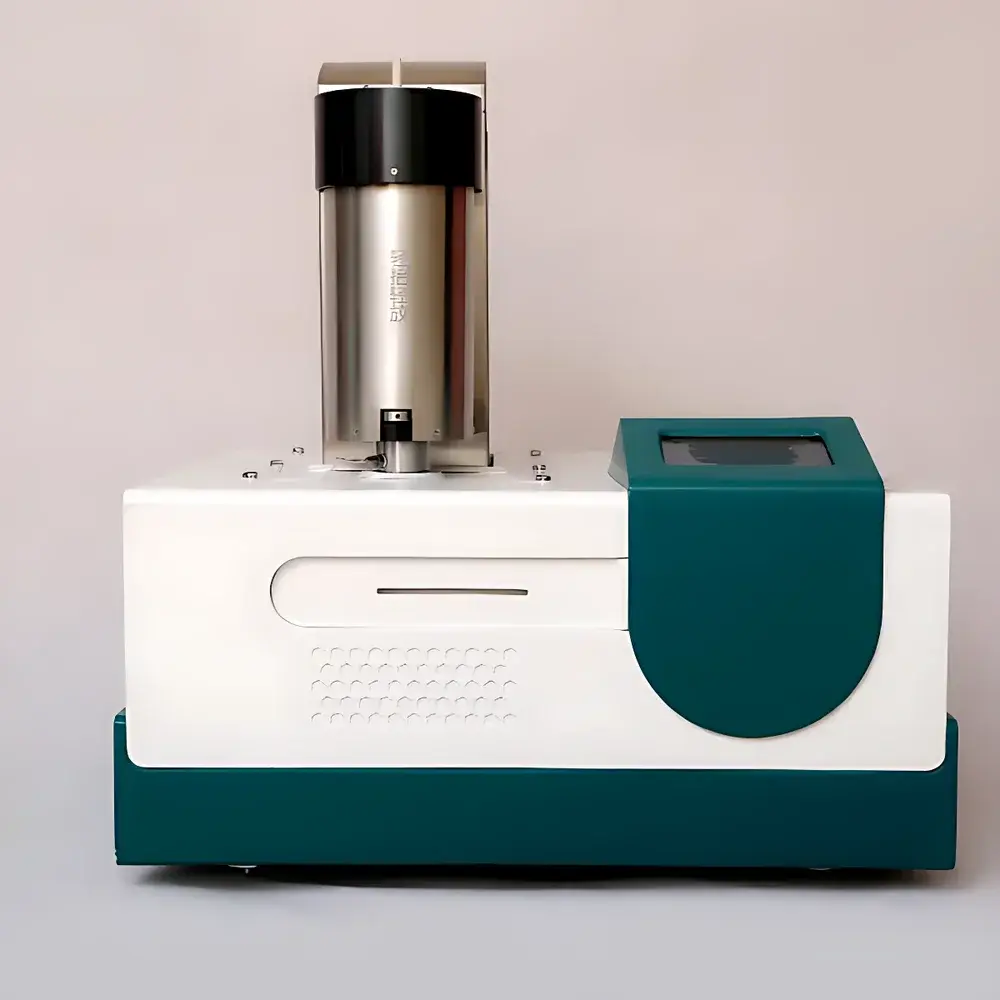
Henven HQG-2 Automated Thermogravimetric Analyzer
| Brand | Henven |
|---|---|
| Origin | Beijing, China |
| Manufacturer Type | Direct Manufacturer |
| Region of Origin | Domestic (China) |
| Model | HQG-2 |
| Operating Environment | Ambient Pressure |
| Sample Capacity | Single Sample |
| Instrument Type | General-Purpose |
| Temperature Range | Room Temperature to 1250 °C |
| Temperature Accuracy | ±0.1 °C |
| Temperature Precision | ±0.1 K |
| Dynamic Weighing Range | 0.01 mg to 5 g |
| Balance Sensitivity | 0.1 µg |
| Mass Accuracy | 0.1 µg |
| Heating/Cooling Rate | 0.1–100 K/min |
| Maximum Sample Mass | 5 g |
| Baseline Repeatability | 0.01 mg |
| Baseline Drift | 0.01 mg |
Overview
The Henven HQG-2 Automated Thermogravimetric Analyzer is a high-stability, microbalance-integrated thermal analysis system engineered for precision measurement of mass change as a function of temperature or time under controlled atmospheric conditions. Based on the fundamental principle of thermogravimetry (TGA), the instrument subjects a sample to a programmable thermal profile while continuously monitoring mass variation using a high-resolution electromagnetic force compensation balance. This enables quantitative detection of physical transitions (e.g., desorption, sublimation, volatilization) and chemical reactions (e.g., decomposition, oxidation, reduction, dehydration) with trace-level sensitivity. Designed for rigorous laboratory environments—including R&D centers, QC/QA laboratories, and academic research facilities—the HQG-2 delivers reproducible data across extended temperature ranges up to 1250 °C, supporting method development and validation in compliance with ISO 11358, ASTM E1131, and USP guidelines for thermal analysis.
Key Features
- Integrated furnace-lift mechanism with precise vertical positioning ensures consistent sample geometry relative to thermocouple and gas flow, enhancing inter-run reproducibility.
- Dual thermocouple configuration: one continuously monitors furnace block temperature (active at all times); the second measures actual sample temperature during operation, enabling real-time differential thermal feedback.
- Mass flow controller (MFC)-based dual-gas atmosphere system supports seamless switching between inert (N₂, Ar), oxidative (air, O₂), or reducing (H₂, CO) environments; optional corrosion-resistant MFCs available for HCl, SO₂, NH₃, or HF service.
- Modular crucible support system accommodates standardized ceramic, aluminum, quartz, graphite, and platinum crucibles (Φ5×4 mm to Φ18×20 mm), with adjustable rod assemblies enabling full 0.01 mg–5 g dynamic weighing range.
- Auto-ranging microbalance with 0.1 µg resolution and <0.1 µg RMS noise floor, coupled with active drift compensation algorithms and baseline stabilization routines (≤0.01 mg drift over 60 min).
- Programmable isothermal holds up to 72 hours at any temperature point within the operating range, supporting long-term stability testing and kinetic modeling of slow degradation processes.
Sample Compatibility & Compliance
The HQG-2 accepts solid, powdered, granular, or thin-film samples across diverse material classes—including polymers, pharmaceutical excipients and APIs, catalysts, metal oxides, ceramics, composites, and geological specimens. Its wide dynamic mass range (0.01 mg–5 g) allows both micro-scale screening and macro-scale process validation. The system supports GLP/GMP-aligned workflows through audit-trail-enabled software, electronic signatures, and secure user access levels. Optional vacuum module (2.5×10⁻² Pa) extends applicability to low-pressure pyrolysis and volatile residue analysis. All hardware and firmware comply with IEC 61000-4 electromagnetic compatibility standards and CE safety directives.
Software & Data Management
The proprietary TGA Control Suite provides full instrument control, real-time visualization, and post-acquisition analysis. It supports simultaneous acquisition of TG, DTG (first derivative), and DDTG (second derivative) curves, with customizable axis scaling (temperature/time abscissa; absolute mass/% mass ordinate). Built-in calibration modules allow user-performed mass and temperature verification using NIST-traceable standards (e.g., Ni, Al₂O₃, CaC₂O₄·H₂O). Advanced analysis tools include multi-step decomposition fitting, activation energy calculation via Kissinger, Ozawa-Flynn-Wall, or Friedman methods, comparative overlay of up to 16 datasets, and customizable report generation compliant with 21 CFR Part 11 requirements (electronic records, signature authentication, change history logging).
Applications
- Quantitative determination of moisture, solvent residue, filler content, and ash yield in polymer formulations per ISO 3451 and ASTM D3172.
- Thermal stability assessment and decomposition kinetics of active pharmaceutical ingredients (APIs) under ICH Q1A(R3) stress conditions.
- Catalyst deactivation profiling via coke burn-off analysis in controlled O₂/N₂ mixtures.
- Oxidation onset temperature (OOT) and char yield evaluation of flame-retardant composites per UL 94 and ASTM E1358.
- Decomposition pathway mapping of battery electrode materials (e.g., LiCoO₂, NMC) under inert and air atmospheres.
- Residue analysis of coatings, adhesives, and sealants following thermal cycling protocols.
FAQ
What is the maximum recommended sample mass for optimal resolution?
For highest mass resolution (0.1 µg), samples ≤200 mg are recommended; the full 5 g capacity is intended for high-mass industrial samples where absolute weight loss % remains the primary metric.
Can the HQG-2 be interfaced with GC or MS systems?
Yes—optional heated transfer lines (up to 200 °C), GC/MS coupling adapters, and temperature-stabilized interface zones are available to enable evolved gas analysis (EGA) workflows.
Is temperature calibration traceable to national standards?
Yes—users may perform in-situ calibration using certified reference materials (CRMs) with documented NIST or PTB traceability; calibration certificates are generated within the software.
Does the system support purge gas switching during a single run?
Yes—dual MFCs allow automated, timed switching between two gases (e.g., N₂ → air) at user-defined temperature or time points without interrupting data acquisition.
What maintenance intervals are recommended for the microbalance and furnace?
Balance zero-point verification every 24 hours of operation; furnace insulation inspection annually; MFC recalibration every 6 months or after exposure to corrosive gases.



