
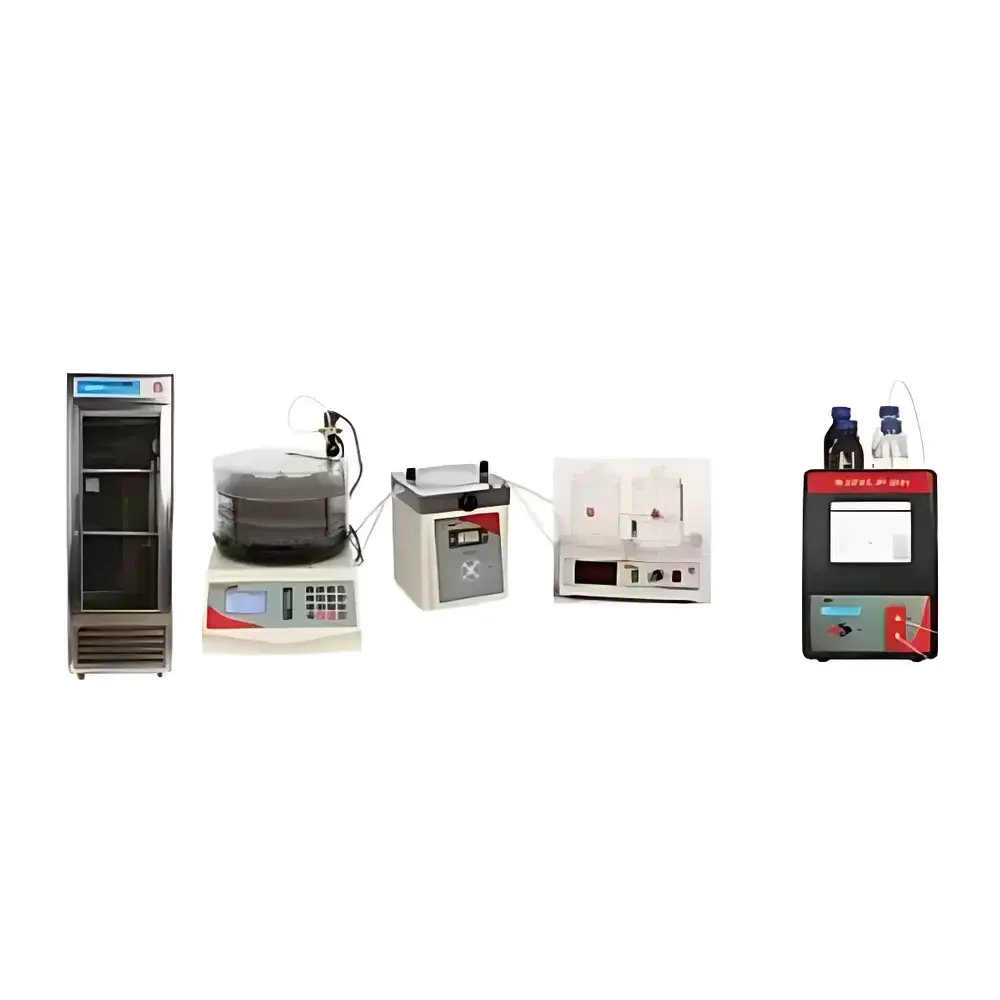
JP-2001-D-III Automated Low-Pressure Liquid Chromatography System
| Brand | JiaPeng |
|---|---|
| Origin | Shanghai, China |
| Model | 2001-D-III |
| Instrument Type | Low-Pressure Liquid Chromatograph (LPLC) |
| Detection Wavelengths | 260 nm & 280 nm (standard), optional 310 nm & 405 nm |
| UV Light Source | LED cold light source (lifetime >50,000 h) |
| Flow Rate Range | 2 × (0.5–900) mL/h |
| Pump Speed Control | 0–65 rpm |
| Gradient Volume Capacity | 1000 mL |
| Fraction Collection | 100 tubes × up to 12 mL/tube |
| Tube Programming | User-defined start number, 1–9999 drops or 0–100 mV peak threshold |
| Timing Range | 1 s – 199 h 59 min 59 s |
| Display | 10.1-inch high-definition blue-membrane LCD |
| Column Compatibility | GE-standard fittings (1.0×40 cm, 1.6×50 cm, 2.6×60 cm |
| Integrated Modules | JP-3001 dual-beam nucleic acid/protein detector, TH-500A gradient mixer, DBS-100 fraction collector, HL-2S constant-flow peristaltic pump |
| Software | Real-time acquisition and display of time, UV absorbance, gradient profile, temperature, conductivity, and tube index |
Overview
The JP-2001-D-III Automated Low-Pressure Liquid Chromatography System is an integrated, benchtop-scale chromatographic platform engineered for reproducible separation and purification of biomolecules under ambient pressure conditions. It operates on the principle of low-pressure liquid chromatography (LPLC), where mobile phase delivery is achieved via precision peristaltic pumping, enabling controlled elution across a range of stationary phases—including gel filtration (GFC), ion exchange (IEX), hydrophobic interaction (HIC), and affinity media. Designed for laboratories requiring robust, operator-independent operation without high-pressure infrastructure, the system delivers consistent resolution for proteins, nucleic acids, peptides, natural products, and small-molecule compounds. Its modular architecture supports method development, analytical-scale fractionation, and preparative workflows in academic research, pharmaceutical QC, food safety testing, and agricultural biochemistry applications.
Key Features
- Integrated dual-beam UV-Vis detection using JP-3001 optical module with real-time baseline correction at 260 nm and 280 nm—optimized for nucleic acid and protein quantification; optional wavelengths (310 nm, 405 nm) extend applicability to aromatic metabolites and enzyme assays.
- TH-500A gradient mixer with 1000 mL capacity enables linear, stepwise, or custom-programmed solvent gradients with high mixing homogeneity and minimal delay volume.
- DBS-100 automated fraction collector supports multiple collection modes: time-based, drop-counted, peak-triggered (0–100 mV threshold), and volume-based—with programmable tube numbering (1–9999) and individual tube capacity up to 12 mL.
- HL-2S dual-channel constant-flow peristaltic pump provides independent flow control across two parallel streams (0.5–900 mL/h per channel), facilitating binary gradient formation or parallel column operation.
- 10.1-inch high-resolution blue-membrane LCD interface with intuitive navigation, one-touch zero calibration, and simultaneous display of UV signal, gradient curve, elapsed time, and active tube index.
- GE-compatible column hardware (1.0×40 cm, 1.6×50 cm, 2.6×60 cm; two units per size) allows seamless integration with pre-packed resins and facilitates method transfer to AKTA platforms during scale-up.
Sample Compatibility & Compliance
The JP-2001-D-III accommodates aqueous and mildly organic mobile phases (e.g., PBS, Tris-HCl, NaCl gradients, 20% acetonitrile), supporting common chromatographic media such as Sephadex®, DEAE-Sepharose®, and Ni-NTA agarose. It meets fundamental requirements for GLP-compliant documentation when operated with audit-trail-enabled software configurations. While not certified for GMP manufacturing environments, its data integrity features—including timestamped UV traces, gradient logs, and fraction metadata—align with principles outlined in FDA 21 CFR Part 11 for laboratory recordkeeping. All optical and fluidic components comply with ISO 8573-1 (compressed air purity) and IEC 61010-1 (electrical safety for laboratory equipment).
Software & Data Management
The embedded chromatography workstation enables real-time acquisition of UV absorbance, gradient composition, column temperature (via optional probe), conductivity (with compatible module), and fraction assignment. Data are saved in proprietary .jpc format with embedded metadata (instrument ID, operator, date/time stamp, method parameters). Export options include CSV and PDF report generation with customizable templates. Raw signals support post-run integration, baseline subtraction, and peak deconvolution using built-in algorithms. For regulatory environments, optional software upgrades provide electronic signatures, user access levels, and full audit trail functionality compliant with ALCOA+ data integrity standards.
Applications
- Purification of recombinant proteins and monoclonal antibodies from E. coli or mammalian cell lysates via ion exchange or size exclusion.
- Isolation of plasmid DNA and RNA from enzymatic digests or extraction buffers using anion-exchange LPLC.
- Fractionation of plant secondary metabolites (e.g., flavonoids, alkaloids) prior to HPLC-MS analysis.
- Desalting and buffer exchange of peptide libraries prior to MALDI-TOF characterization.
- Quality control of vaccine antigens and therapeutic enzymes by assessing aggregation state via gel filtration.
- Teaching chromatographic theory and method optimization in undergraduate biochemistry and analytical chemistry laboratories.
FAQ
What types of columns are supported by the JP-2001-D-III?
The system accepts standard GE-compatible columns (1.0×40 cm, 1.6×50 cm, 2.6×60 cm) with female Luer-lock or UNF 1/4″-28 fittings. Custom column adapters are available upon request.
Can the system be used for reverse-phase separations?
No—this is a low-pressure system limited to aqueous and low-organic-content mobile phases. Reverse-phase applications require HPLC/UHPLC instrumentation with stainless-steel fluidics and high-pressure pumps.
Is the software validated for regulated environments?
The base software does not include 21 CFR Part 11 validation packages; however, IQ/OQ documentation and configurable audit trail modules are available as optional add-ons for regulated labs.
What maintenance is required for long-term reliability?
Routine maintenance includes quarterly calibration of UV baseline and flow rate verification; annual replacement of peristaltic pump tubing and LED light source is recommended after 50,000 hours of operation.
Does the system support multi-wavelength scanning?
No—the JP-3001 detector is fixed-wavelength; spectral scanning requires a diode array detector (DAD), which is not integrated into this model.




