
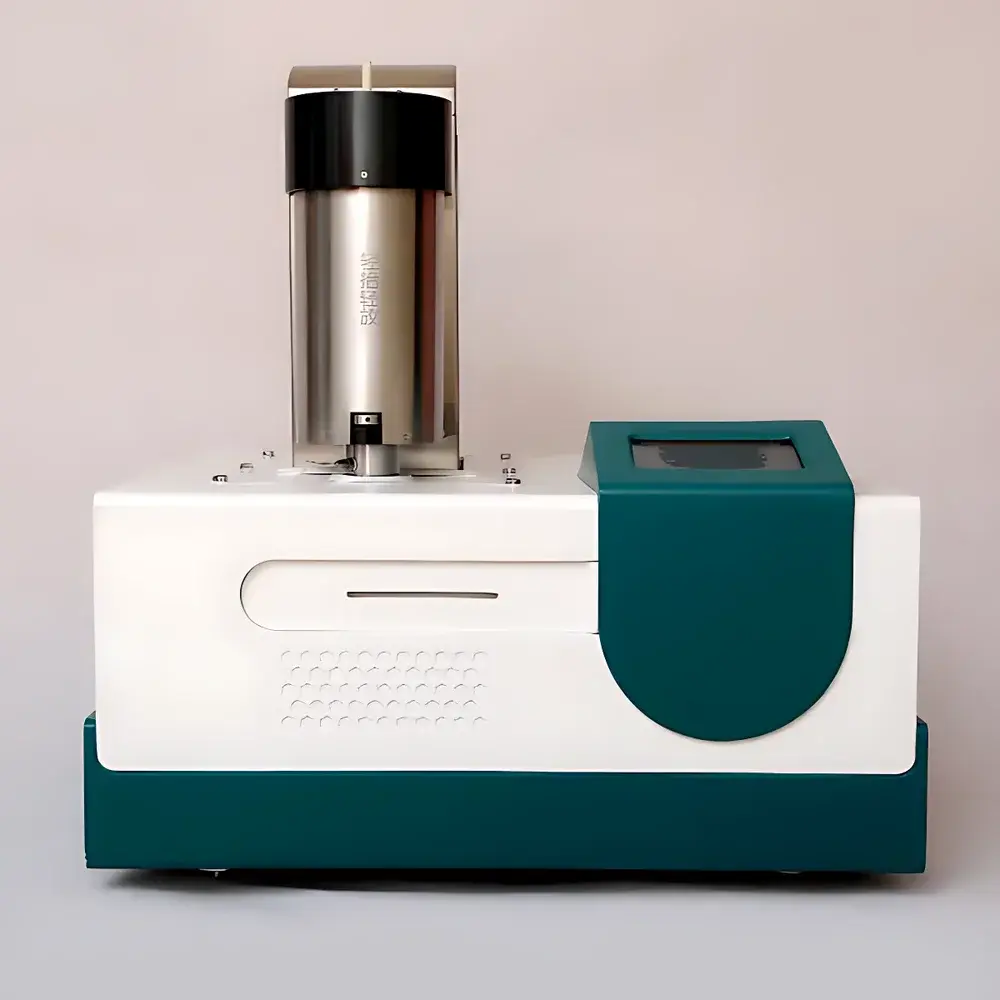
Henven HQG-1 Automated Thermogravimetric Analyzer
| Brand | Henven |
|---|---|
| Origin | Beijing, China |
| Manufacturer Type | Direct Manufacturer |
| Region of Origin | Domestic (China) |
| Model | HQG-1 |
| Operating Environment | Ambient Pressure |
| Sample Capacity | Single Sample |
| Instrument Type | General-Purpose |
| Temperature Range | Room Temperature to 1150 °C |
| Temperature Accuracy | ±0.1 °C |
| Temperature Precision | ±0.1 K |
| Dynamic Weighing Range | 0.01 mg – 5 g |
| Balance Sensitivity | 0.1 µg |
| Mass Accuracy | 0.1 µg |
| Heating/Cooling Rate | 0.1 – 100 K/min |
| Maximum Sample Mass | 5 g |
| Baseline Repeatability | 0.01 mg |
| Baseline Drift | 0.01 mg |
Overview
The Henven HQG-1 Automated Thermogravimetric Analyzer (TGA) is a precision-engineered instrument designed for quantitative measurement of mass change as a function of temperature or time under controlled thermal and atmospheric conditions. Based on the fundamental principle of thermogravimetry—where sample mass is continuously monitored during programmed heating, cooling, or isothermal holds—the HQG-1 delivers high-fidelity data essential for characterizing thermal stability, decomposition kinetics, compositional analysis, and reaction mechanisms. Its robust design integrates a high-stability microbalance, dual thermocouple temperature monitoring (furnace and sample), and a programmable furnace capable of operation from ambient to 1150 °C with ±0.1 °C accuracy. The system supports both dynamic and static thermal protocols, enabling compliance with standardized test methods including ASTM E1131, ISO 11358, and USP for residual solvent and volatile content assessment.
Key Features
- Integrated microbalance with 0.1 µg sensitivity and 0.01 mg baseline repeatability, ensuring high-resolution detection of subtle mass transitions.
- Dual thermocouple architecture: one dedicated to furnace temperature monitoring (active at all times), and a second for real-time sample temperature measurement—critical for accurate kinetic modeling and calibration traceability.
- Programmable heating/cooling rates from 0.1 to 100 K/min, with isothermal hold capability up to 72 hours at any temperature within the operating range.
- Modular atmosphere control system featuring dual-channel mass flow controllers (MFCs), enabling precise switching between inert, oxidative, reductive, or corrosive gas environments during a single run; optional corrosion-resistant MFC modules available upon request.
- Motorized, position-accurate furnace lift mechanism minimizes thermal lag and mechanical drift, enhancing inter-run reproducibility.
- Configurable crucible support system accommodating standard ceramic crucibles (e.g., Φ5×4 mm, Φ18×20 mm) as well as optional platinum, quartz, graphite, and aluminum variants for application-specific compatibility.
- Auto-ranging data acquisition with real-time signal scaling and user-definable axis units (temperature/time; absolute mass/% mass loss).
Sample Compatibility & Compliance
The HQG-1 accommodates solid, powder, and granular samples across diverse material classes—including polymers, pharmaceutical actives and excipients, catalysts, inorganic oxides, metal alloys, and composites—with mass loading flexibility from 0.01 mg to 5 g via interchangeable support rods. Crucible selection ensures chemical inertness and thermal stability under target atmospheres and temperatures. The instrument meets core requirements for GLP-compliant laboratories: full audit trail logging, electronic signature support (aligned with FDA 21 CFR Part 11 principles), and traceable calibration using certified reference materials (e.g., Ni, Al, CaC₂O₄·H₂O). Optional vacuum module (2.5×10⁻² Pa) extends applicability to low-pressure pyrolysis and sublimation studies.
Software & Data Management
The proprietary TGA analysis software provides automated acquisition, visualization, and post-processing of TG, DTG, and DDTG curves. Built-in algorithms support quantitative residue calculation, derivative peak identification, multi-step decomposition fitting, and isoconversional kinetic analysis (e.g., Friedman, Ozawa-Flynn-Wall). Users may define custom mathematical expressions for derived parameters (e.g., activation energy, reaction order), and the software environment supports batch processing, comparative overlay, and export to CSV, ASCII, or vendor-neutral formats (e.g., ASTM E1970). All raw and processed data are timestamped and stored with full metadata—including gas flow profiles, furnace position status, and balance diagnostics—to satisfy regulatory documentation requirements.
Applications
The HQG-1 serves critical functions in R&D, quality assurance, and regulatory submission workflows. Typical use cases include: quantification of moisture, solvents, and volatiles in pharmaceutical dosage forms; determination of filler content and polymer degradation onset in thermoplastics; catalytic coke burn-off analysis in petrochemical research; oxidation resistance evaluation of high-temperature alloys; and thermal stability screening of battery electrode materials. Its compatibility with GC/MS coupling (via optional heated transfer line and interface) enables evolved gas analysis (EGA) for mechanistic insight into decomposition pathways.
FAQ
What calibration standards are recommended for routine verification?
Certified reference materials such as nickel (Ni), aluminum (Al), and calcium oxalate monohydrate (CaC₂O₄·H₂O) are used for simultaneous temperature and mass calibration per ASTM E1131.
Can the HQG-1 operate under reducing or corrosive atmospheres?
Yes—custom-configured MFCs with Hastelloy or quartz-lined components are available for H₂, NH₃, Cl₂, SO₂, and other aggressive gases.
Is the software compliant with 21 CFR Part 11 requirements?
The system supports electronic signatures, audit trails, and role-based access control; full validation documentation is provided upon request.
What is the minimum detectable mass change under typical operating conditions?
With optimized signal averaging and noise suppression, the effective resolution is ≤0.1 µg over a 10-minute window at stable temperature.
Does the instrument support coupling to external analytical systems?
Yes—standardized heated transfer interfaces (up to 200 °C) enable direct connection to FTIR, MS, or GC systems for evolved gas analysis.



