
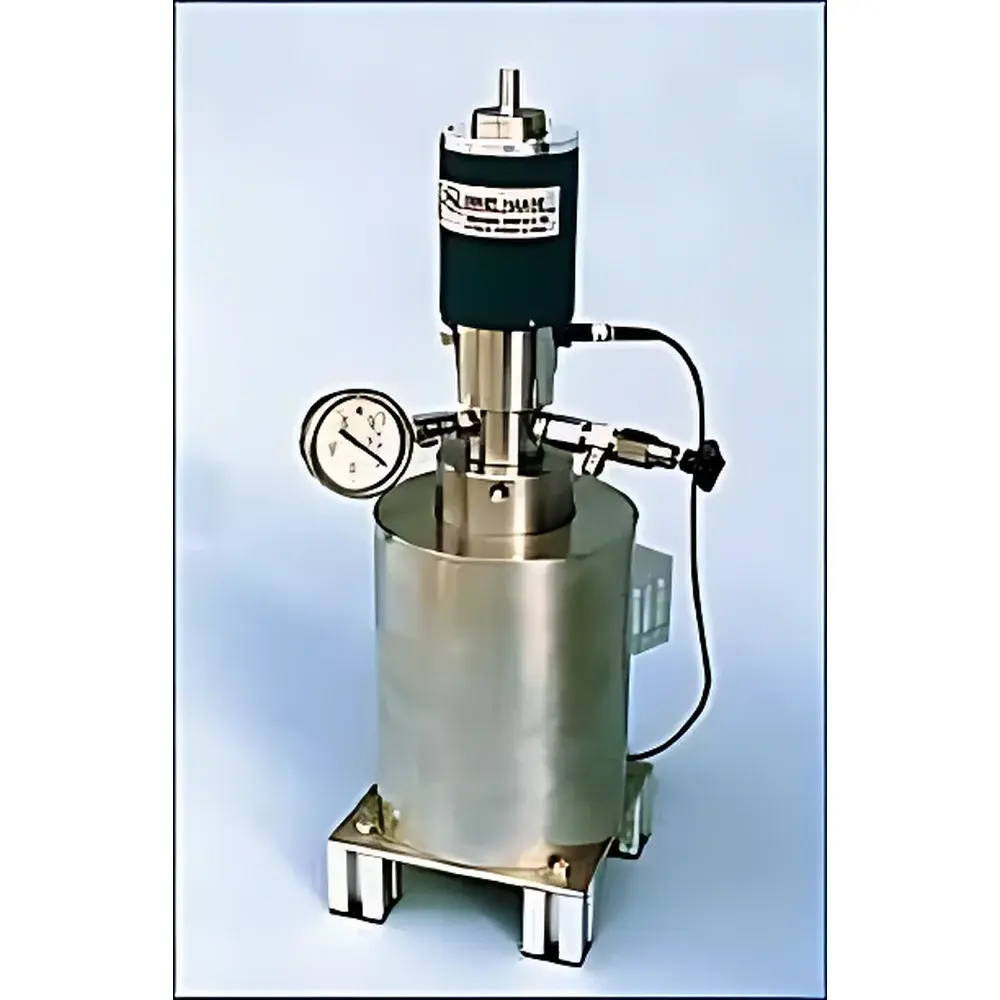
Hastelloy-C276-Lined 50 mL Miniature High-Pressure Reactor System
| Origin | Germany |
|---|---|
| Manufacturer Type | Authorized Distributor |
| Origin Category | Imported |
| Model | 50 mL Miniature |
| Pricing | Available Upon Request |
| Effective Volume | 50 mL |
| Max Operating Pressure | 350 bar |
| Max Operating Temperature | 350 °C |
| Wetted Materials | Standard – ASTM A276 Grade 316L Stainless Steel |
| Optional Wetted Materials | Hastelloy C-276, Titanium Grade 2, Tantalum, Inconel 625 |
| Heating System | Integrated Electric Heating with PID Control |
| Temperature Sensing | Dual RTD Inputs (Type K or Pt100) |
| Pressure Monitoring | Digital Pressure Transducer with Local Display & 4–20 mA Output |
| Stirring | Magnetically Coupled Drive, Remote-Controlled, 0–3000 rpm |
| Safety Components | Rupture Disc Assembly (ASME BPVC Section VIII Compliant), Dual-Stage Pressure Relief Valve |
| Condenser | Reflux Condenser with Sampling Port |
| Data Acquisition | RS485/Modbus RTU & USB Interface Compatible with LabVIEW, MATLAB, and Custom SCADA Systems |
| Compliance | Designed per PED 2014/68/EU, ASME B31.3 Process Piping Guidelines, and ISO 4762 for Fastener Integrity |
Overview
The Hastelloy-C276-Lined 50 mL Miniature High-Pressure Reactor System is an engineered solution for kinetic studies, catalytic screening, and process safety evaluation under extreme thermodynamic conditions. Based on sealed-vessel batch reactor architecture, it operates on the principle of controlled isochoric reaction environments where pressure is generated in situ via exothermic reactions or gas introduction, while temperature is precisely regulated via embedded cartridge heaters and closed-loop PID control. Its compact 50 mL effective volume enables statistically significant material consumption reduction—critical for high-value catalysts, pharmaceutical intermediates, or novel energetic materials—without compromising mechanical integrity or measurement fidelity. Designed and assembled in Germany to stringent European manufacturing protocols, the system meets the dimensional, metallurgical, and documentation requirements for integration into GLP-compliant laboratories and early-phase process development workflows.
Key Features
- Robust pressure containment: ASME-certified rupture disc assembly (set point adjustable between 250–350 bar) integrated with redundant mechanical relief valve; vessel body rated to 350 bar at 350 °C per EN 13445-3 Annex C fatigue analysis.
- Thermal management architecture: Dual-zone electric heating (base + lid) with independent PID loops, enabling axial temperature uniformity ≤ ±2.5 °C across the reaction zone under steady-state operation.
- Magnetically coupled agitation: Hermetically sealed drive eliminates dynamic seal failure risk; torque-controlled motor delivers consistent shear profiles from 0–3000 rpm, supporting heterogeneous slurry reactions and gas–liquid mass transfer quantification.
- Digital instrumentation suite: High-stability pressure transducer (0.1% FS accuracy, 0–400 bar range) and dual RTD inputs support synchronized acquisition of P–T–N–t (pressure–temperature–stirring speed–time) datasets at up to 10 Hz sampling rate.
- Material flexibility: Standard wetted components fabricated from ASTM A276 316L stainless steel; optional upgrade paths include Hastelloy C-276 cladding (for HCl/HF service), titanium Grade 2 (for chlorinated media), tantalum (for hot concentrated sulfuric acid), and Inconel 625 (for oxidizing halogen environments).
- Reflux-enabled sampling: Integrated Liebig-type condenser with calibrated dip-tube allows for continuous vapor-phase equilibrium monitoring and discrete liquid-phase sampling without depressurization.
Sample Compatibility & Compliance
This reactor accommodates solid catalysts (e.g., supported Pd/C, Ni/Raney), viscous slurries (up to 10,000 cP), supercritical fluids (CO₂, NH₃), and corrosive reagents including anhydrous HF, oleum, and molten alkali hydroxides. All wetted surfaces undergo passivation per ASTM A967 and are supplied with full material traceability (MTR EN 10204 3.1). The system conforms to Pressure Equipment Directive (PED) 2014/68/EU Category IV, carries CE marking with notified body oversight (TÜV Rheinland 0197), and supports audit-ready documentation packages compliant with FDA 21 CFR Part 11 (electronic records/signatures) when paired with validated data acquisition software.
Software & Data Management
Native communication via Modbus RTU over RS485 enables seamless integration into existing DCS or LIMS infrastructures. Included PC software provides real-time trend visualization, configurable alarm thresholds (e.g., dP/dt > 5 bar/min triggers automatic cooling ramp), and automated report generation per ISO/IEC 17025 clause 7.8. Raw binary data streams are exportable in CSV, HDF5, and TDMS formats—compatible with Python-based kinetic modeling tools (e.g., Cantera, Pyomo) and commercial platforms such as Aspen Kinetics and gPROMS. Audit trails record operator ID, parameter changes, and system events with SHA-256 hashing for forensic integrity verification.
Applications
- Hydrogenation kinetics under elevated H₂ partial pressure (≤300 bar)
- Supercritical water oxidation (SCWO) of persistent organic pollutants
- Acid-catalyzed esterification and transesterification in continuous-flow precursor screening
- Thermal stability assessment of battery electrolyte formulations (e.g., LiPF₆ in EC/DMC)
- Gas–solid Fischer–Tropsch synthesis using microgram-scale Fe–Co bimetallic catalysts
- Decomposition onset profiling of peroxides and azo initiators per UN Test Series H
FAQ
Is the reactor suitable for use with hydrofluoric acid (HF)?
Yes—when specified with Hastelloy C-276 lining and fluorocarbon-free elastomer seals (Kalrez® 6375), the system maintains structural integrity during exposure to anhydrous HF up to 200 °C.
Can the stirring speed be modulated during a run based on pressure feedback?
Yes—the controller supports closed-loop agitation control via programmable logic; for example, rpm can be reduced automatically if dP/dt exceeds user-defined safety thresholds.
What documentation is provided for regulatory submissions?
A complete qualification package is available upon request, including Factory Acceptance Test (FAT) report, Material Certificates (EN 10204 3.1), Pressure Vessel Design Calculations (per AD 2000 Merkblatt), and IQ/OQ protocols aligned with ASTM E2500.
Does the system support inert gas purging prior to pressurization?
Yes—integrated purge sequence logic enables three-stage N₂/Ar evacuation cycles with vacuum hold verification (<1 mbar absolute) before repressurization.
Is remote monitoring possible via Ethernet or Wi-Fi?
While native connectivity is RS485/USB, optional gateway modules (e.g., Moxa EDS-G205A) provide secure TLS 1.2 Ethernet bridging with OPC UA server functionality for enterprise-level SCADA access.



