
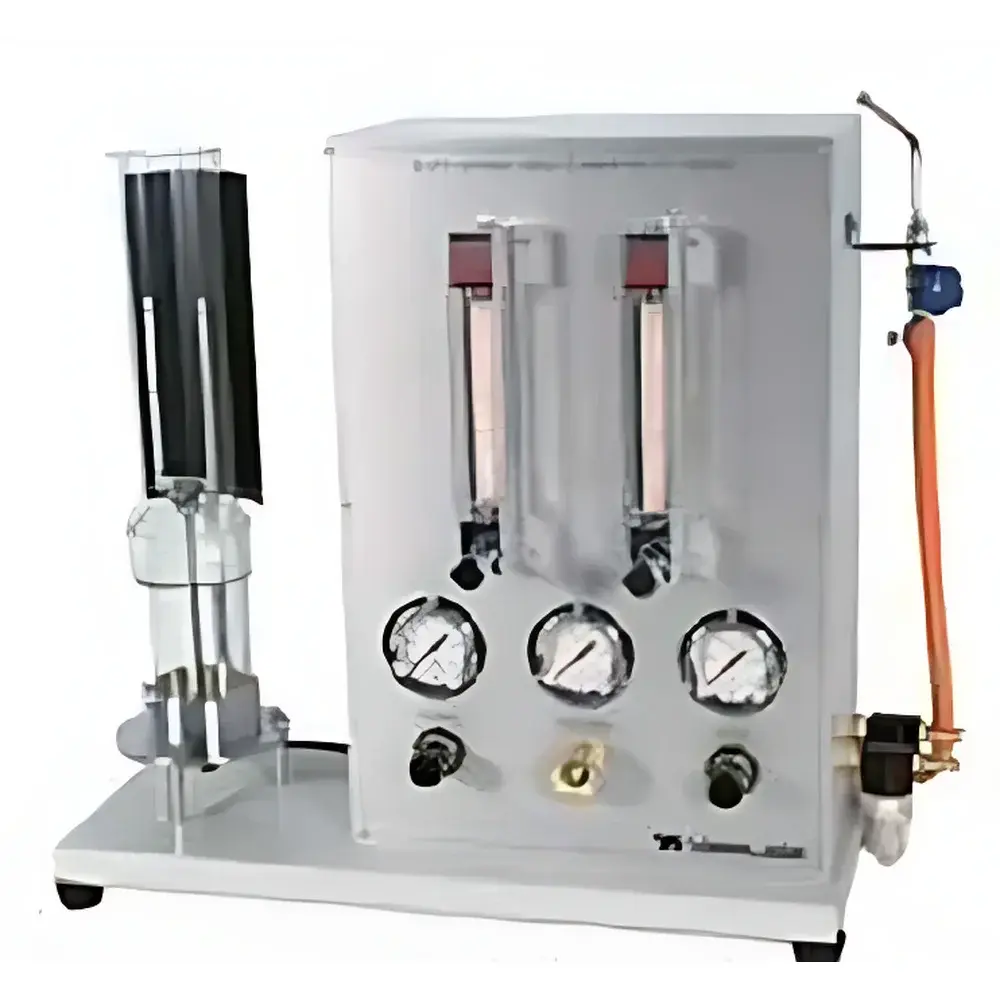
No.214 Oxygen Index Tester
| Origin | Germany |
|---|---|
| Manufacturer Type | Authorized Distributor |
| Origin Category | Imported |
| Model | No.214 |
| Quotation | Upon Request |
| Standards Compliance | ASTM D2863, ISO 4589-2, JIS K6269 & K7201 |
| Combustion Column ID | φ75±3 mm (standard), φ95 mm (optional) |
| Height | 450±5 mm |
| Gas Flow Control | Dual digital mass flow meters (O₂ & N₂) |
| Pressure Monitoring | O₂/N₂ supply pressure gauges + leak detection port |
| Ignition Source | Adjustable propane or pipeline gas burner (flame length 6–25 mm) |
| Sample Holder | U-shaped stainless steel fixture |
| Sample Types | Rigid/flexible plastics, elastomers, rubber compounds, textile fibers, and laminates |
| Power Supply | AC 100 V, 1-phase, 3 A, 50/60 Hz |
| Dimensions (W×D×H) | Approx. 600 × 290 × 660 mm |
| Weight | Approx. 30 kg |
Overview
The No.214 Oxygen Index Tester is a precision-engineered instrument designed for the quantitative determination of the Limiting Oxygen Index (LOI) of solid polymeric materials according to internationally recognized combustion safety standards. Based on the principle of upward flame propagation in a vertically oriented specimen column under controlled oxygen–nitrogen atmospheres, the system measures the minimum volume percentage of oxygen in the gas mixture required to support candle-like flaming combustion for at least 3 minutes—or until the flame front advances 50 mm along the sample surface. This gravimetrically stable, diffusion-controlled combustion environment enables reproducible classification of material flammability, serving as a critical parameter in fire hazard assessment, regulatory compliance documentation, and formulation development for flame-retardant polymers.
Key Features
- Compliant dual-column configuration: Standard φ75 ±3 mm combustion tube (per ASTM D2863 and ISO 4589-2) with optional φ95 mm column for thicker or low-density specimens.
- High-stability gas delivery system featuring independent digital mass flow controllers for oxygen and nitrogen—ensuring accurate, repeatable gas mixing ratios from 10.0% to 100.0% O₂ (resolution: 0.1%) with built-in calibration traceability.
- Integrated pressure monitoring suite including dedicated O₂/N₂ supply pressure gauges and a dedicated leak-check port, enabling pre-test verification of system integrity per ISO 4589-2 Section 7.2.
- Adjustable propane or pipeline gas burner with fine-threaded height control, delivering a stable, laminar flame (6–25 mm vertical length) meeting the ignition source requirements of all referenced standards.
- U-shaped stainless steel specimen holder engineered for consistent vertical alignment and thermal isolation; accommodates standard test bars (80–150 mm × 10 mm × 4 mm) as well as irregular geometries including foams, textiles, and composites.
- Robust benchtop architecture (30 kg, 600 × 290 × 660 mm) with reinforced base plate, flame-resistant housing, and rear-mounted gas line routing—designed for long-term operation in QC laboratories compliant with ISO/IEC 17025 and GLP environments.
Sample Compatibility & Compliance
The No.214 supports a broad spectrum of non-metallic materials, including thermoplastics (e.g., PVC, PE, PC), thermosets (epoxies, phenolics), elastomers (silicone, EPDM), natural/synthetic fibers (cotton, aramid, polyester), and layered composites. All test procedures strictly adhere to the specimen conditioning, orientation, and observation protocols defined in ASTM D2863 (Standard Test Method for Determining Flammability of Plastics Using the Oxygen Index), ISO 4589-2 (Plastics — Determination of Burning Behaviour by Oxygen Index — Part 2: Ambient-Temperature Test), and Japanese Industrial Standards JIS K6269 (Rubber — Determination of Oxygen Index) and JIS K7201 (Plastics — Determination of Oxygen Index). The instrument’s mechanical and pneumatic design satisfies the dimensional tolerances, flow uniformity, and flame stability criteria mandated by these standards for audit-ready testing.
Software & Data Management
While the No.214 operates as a manually supervised benchtop system, its digital flow meters output RS-232 or analog 4–20 mA signals compatible with third-party laboratory data acquisition platforms (e.g., LabVIEW, DeltaV, or custom SCADA). All gas mixture settings, observed burn times, char lengths, and pass/fail determinations are recorded in accordance with ISO/IEC 17025 Clause 7.5 (Technical Records) and FDA 21 CFR Part 11 requirements when integrated with validated electronic lab notebooks (ELN). Calibration certificates for flow meters and pressure gauges are supplied with NIST-traceable documentation, supporting GMP and aerospace-grade quality audits.
Applications
- Flame retardancy screening during polymer formulation R&D (e.g., halogen-free additive optimization).
- Batch release testing for wire & cable jacketing compounds (UL 758, IEC 60332-1).
- Regulatory submission support for construction materials (EN 13501-1, GB 8624).
- Comparative LOI benchmarking across material families (e.g., PP vs. FR-PP vs. PBT).
- Root-cause analysis of unexpected field ignition events via post-failure LOI correlation.
- Training platform for fire safety engineering curricula and ISO 17025 internal auditor workshops.
FAQ
What standards does the No.214 Oxygen Index Tester fully support?
ASTM D2863, ISO 4589-2, JIS K6269, and JIS K7201—including full adherence to specimen geometry, gas flow velocity, and observation timing requirements.
Can the instrument be used for testing flexible foams or thin films?
Yes—when mounted in the U-shaped holder with optional support inserts; however, ISO 4589-2 Annex B recommends supplementary evaluation (e.g., piloted ignition) for materials exhibiting melt-dripping or shrinkage.
Is third-party calibration certification included?
Each unit ships with factory calibration reports for flow meters and pressure gauges, traceable to national metrology institutes; on-site UKAS or DAkkS-accredited recalibration services are available upon request.
What gas supply specifications are required for safe operation?
Oxygen (≥99.5% purity, dew point ≤ –40°C) and nitrogen (≥99.99% purity, oil-free) delivered at 0.3–0.5 MPa; propane must meet EN 589 or ASTM D1835 Grade HD-5 specifications.
How is operator safety ensured during testing?
The unit incorporates a tempered glass viewing shield, automatic gas shutoff upon door opening, flame arrestor mesh in the exhaust duct, and CE-compliant electrical insulation per EN 61010-1.



