
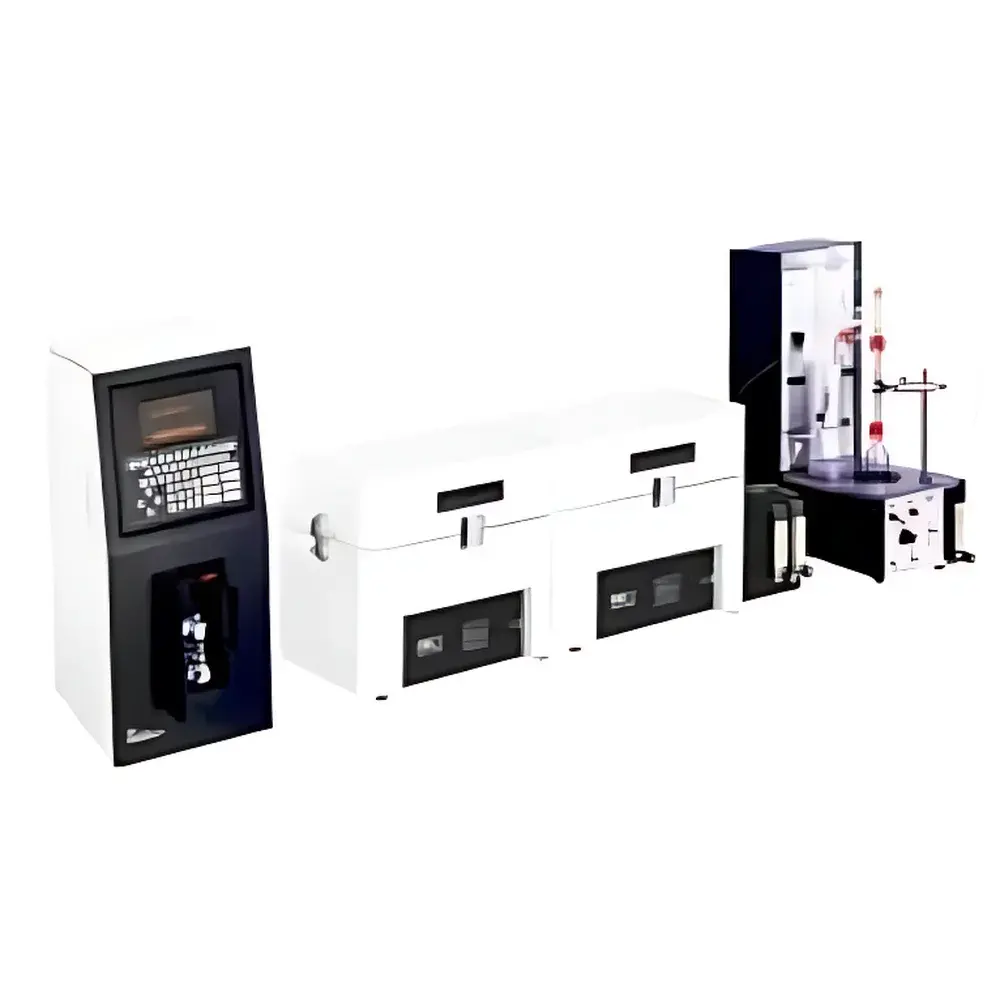
UIC CM350 Coulometric Total Sulfur and Total Sulfite Analyzer
| Brand | UIC (USA) |
|---|---|
| Origin | USA |
| Model | CM350 |
| Category | Other Elemental Analyzers |
| Compliance | ASTM D3120, D3246, D5453 |
| Detection Principle | Coulometric titration based on Faraday’s law |
| Dynamic Range | 1 µg – 10,000 µg sulfur (equivalent to ~1 ppm – 100% w/w, sample-dependent) |
| Resolution | 0.01 µg S |
| Analysis Time | 5–7 min (combustion mode), ≤15 min (acid digestion mode) |
| Sample Forms | Solids (0.5 mg – 10 g) and liquids |
| Furnace Max Temp | 1100 °C |
| Data Storage | Internal floppy drive (CM5014S), exportable via RS232 |
Overview
The UIC CM350 Coulometric Total Sulfur and Total Sulfite Analyzer is a fully integrated, dual-mode elemental analyzer engineered for precise, trace-to-bulk quantification of total sulfur and total sulfite in diverse matrices. It operates on the fundamental electrochemical principle of coulometric titration—directly applying Faraday’s law to quantify sulfur species as SO2 and H2S generated during high-temperature combustion or controlled acid digestion. Unlike photometric or UV-fluorescence systems, the CM350 delivers absolute measurement without reliance on calibration curves or reference standards, ensuring metrological traceability and long-term stability. Its architecture combines three core subsystems: the CM5014S coulometric sulfur detector, the CM5380 dual-zone programmable combustion furnace (up to 1100 °C), and the CM5130 acid digestion module implementing a modified Monier-Williams procedure. This tripartite design enables method flexibility across regulatory and research workflows—supporting both ASTM D3120 (sulfite in wine), D3246 (sulfur in petroleum), D5453 (total sulfur in light hydrocarbons), and ISO 20846 (gasoline), as well as pharmacopeial requirements such as USP for heavy metals and sulfated ash-related sulfur screening.
Key Features
- Dual-mode operation: Simultaneous support for high-temperature oxidative combustion (for total sulfur) and low-temperature acid digestion (for total sulfite), eliminating cross-method instrument duplication.
- True zero-calibration architecture: The CM5014S detector employs a microcoulometric cell with platinum working electrodes and iodide/iodine redox chemistry—providing inherent linearity from 1 µg to 10,000 µg sulfur, validated per NIST-traceable protocols.
- Dual-chamber combustion furnace (CM5380): Features independent temperature control for oxidation and catalytic reduction zones, automatic O2/He gas mixing, split-body mechanical design for rapid catalyst access and ash removal, and programmable ramp-hold profiles up to 1100 °C.
- Modular acid digestion system (CM5130): Configurable reaction vessels (10–100 mL), precision acid dispensing, Peltier-assisted sample heating control, and integrated air purge with adjustable flow rate—enabling reproducible sulfite liberation within ≤15 minutes.
- Regulatory-ready data handling: RS232 interface supports LIMS integration; optional software add-ons provide 21 CFR Part 11-compliant electronic signatures, full audit trails, and GLP/GMP-aligned report generation with metadata stamping (operator ID, timestamp, method version, calibration status).
Sample Compatibility & Compliance
The CM350 accommodates heterogeneous sample types without derivatization or pre-concentration: solid powders (coal, ores, pharmaceutical excipients, foodstuffs), slurries (cement, soil extracts), viscous liquids (crude oil, syrups, wine), and aqueous solutions (beverages, process streams). Its broad dynamic range (1 ppm–100% w/w S) and scalable sample mass (0.5 mg–10 g) eliminate dilution errors and reduce method development time. The system meets essential compliance benchmarks including ASTM D3120 (sulfite in alcoholic beverages), D3246 (sulfur in distillate fuels), D5453 (ultra-low sulfur diesel), ISO 20846 (automotive gasoline), ISO 29842 (natural gas), and USP (sulfur limit tests). All hardware modules are CE-marked and designed for Class I, Division 2 hazardous location compatibility when installed with appropriate gas venting.
Software & Data Management
Data acquisition and processing are managed through UIC’s proprietary CM-Link software suite (Windows-based), which provides real-time coulometric current monitoring, automatic endpoint detection, stoichiometric mass balance correction, and customizable reporting templates. Raw data—including time-resolved titration curves, furnace thermograms, and digestion pressure logs—are stored in ASCII format for third-party statistical analysis. The CM5014S unit includes a built-in 3.5″ floppy drive for offline archiving; optional USB-to-floppy emulators and network-enabled file servers support modern IT infrastructure. For regulated environments, the optional CM-Compliance Pack adds role-based user authentication, electronic signature capture, change control logs, and automated backup verification—fully aligned with FDA 21 CFR Part 11 Annex 11 and EU GMP Annex 11 expectations.
Applications
- Fuel quality control: Quantification of total sulfur in diesel, jet fuel, and marine bunkers per ISO 8754 and EPA Method IO-3.2.
- Food & beverage safety: Total sulfite determination in wines, dried fruits, and processed meats per AOAC 995.12 and EU Regulation No. 1308/2013.
- Pharmaceutical QC: Sulfur content verification in APIs, excipients, and packaging leachables per ICH Q5E and USP chapters , .
- Geological & environmental testing: Total sulfur in coal, shale, fly ash, and sediment cores per ASTM D1552 and ISO 10156.
- Materials science: Sulfur impurity profiling in battery cathode precursors, catalysts, and polymer additives where ppm-level contamination affects performance.
FAQ
Does the CM350 require daily recalibration?
No. The coulometric detection principle is inherently absolute and does not rely on external calibration standards. System verification is performed using certified reference materials (e.g., NIST SRM 1633c) at defined intervals per laboratory quality procedures.
Can the same sample be analyzed for both total sulfur and total sulfite?
Yes—provided the sample matrix permits both combustion and acid digestion. Sequential analysis requires physical re-aliquoting but uses identical detector electronics and data processing logic.
Is acid digestion limited to sulfite, or can other reducible sulfur species be measured?
The CM5130 module targets sulfite (SO32−) specifically under controlled acidic conditions; thiosulfate and dithionite may partially interfere and should be evaluated case-by-case per ISO 29842 Annex B.
What maintenance routines are recommended for the combustion furnace?
Catalyst beds (Pt-coated quartz wool) should be inspected after every 200 runs; furnace liners require cleaning every 500 cycles using ceramic brushes and ultrasonic acetone bath—no consumable replacement is needed between scheduled services.
How is data integrity ensured during power interruption?
The CM5014S detector retains volatile memory for up to 72 hours on internal backup capacitors; all active titration sequences auto-resume upon power restoration without data loss or endpoint corruption.






