
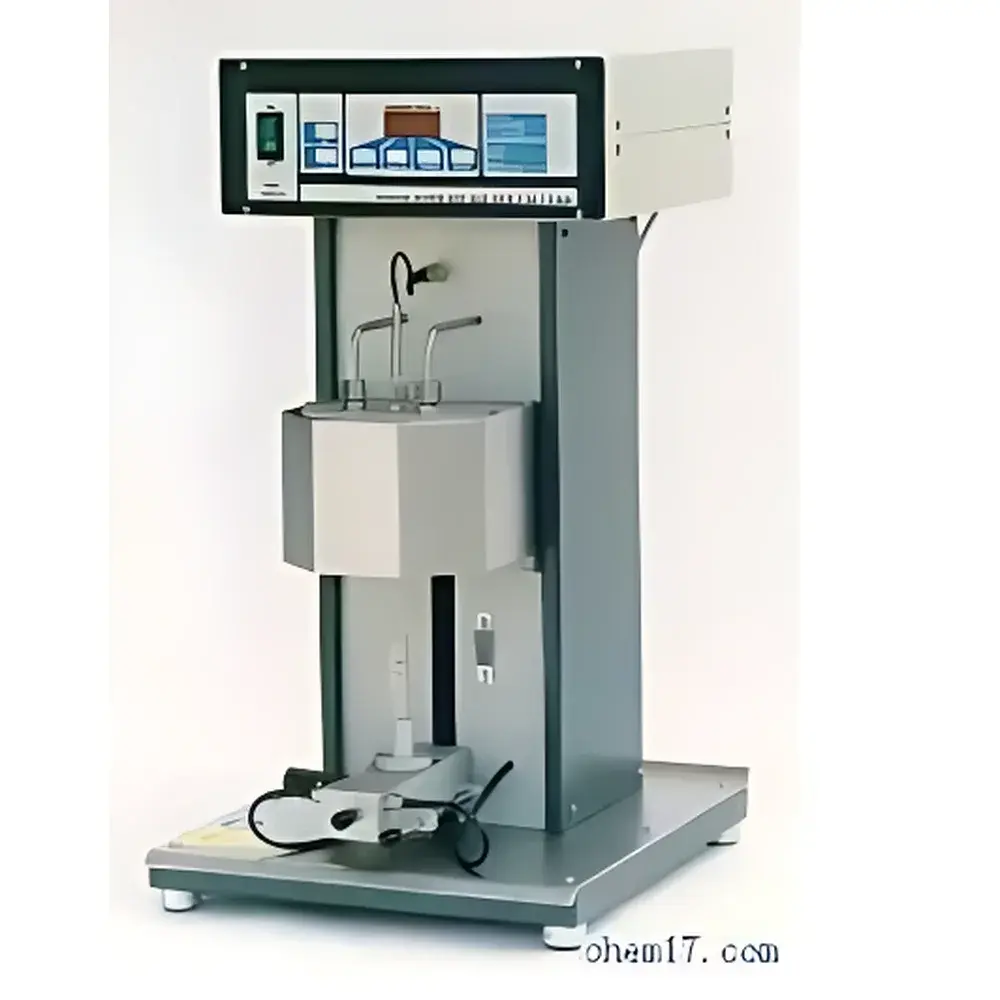
ASTM D566 Automatic Grease Dropping Point Tester
| Origin | Switzerland |
|---|---|
| Manufacturer Type | Authorized Distributor |
| Origin Category | Imported |
| Model | ASTM D566 |
| Pricing | Upon Request |
Overview
The ASTM D566 Automatic Grease Dropping Point Tester is a precision-engineered benchtop instrument designed to determine the dropping point of lubricating greases in strict accordance with ASTM D566, ASTM D2265, and IP 132 standard test methods. The dropping point is defined as the temperature at which grease transitions from a semi-solid to a liquid state under controlled heating—serving as a critical indicator of thermal stability, consistency classification, and suitability for high-temperature service applications. Unlike legacy manual setups, this system implements fully automated thermal profiling, real-time optical detection, and programmable cooling protocols to ensure repeatability, operator safety, and compliance with GLP and ISO/IEC 17025 laboratory requirements. Its core measurement principle relies on regulated ramp-heating kinetics coupled with photodetection of the first discrete droplet fall from a standardized cup-and-tube assembly—a method validated for reproducibility across diverse thickener types (e.g., lithium, calcium, polyurea, clay-based) and base oil formulations.
Key Features
- Fully automated heating control: Initial ramp rate of 5.5 °C/min, automatically reduced to 1.0–1.5 °C/min when sample temperature reaches 18 °C below user-input estimated dropping point
- Optical droplet detection system: High-sensitivity photoelectric sensor precisely identifies the moment of first droplet detachment, eliminating subjective visual interpretation
- Integrated water-cooling circuit: Activates automatically upon droplet detection; cooling duration is programmable via front-panel keypad to enable rapid turnaround between samples
- Pt100 RTD temperature sensor with 0.1 °C resolution and traceable calibration path; operating range: ambient to 400 °C
- Robust construction: Ceramic-coated stainless steel housing and corrosion-resistant stainless steel heating block for long-term thermal stability and chemical resistance
- Safety-critical interlocks: Auto-shutdown triggered if no droplet is detected 30 °C above estimated dropping point or upon reaching 400 °C absolute upper limit
- IP-rated oil-resistant membrane keyboard for reliable operation in industrial lab environments
- RS232 serial interface for data export, remote monitoring, and integration into LIMS or electronic lab notebooks
Sample Compatibility & Compliance
The instrument accommodates standard ASTM D566 sample geometry: two borosilicate glass sample tubes (included), two copper cups, and one calibrated thermometer. It supports greases ranging from NLGI No. 000 to No. 6 consistency grades, including complex-thickened, synthetic, and biodegradable formulations. All operational parameters—including heating rate profiles, cooling start conditions, and alarm thresholds—are configurable to align with internal SOPs while maintaining full traceability to ASTM D566 Annex A1 (automated method validation). CE marking confirms conformity with EU Machinery Directive 2006/42/EC and Electromagnetic Compatibility Directive 2014/30/EU. Routine verification may be performed using certified PT100 simulators (CAL001/CAL002), supporting audit readiness for FDA 21 CFR Part 11–governed quality systems.
Software & Data Management
While the base unit operates via embedded microcontroller with intuitive keypad navigation, raw temperature-time data and event timestamps (droplet detection, cooling initiation, shutdown triggers) are streamed in ASCII format via RS232 to external PCs. Compatible third-party software enables time-stamped data logging, statistical analysis (e.g., mean, SD, %RSD across replicate runs), and report generation compliant with ISO/IEC 17025 clause 7.8. Audit trails capture all parameter changes, operator IDs (if integrated with network authentication), and instrument status flags—essential for GMP/GLP documentation and regulatory submissions. Calibration records, maintenance logs, and performance verification results can be archived alongside analytical data to satisfy ALCOA+ data integrity principles.
Applications
- Quality control of incoming raw materials and finished greases in OEM and additive manufacturing facilities
- Thermal stability benchmarking during grease formulation development and shelf-life prediction studies
- Comparative assessment of thickener degradation kinetics under accelerated aging protocols
- Regulatory testing for automotive, aerospace, wind turbine, and heavy-duty industrial lubricant certifications
- Failure analysis of field-failed greases where thermal overload is suspected
FAQ
What standards does this instrument fully comply with?
It is engineered and validated for ASTM D566, ASTM D2265, and IP 132 test procedures.
How is temperature accuracy maintained over time?
Using a Pt100 RTD sensor with NIST-traceable calibration; optional CAL001/CAL002 simulators allow routine verification without physical reference standards.
Can the cooling cycle be adjusted?
Yes—cooling duration is fully programmable via the front-panel interface to match lab throughput requirements.
Is remote data acquisition supported?
Yes—ASCII-formatted temperature/time/event data is transmitted via RS232 for integration with LIMS, SCADA, or custom analytics platforms.
What happens if no droplet is detected during heating?
The system triggers a safety alarm and shuts down if no droplet is observed 30 °C above the user-defined estimate—or at 400 °C, whichever occurs first.






