
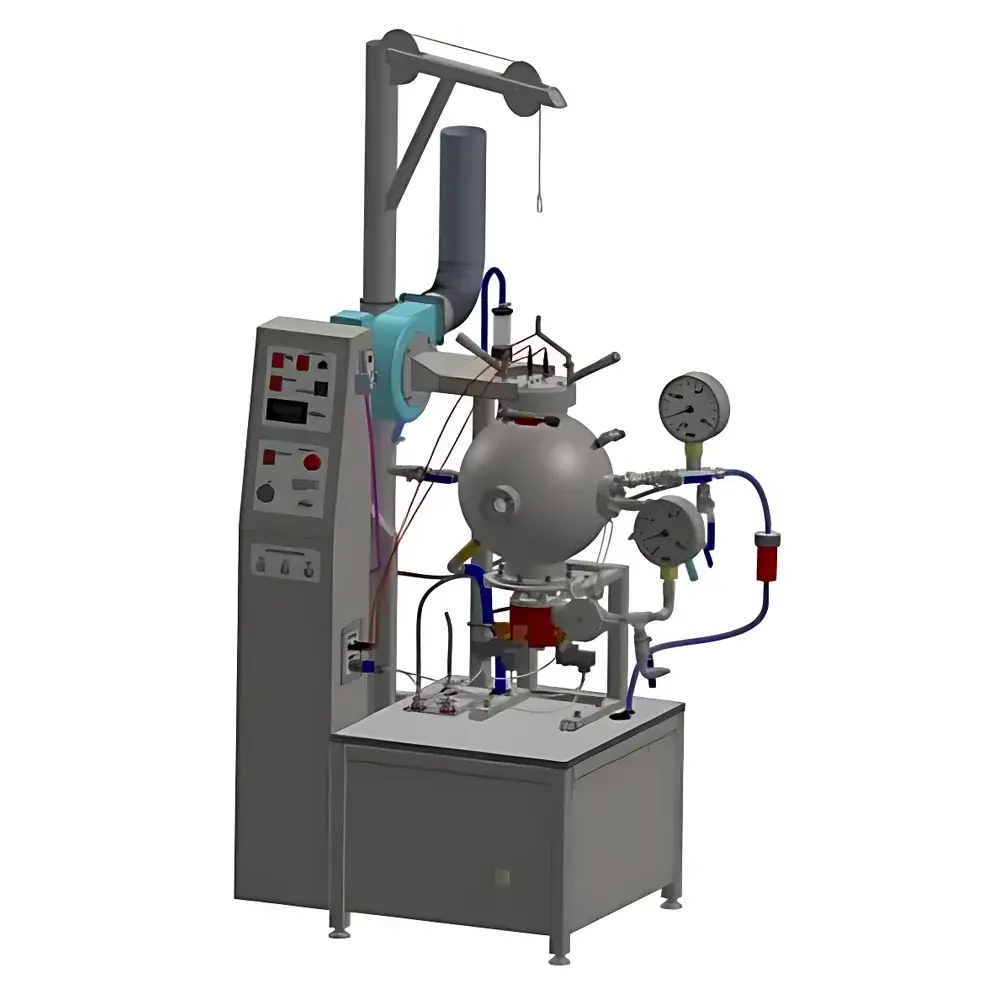
ANKO SPD2.2 20-L Spherical Dust Explosion Limit Analyzer
| Origin | Poland |
|---|---|
| Manufacturer Type | Authorized Distributor |
| Origin Category | Imported Instrument |
| Model | SPD2.2 |
| Price Range | USD 27,000 – 68,000 |
| Compliance | ASTM E1226, ASTM E1515, EN 14034-1:2004+A1:2011, EN 14034-2:2006+A1:2011, EN 14034-3:2006+A1:2011 |
| Vessel Volume | 20 L |
| Vessel Material | AISI 316 Stainless Steel |
| Maximum Working Pressure | 40 bar (gauge) |
| Pressure Measurement Range | 0–25 bar (absolute) |
| (dp/dt)max Detection Threshold | >4000 bar/s |
| Kst Range | >1000 bar·m/s |
| Explosibility Parameters | LEL/UEL/MEC from 0 g/m³, LOC: 1–21 % O₂ |
| Dust Injection Valve Response Time | ≤30 ms |
| Vacuum Display Range | 0–1 bar (absolute) |
| Vacuum Control | Auto & Manual Modes |
| Vessel Temperature Monitoring | Front-panel digital readout |
| Data Acquisition Rate | 10–100 kHz |
| Software | ANKO Explosion Plotter v3.x (GLP-compliant reporting, audit trail, test sequence automation, noise-filtered signal processing, PDF report generation) |
| Accessories | Integrated vacuum pump unit, exhaust scrubber with flow controller, borosilicate observation viewport, dedicated workstation, thermal printer |
Overview
The ANKO SPD2.2 20-L Spherical Dust Explosion Limit Analyzer is a fully integrated, standards-compliant apparatus engineered for the quantitative assessment of combustible dust explosion hazards in industrial process safety and regulatory compliance laboratories. Based on the fundamental principles of confined spherical explosion testing, the instrument subjects a precisely metered dust cloud to controlled ignition within a standardized 20-liter stainless-steel vessel under defined initial pressure, oxygen concentration, and turbulence conditions. Its measurement architecture adheres strictly to internationally recognized test methodologies—including ASTM E1226 (Standard Test Method for Explosibility of Dust Clouds), ASTM E1515 (Standard Test Method for Determining the Minimum Explosible Concentration—MEC—of a Combustible Dust in Air), and the EN 14034 series (Parts 1–3) governing Pmax, (dp/dt)max, and explosion severity classification (Kst). Designed for reproducible, traceable, and auditable results, the SPD2.2 serves as a primary tool for hazard identification, process safety management (PSM), and documentation required under OSHA 1910.119, NFPA 652, ATEX Directive 2014/34/EU, and IEC 60079-10-2.
Key Features
- Robust dual-wall 20-L spherical test vessel fabricated from AISI 316 stainless steel, rated for continuous operation up to 40 bar (gauge) and validated for repeated high-energy explosions.
- High-speed pneumatic dust injection system with ≤30 ms actuation time, ensuring consistent dispersion kinetics and minimizing pre-ignition settling effects.
- Real-time absolute pressure monitoring (0–1 bar) via front-panel vacuum display, coupled with dual-mode (auto/manual) vacuum regulation for precise initial condition control prior to test initiation.
- Digital vessel temperature readout integrated into the operator interface, enabling correlation of thermal state with ignition sensitivity and combustion dynamics.
- Dedicated high-fidelity DAQ system operating at configurable sampling rates between 10 kHz and 100 kHz, capturing transient pressure rise profiles with sub-millisecond resolution for accurate (dp/dt)max derivation.
- Borosilicate glass viewport (≥Φ100 mm) providing unobstructed optical access for high-speed imaging, flame propagation analysis, or synchronized video recording during explosion events.
- Integrated exhaust management subsystem comprising a corrosion-resistant scrubber and mass-flow-controlled venting circuit, ensuring safe post-test gas handling and particulate containment per ISO 14040 lifecycle considerations.
Sample Compatibility & Compliance
The SPD2.2 accommodates dry, free-flowing powders across a broad particle size distribution (typically <500 µm D90) and diverse chemical families—including metal dusts (Al, Mg, Ti), organic materials (wood, sugar, flour, pharmaceutical APIs), polymer granules, and carbon-based particulates. Sample introduction is compatible with both gravimetric and volumetric dosing protocols. All test procedures are structured to satisfy GLP (Good Laboratory Practice) and GMP-aligned documentation requirements. The system supports full traceability through embedded electronic signatures, timestamped raw data logs, and immutable audit trails compliant with FDA 21 CFR Part 11 when operated with validated software configurations. Calibration certificates for pressure transducers, vacuum gauges, and temperature sensors are provided with NIST-traceable documentation.
Software & Data Management
The ANKO Explosion Plotter v3.x software suite provides a secure, role-based Windows environment for test definition, execution, real-time visualization, and regulatory-grade reporting. It implements automated calculation of Pmax, (dp/dt)max, Kst, MEC, LEL, UEL, and LOC according to EN 14034-3 and ASTM E1515 algorithms. Signal processing includes adaptive noise filtering, baseline correction, and derivative smoothing to enhance low-amplitude event detection. Each test generates a tamper-evident PDF report containing metadata (operator ID, date/time, environmental conditions), raw pressure vs. time curves, derived parameters, pass/fail status against classification thresholds (e.g., St 0–St 3), and electronic signature fields. Data export options include CSV, MATLAB .mat, and XML formats for integration with enterprise LIMS or PHA databases.
Applications
- Hazard evaluation of bulk solids during R&D, scale-up, and facility design phases.
- Supporting Dust Hazard Analysis (DHA) mandated by NFPA 652 for existing and new process units.
- Generating technical dossiers for ATEX/IECEx equipment certification and zone classification.
- Validating effectiveness of inerting strategies (N2, CO2, Argon) via LOC determination.
- Investigating influence of moisture content, particle morphology, and antistatic additives on explosibility.
- Training and competency assessment for plant safety personnel under OSHA Process Safety Management guidelines.
FAQ
Does the SPD2.2 comply with current revision requirements of EN 14034?
Yes—the instrument meets EN 14034-1:2004+A1:2011, EN 14034-2:2006+A1:2011, and EN 14034-3:2006+A1:2011, including all referenced annexes on calibration, uncertainty estimation, and repeatability criteria.
Can the system be used for hybrid mixture testing (e.g., dust + flammable vapor)?
While primarily configured for pure dust cloud testing, optional vapor injection modules and modified ignition sources are available under ANKO’s Custom Configuration Program—subject to additional validation per IEC 61241-10 and EN 60079-20-2.
Is remote operation and monitoring supported?
The Explosion Plotter software includes TCP/IP-enabled remote desktop access and secure HTTPS-based web dashboard (optional add-on), allowing supervised off-site test initiation and real-time pressure curve viewing with TLS 1.2 encryption.
What maintenance intervals are recommended for pressure transducers and ignition circuits?
Annual recalibration of piezoresistive pressure sensors is advised; spark gap igniters require visual inspection and electrode cleaning after every 50 tests or per visible erosion—detailed in the Maintenance Logbook included with each delivery.
Are training and method transfer services available?
ANKO-certified application engineers provide on-site installation qualification (IQ), operational qualification (OQ), and hands-on user training covering SOP development, troubleshooting, and regulatory audit preparation—delivered globally in English, German, and French.





