
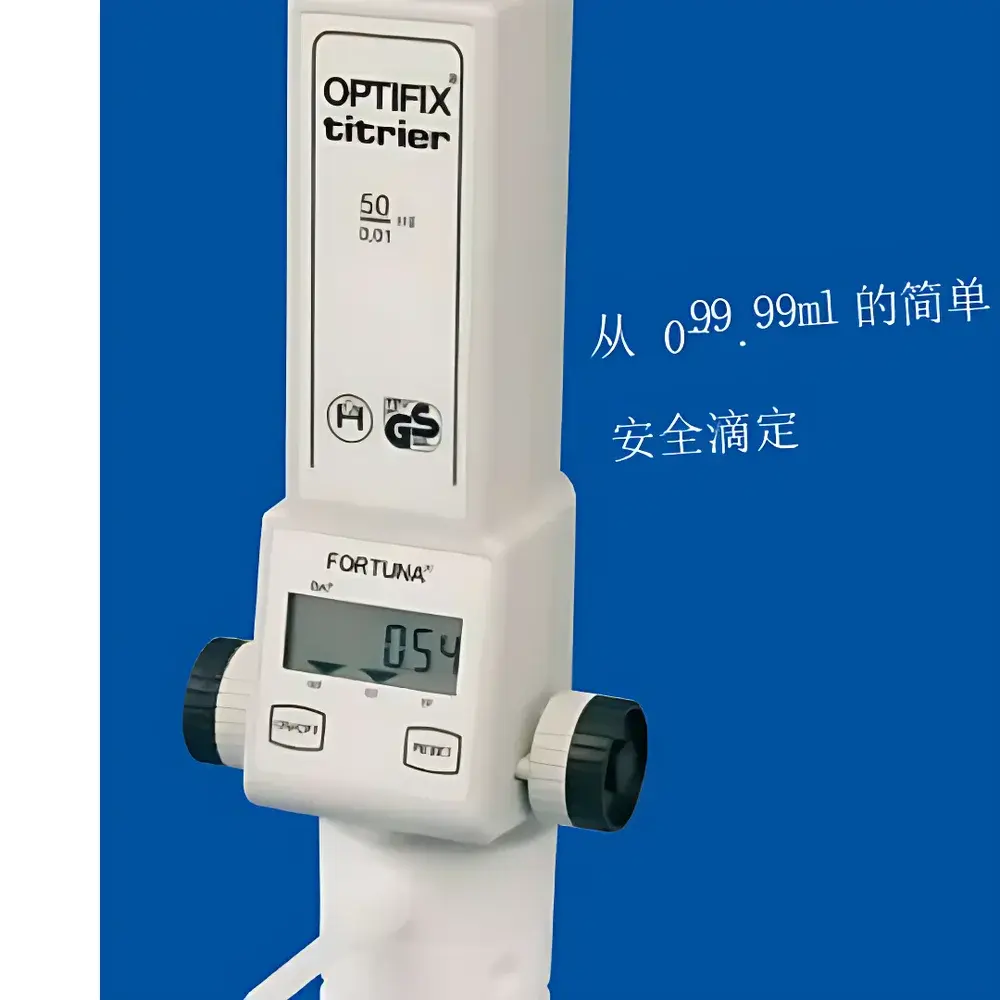
FORTUNA® OPTIFIX® Digital Dispensing Titrator
| Brand | FORTUNA |
|---|---|
| Country of Origin | Germany |
| Model | OPTIFIX® Digital Dispensing Titrator |
| Dispenser Cylinder Volume | 50 mL |
| Maximum Display Value | 99.99 mL |
| Resolution | 0.01 mL |
| Accuracy | ±0.6% |
| Deviation | ±0.2% |
| Display Digit Height | 10 mm |
| Operating Tilt Angle | 10° |
| Valve Module Material | PTFE |
| Bottle Neck Connection | GL 32 (DIN 168) |
| Included Accessories | Two PTFE-coated bottle adapters (GL 40 & GL 45), One PTFE-coated delivery tube, Integrated ball valve in vent line |
Overview
The FORTUNA® OPTIFIX® Digital Dispensing Titrator is a precision-engineered electronic liquid handling instrument designed for repeatable, traceable, and operator-independent volumetric dispensing in analytical, quality control, and routine laboratory workflows. Unlike conventional mechanical burettes or analog dispensers, the OPTIFIX® employs a motor-driven piston mechanism with digital position feedback and real-time LCD readout to deliver defined volumes with high reproducibility. Its core operating principle relies on controlled linear displacement of a PTFE-coated piston within a calibrated glass cylinder, enabling both titration (TIT) and fill (FILL) modes without manual recalibration. The device complies with DIN EN ISO 8655-3 for piston-operated volumetric apparatus and meets GS safety certification requirements for electrical and mechanical integrity in laboratory environments.
Key Features
- Motor-driven dual-mode operation: automatic switching between titration (TIT) and filling (FILL) modes based on directional piston movement and flow detection.
- High-contrast 10 mm digit LCD display with directional arrow indicators—optimized for readability at a 10° forward tilt, supporting ergonomic use by left- and right-handed operators.
- PTFE-based fluid path: all wetted components—including piston, valve module, bottle adapters (GL 40 and GL 45), and delivery tube—are fully PTFE-coated or constructed from virgin PTFE, ensuring chemical resistance to strong acids, bases, oxidizers, and organic solvents.
- No metal springs or corrosion-prone actuation elements: eliminates drift due to oxidation or fatigue, supporting long-term accuracy stability under repeated use.
- Integrated vent-line ball valve prevents siphoning and enables safe, bubble-free priming—even with volatile or low-surface-tension liquids.
- Modular design allows rapid field replacement of cylinder assemblies and valve modules without tools, minimizing downtime during maintenance or cross-contamination mitigation.
Sample Compatibility & Compliance
The OPTIFIX® is validated for use with aqueous, alcoholic, halogenated, and highly corrosive reagents including concentrated HCl, HNO₃, NaOH, and HF solutions (when used with appropriate PTFE-rated accessories). It conforms to DIN 168 (GL 32) standard bottle neck dimensions and supports optional adapters for GL 40 and GL 45 vessels. The unit carries GS certification (Geprüfte Sicherheit), verifying compliance with German and EU safety directives (2014/35/EU Low Voltage Directive and 2014/30/EU EMC Directive). While not intrinsically rated for explosion-proof environments, its non-sparking PTFE architecture and absence of exposed conductive paths make it suitable for general-purpose chemical fume hood applications. Traceability is supported via manual log entry; though the device lacks built-in audit trail functionality, its fixed resolution (0.01 mL) and stable accuracy (±0.6%) align with GLP documentation requirements when paired with standardized SOPs.
Software & Data Management
The OPTIFIX® operates as a standalone electromechanical instrument without embedded firmware or data export capability. All volume readings are displayed in real time on the integrated LCD and must be manually recorded. No USB, Bluetooth, or RS-232 interface is provided; therefore, integration with LIMS or ELN systems requires external transcription or secondary capture via digital lab notebooks. However, its deterministic mechanical response—free from software-dependent calibration drift—ensures consistent performance across extended operational lifecycles without firmware updates or validation requalification. For regulated environments requiring 21 CFR Part 11 compliance, users may implement procedural controls (e.g., dual-operator verification, timestamped logbooks) to satisfy electronic record integrity requirements.
Applications
- Standardized acid-base and redox titrations in ISO/IEC 17025-accredited testing laboratories.
- Preparation of certified reference material (CRM) dilutions in environmental labs analyzing wastewater, soil extracts, or air particulate leachates.
- Batch-wise reagent addition in food safety testing (e.g., AOAC 992.15 for preservative quantification) where repeatability across analysts is critical.
- Controlled dosing of catalysts or initiators in polymer synthesis R&D, where microgram-level consistency affects reaction kinetics.
- Calibration of spectrophotometric cuvettes and ICP-MS sample introduction systems requiring sub-milliliter precision.
FAQ
Does the OPTIFIX® support programmable dispensing sequences or multi-step protocols?
No. It is a single-axis, single-volume-per-actuation device optimized for manual operator control—not automated method execution.
Can the 50 mL cylinder be replaced with other capacities?
No. The OPTIFIX® is calibrated exclusively for its factory-installed 50 mL cylinder. Alternate volumes require separate model variants.
Is the device compatible with pressurized reservoirs or inert gas blankets?
Yes—provided the vent line remains unobstructed and the integrated ball valve is functional. Positive pressure up to 0.5 bar is tolerated without seal failure.
What maintenance intervals are recommended for GL 32 adapter seals?
PTFE seals require no scheduled replacement but should be inspected visually before each use for cracking or deformation—especially after exposure to chlorinated solvents.
How is accuracy verified during routine QC checks?
By gravimetric assessment per ISO 8655-6: dispense three replicates of 10.00 mL into a tared vessel on a Class I analytical balance (0.1 mg readability), then calculate mean error and standard deviation against theoretical mass.



