
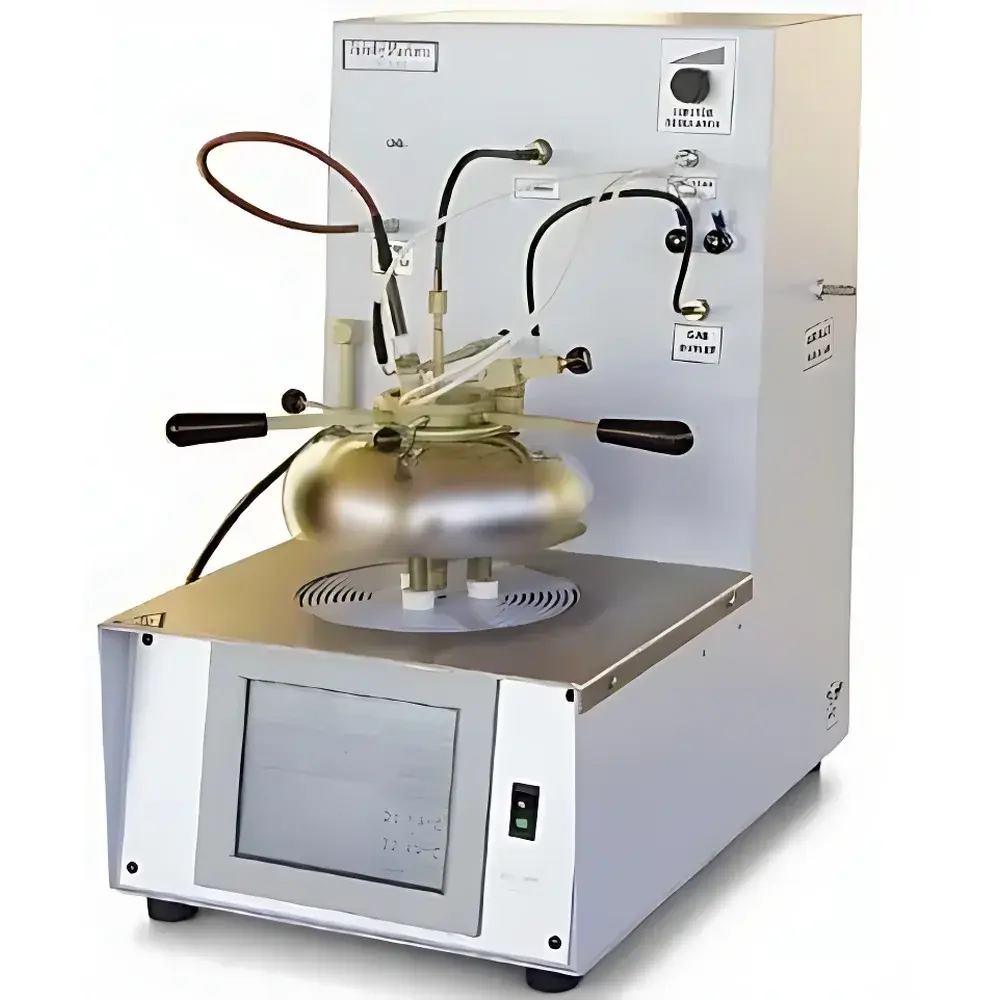
Pensky-Martens Automatic Closed-Cup Flash Point Tester Model 600-SA
| Origin | Switzerland |
|---|---|
| Manufacturer Type | Authorized Distributor |
| Origin Category | Imported Instrument |
| Model | 600-SA |
| Pricing | Available Upon Request |
Overview
The Pensky-Martens Automatic Closed-Cup Flash Point Tester Model 600-SA is a precision-engineered instrument designed for fully automated flash point determination of petroleum products and related organic liquids in accordance with internationally recognized standard test methods. It operates on the fundamental principle of the Pensky-Martens closed-cup method, where a sample is heated under controlled conditions inside a sealed cup, and an ignition source is periodically introduced at predetermined temperature intervals. Detection of flame propagation—indicative of the flash point—is achieved via a high-sensitivity ionization detector that responds to minute changes in electrical conductivity caused by combustion intermediates. This physical-chemical detection mechanism ensures high reproducibility and eliminates subjective visual interpretation. The instrument is specifically engineered for routine quality control, regulatory compliance testing, and R&D applications across refineries, lubricant manufacturers, fuel distributors, and third-party testing laboratories.
Key Features
- Fully automated operation compliant with ASTM D93 (Method A & B), ASTM D3941, ASTM E502, IP 34, ISO 2719, EN 22719, and DIN 51578
- Integrated ionization flame detection system with automatic ignition sequencing and real-time signal processing
- Dual-speed electronic stirrer (120 rpm and 240 rpm) meeting Method A and Method B requirements
- Precision PT100 Class A temperature sensor with ±0.1 °C accuracy and 0.06 °C resolution over the full operating range
- Copper sample cup with engraved volume markings, heat-resistant handle, and standardized geometry per ASTM/ISO specifications
- Electronic heating system with independent overtemperature protection circuitry and thermal cutoff
- Forced-air cooling system enabling rapid cooldown between tests and improved throughput
- Robust mechanical ignition actuator synchronized with temperature ramping logic
- CE-marked design meeting IEC 61010-1 safety requirements for laboratory electrical equipment
Sample Compatibility & Compliance
The Model 600-SA supports flash point analysis of a broad spectrum of volatile and semi-volatile liquid samples, including but not limited to gasoline, diesel fuel, kerosene, jet fuel, lubricating oils, biodiesel blends, industrial solvents, waste oils, and chemical intermediates. Its operational temperature range spans +35 °C to +370 °C, accommodating both low-flash hydrocarbons and high-boiling residual fuels. All hardware components—including the sample cup, air bath assembly, and ignition chamber—are manufactured to exact dimensional tolerances defined in ASTM D93 Annex A1 and ISO 2719 Clause 6. The instrument’s measurement uncertainty profile has been validated against certified reference materials traceable to NIST and BAM standards, ensuring alignment with GLP and ISO/IEC 17025 accreditation requirements. Data integrity is maintained through audit-trail-capable software logging, supporting FDA 21 CFR Part 11 readiness when configured with appropriate user access controls.
Software & Data Management
LabLink software—compatible with Windows 2000, XP, and Vista—provides centralized control of up to ten 600-SA analyzers simultaneously. The interface features modular architecture with four core functional menus: Analysis (method definition, sequence scheduling, real-time monitoring), Diagnostics (sensor calibration status, hardware self-test reports), Calibration (multi-point PT100 verification, ionization threshold adjustment), and Data Processing (statistical summary, trend analysis, export to CSV or Excel). Users may define custom test protocols—including ramp rate, dwell time, ignition frequency, and pass/fail criteria—and configure report templates with embedded logos, headers, and metadata fields. All test events—including temperature logs, ignition attempts, flame detection timestamps, and operator actions—are timestamped and stored with immutable digital signatures. Exported datasets retain full traceability for inclusion in LIMS environments or regulatory submissions.
Applications
This instrument serves critical roles in petroleum product specification verification (e.g., ASTM D4052 density correlation, D97 pour point validation), refinery process stream monitoring, finished fuel certification prior to shipment, hazardous material classification per UN GHS and DOT regulations, environmental waste characterization (EPA SW-846 Method 1010A), and formulation development of specialty lubricants and biofuels. Its robustness and method fidelity make it suitable for use in ISO 17025-accredited laboratories performing contract testing for OEMs and regulatory agencies. Routine maintenance includes periodic verification using certified flash point standards (e.g., n-decane, tetralin, and cetane), while annual recalibration of the PT100 probe and ionization detector is recommended to sustain metrological confidence.
FAQ
What standards does the 600-SA comply with?
It conforms to ASTM D93 (Methods A and B), ASTM D3941, ASTM E502, IP 34, ISO 2719, EN 22719, and DIN 51578.
Is the instrument compatible with modern LIMS systems?
Yes—LabLink supports CSV and Excel exports; custom API integration is available upon request for validated LIMS interfacing.
Can the 600-SA be used for waste oil analysis?
Yes, provided the sample viscosity and particulate content fall within the instrument’s handling limits as defined in ASTM D93 Annex A3.
What maintenance is required for long-term accuracy?
Quarterly cleaning of the copper cup and ignition nozzle, biannual verification with certified reference standards, and annual PT100 and ionization detector recalibration are recommended.
Does the system support 21 CFR Part 11 compliance?
When deployed with LabLink v3.2+ and configured with role-based user accounts, electronic signatures, and audit trail activation, it meets foundational Part 11 requirements for electronic records and signatures.





