
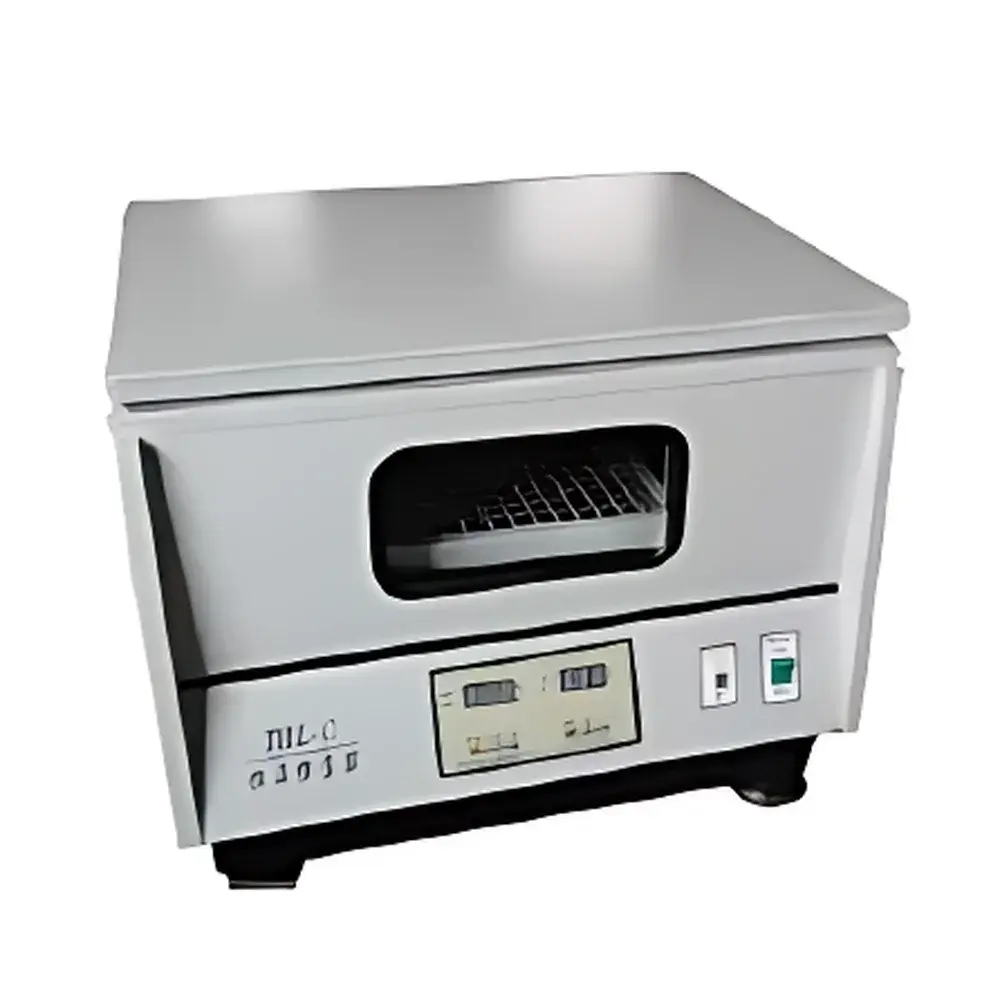
Qiangle THZ-C Precision Temperature-Controlled Orbital Shaker
| Origin | Jiangsu, China |
|---|---|
| Manufacturer Type | Authorized Distributor |
| Product Origin | Domestic (China) |
| Model | THZ-C Temperature-Controlled Orbital Shaker |
| Quotation | USD 980 (FOB Jiangsu) |
| Instrument Category | General-Purpose Laboratory Orbital Shaker |
| Timing Range | None (Manual Operation Only) |
| Oscillation Frequency | 40–300 rpm, Continuously Adjustable with Digital Display and Memory Retention |
| Oscillation Amplitude | 25 mm (Standard Orbital Motion) |
| Temperature Control Range | Ambient +5°C to 60°C (Digital PID Controller, ±0.3°C Stability at 37°C) |
| Platform Quantity | Single Deck |
| Maximum Load Capacity | 6 × 1000 mL Erlenmeyer Flasks (Configurable with Universal Clamps or Tube Holders) |
| Noise Level | <50 dB(A) at 1 m Distance (Measured at 300 rpm, No Load) |
| Interior Illumination | Integrated White LED Lighting (Switchable, Non-UV, for Visual Monitoring) |
| Dimensions (W×D×H) | 500 × 610 × 490 mm |
| Total Power Consumption | 300 W (Heating Element: 250 W |
| Motor & Control Circuitry | 50 W) |
| Electrical Supply | 220 V AC, 50 Hz, Single-Phase |
Overview
The Qiangle THZ-C Precision Temperature-Controlled Orbital Shaker is an engineered platform for reproducible, low-shear mixing and incubation of biological and chemical samples under tightly regulated thermal conditions. Designed around a robust brushless DC motor and a precision-machined eccentric drive mechanism, the shaker delivers stable orbital motion (25 mm diameter) across its full frequency range—enabling uniform suspension of microbial cultures, cell lines, enzyme assays, and immunoassay plates. Its integrated Peltier-free resistive heating system, coupled with a digital PID temperature controller and high-resolution NTC sensor array, maintains setpoint accuracy within ±0.3°C at 37°C—a performance benchmark aligned with ISO 13485–compliant laboratory workflows. Unlike convection-based incubators, the THZ-C combines thermal regulation and mechanical agitation in a single compact footprint, eliminating cross-contamination risks associated with external water baths or separate incubation chambers.
Key Features
- Digitally controlled oscillation frequency (40–300 rpm), continuously adjustable via front-panel keypad with real-time display and automatic parameter retention after power cycling
- PID-driven temperature regulation from ambient +5°C to 60°C, featuring dual-point calibration support and overtemperature cut-off protection (hardware-limited to 65°C)
- Single-tier stainless-steel platform (320 × 350 mm usable area) compatible with universal clamps, flask holders (up to 6 × 1000 mL), microplate adapters, and test tube racks
- Low-noise operation (<50 dB[A] at 1 m, per IEC 61672-1) achieved through vibration-damped motor mounting and balanced drive shaft assembly
- Integrated white LED lighting with independent switch—designed for non-phototoxic visual inspection without UV emission or thermal load on samples
- Compliance-ready design: CE-marked per EN 61010-1 (Safety Requirements for Electrical Equipment for Measurement, Control, and Laboratory Use) and EN 61326-1 (EMC for Laboratory Instruments)
Sample Compatibility & Compliance
The THZ-C supports a broad spectrum of life science sample formats—including Erlenmeyer flasks (50–1000 mL), culture tubes (13–50 mm OD), 96-well microplates (flat-bottom and U/V-bottom), and custom glassware mounted via optional silicone-coated clamps. Its non-condensing chamber design prevents moisture accumulation during extended runs at elevated temperatures, reducing contamination risk in sterile applications. While not certified for GMP manufacturing environments, the unit meets essential requirements for GLP-compliant research labs: audit-trail-capable parameter logging (via optional RS-232/USB interface), traceable calibration documentation, and mechanical stability validated per ASTM D4767 (for orbital shaker repeatability). It is routinely deployed in academic microbiology, biopharmaceutical QC, and diagnostic reagent development where ISO/IEC 17025-aligned equipment qualification is required.
Software & Data Management
The THZ-C operates as a standalone instrument with embedded firmware supporting manual mode only. For laboratories requiring electronic records, an optional RS-232 serial interface (standard on THZ-C-PRO variant) enables connection to LIMS or ELN systems using ASCII command protocol (e.g., “GET_TEMP”, “SET_RPM”). Parameter changes are logged locally in non-volatile memory with timestamp (YYYY-MM-DD HH:MM format), supporting retrospective review during internal audits. Though not FDA 21 CFR Part 11 compliant out-of-the-box, the device may be integrated into Part 11–governed workflows when paired with validated third-party data acquisition software that enforces electronic signature, audit trail, and role-based access control.
Applications
- Microbial growth kinetics (E. coli, yeast, Bacillus spp.) under controlled aeration and temperature
- Protein solubilization and antigen-antibody binding kinetics in ELISA and lateral flow assay development
- Cell suspension culture maintenance for CHO and HEK293 lines prior to transfection or harvesting
- Solvent extraction efficiency studies in natural product isolation (e.g., polyphenols from plant matrices)
- Environmental sample homogenization for wastewater BOD/COD analysis per APHA Standard Methods 5210B
- Reagent shelf-life validation under accelerated thermal stress (ICH Q1A guidelines)
FAQ
Does the THZ-C support programmable ramping or multi-step protocols?
No—the THZ-C operates in fixed-setpoint mode only. For time-dependent temperature or speed profiles, consider the THZ-C-PRO variant with programmable controller and USB data logging.
Is the platform autoclavable or chemically resistant?
The stainless-steel deck is corrosion-resistant to 70% ethanol, 10% bleach, and common laboratory detergents; however, it is not autoclavable due to integrated electronics and thermal sensors.
Can the THZ-C be used for anaerobic culture applications?
Yes—when placed inside a modular anaerobic chamber (e.g., Coy Labs or Don Whitley systems), the THZ-C maintains stable oscillation and temperature without interference from nitrogen/hydrogen atmospheres.
What is the recommended recalibration interval for temperature and speed sensors?
Per manufacturer recommendation and ISO/IEC 17025 guidance, annual verification against NIST-traceable references is advised—using a calibrated digital thermometer (±0.1°C) and optical tachometer (±1 rpm).
Is there a warranty extension option for continuous 24/7 operation?
Standard warranty covers 24 months parts-and-labor under normal laboratory use (≤16 hrs/day); extended coverage for round-the-clock operation requires prior written agreement and installation of enhanced thermal management kit (optional accessory).




