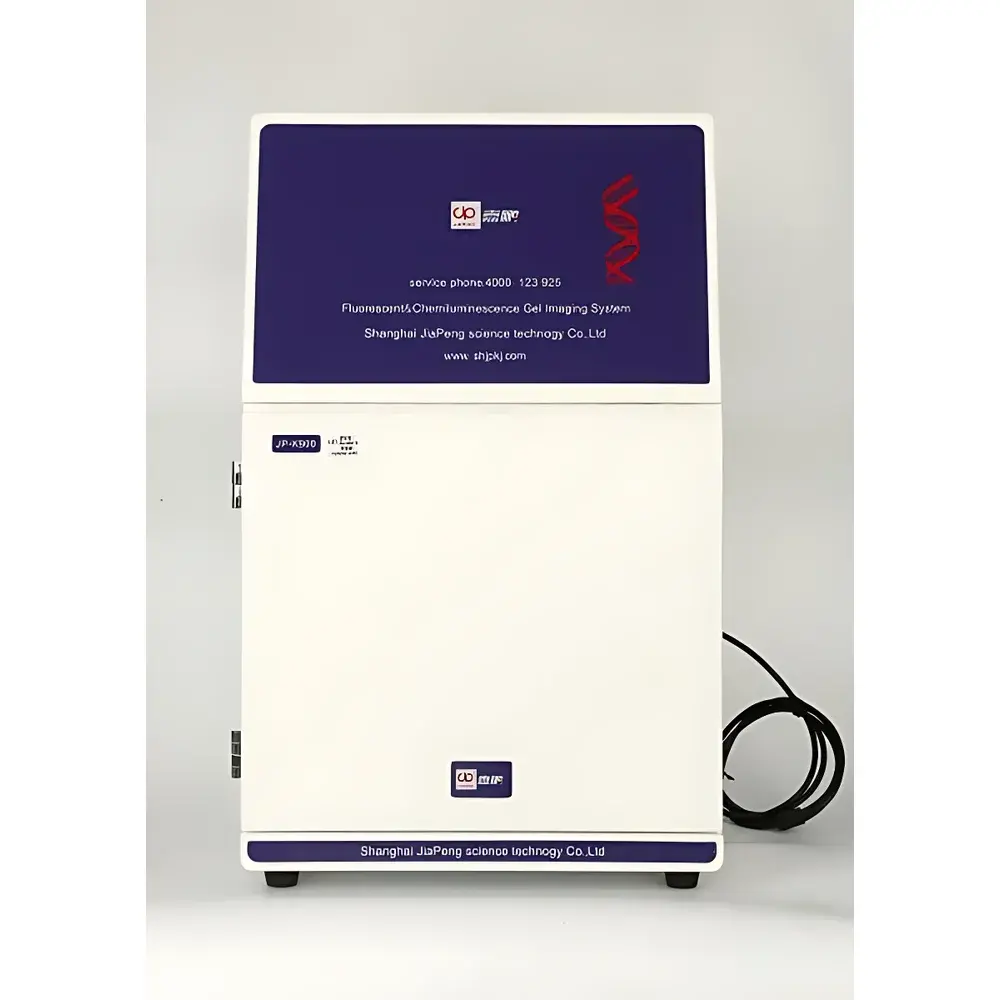
Jiapeng JP-K300 Chemiluminescence Gel Imaging System
| Brand | Jiapeng |
|---|---|
| Origin | Shanghai, China |
| Manufacturer Type | Authorized Distributor |
| Product Category | Domestic |
| Model | JP-K300 |
| Instrument Type | Chemiluminescence Gel Imaging System |
| CCD Resolution | 9 MP (3000 × 3000) |
| Bit Depth | 16-bit |
| Dynamic Range | 4.8 OD |
| CCD Sensor Size | 4/3" |
| Pixel Size | 5.4 µm × 5.4 µm |
| Cooling Temperature | −45 °C (ΔT ≈ −65 °C vs ambient) |
| Quantum Efficiency | >75% |
| Lens Aperture | f/0.95 Fixed-Focus Macro Lens |
| White Light Source | Top-Mounted Uniform LED Panel |
| Minimum Detectable DNA | 0.01 ng (EB-stained) |
| Dark Current | <0.0005 e⁻/pixel/s |
| SNR | ≥56 dB |
| Dual Imaging Area | 9.5 × 9.5 cm & 12.5 × 12.5 cm |
| Power Input | AC 220 V, 50/60 Hz |
| Dimensions (W×D×H) | 390 × 440 × 735 mm |
| Weight | 18.3 kg |
Overview
The Jiapeng JP-K300 Chemiluminescence Gel Imaging System is a fully automated, high-sensitivity digital imaging platform engineered for quantitative analysis of nucleic acids and proteins resolved by electrophoresis, blotting, and chemiluminescent or bioluminescent detection. It operates on the principle of low-noise, cooled CCD-based photon capture—optimized for ultra-low-light signal acquisition across UV transillumination (for ethidium bromide or SYBR-safe stained gels), visible white-light reflection (for membrane documentation), and highly sensitive chemiluminescence detection (e.g., HRP- or AP-conjugated secondary antibodies in Western blots). The system integrates a thermoelectrically cooled Sony IMX533CLK-D sensor with 4/3″ optical format and deep-cooling capability (−45 °C stabilized), enabling extended exposure times without thermal noise accumulation—critical for detecting faint bands in low-abundance target proteins or small RNA species. Its f/0.95 fixed-focus macro lens ensures maximum photon throughput and spatial fidelity across the entire field of view, eliminating focus drift during multi-step acquisitions.
Key Features
- High-performance cooled CCD detector: Sony IMX533CLK-D sensor (4/3″, 3000 × 3000 pixels, 9 MP) with selectable binning modes (1×1 to 8×8) for optimized sensitivity/resolution trade-offs
- Deep thermoelectric cooling: Stable −45 °C operation (up to 65 °C below ambient), reducing dark current to <0.0005 e⁻/pixel/s and supporting exposures up to 60 minutes
- Ultra-fast optical train: f/0.95 high-transmission fixed-focus macro lens—no manual focusing required; optional f/0.8 lens available for enhanced light gathering
- Dual-format sample stage: Drawer-style dual-position platform (9.5 × 9.5 cm and 12.5 × 12.5 cm active areas) accommodates standard mini- and midi-gels, transfer membranes, and petri dishes
- Uniform top-mounted white LED illumination: Engineered for consistent reflectance imaging of nitrocellulose or PVDF membranes with minimal hot-spot artifacts
- Integrated UV transilluminator (302 nm, optional 365 nm): Equipped with protective interlock and fold-down safety shield compliant with IEC 61010-1
- User-programmable auto-shutdown: Timer-controlled source deactivation (0–60 min) minimizes unnecessary exposure and extends LED/lamp lifetime
- Anti-scatter sample tray design: Reduces stray light contamination, improving contrast and dynamic range reproducibility across repeated acquisitions
Sample Compatibility & Compliance
The JP-K300 supports a broad range of life science sample formats including agarose and polyacrylamide gels (stained with EB, SYBR Gold, GelRed, or Coomassie), nitrocellulose and PVDF membranes post-electrophoretic transfer, autoradiography films (digitization mode), and luminescent cell-based assays (e.g., luciferase reporter plates). All optical and electrical subsystems comply with IEC 61010-1 (Safety Requirements for Electrical Equipment for Measurement, Control, and Laboratory Use) and IEC 62471 (Photobiological Safety of Lamps and Lamp Systems). The system’s firmware architecture supports audit-trail-enabled operation under GLP and GMP environments when paired with validated software configurations—meeting foundational requirements for data integrity per FDA 21 CFR Part 11 Annex 11 (where electronic records and signatures are employed).
Software & Data Management
The JP-K300 is operated via Jiapeng’s proprietary GelCapture Pro software (Windows 10/11 compatible), which provides full instrument control, real-time preview, exposure optimization, background subtraction, lane/band profiling, molecular weight calibration, and densitometric quantification. Raw image data is saved in lossless TIFF format with embedded metadata (exposure time, gain, lens ID, temperature, timestamp). Batch processing workflows support alignment, normalization, and export to CSV or Excel for statistical analysis. Software modules include pre-configured SOP templates for common applications (e.g., “Western Blot Quantitation,” “DNA Ladder Analysis”) and optional add-ons for multi-channel fluorescence overlay and chemiluminescence decay curve modeling. All user actions—including parameter changes, image annotations, and report generation—are logged with timestamps and operator IDs to satisfy traceability requirements.
Applications
- Quantitative Western blot analysis using HRP- or alkaline phosphatase-mediated chemiluminescence substrates (e.g., ECL, CDP-Star)
- DNA/RNA gel documentation and band intensity normalization against internal standards (e.g., β-actin, GAPDH, rRNA)
- Colony hybridization and Southern/Northern blot imaging
- Protein expression profiling via Coomassie- or silver-stained SDS-PAGE gels
- Cell-based luminescent assays including luciferase reporter gene activity and ATP viability measurements
- Digital archiving of electrophoretic results for regulatory submissions (e.g., IND, BLA dossiers requiring raw image traceability)
- Educational laboratory instruction in molecular biology techniques requiring reproducible, publication-grade imaging
FAQ
What is the minimum detectable amount of DNA using ethidium bromide staining?
The JP-K300 achieves detection limits of ≤0.01 ng of EB-stained double-stranded DNA under standard 1-second exposure conditions.
Can the system acquire images from multiple exposure times automatically?
Yes—GelCapture Pro supports multi-exposure bracketing (up to 9 steps), enabling dynamic range extension and optimal signal capture across high- and low-intensity bands within a single run.
Is the CCD sensor capable of binning, and what are the available modes?
The IMX533CLK-D sensor supports hardware binning in 1×1, 2×2, 3×3, 4×4, 6×6, and 8×8 configurations—adjustable in real time to prioritize sensitivity (binned) or spatial resolution (unbinned).
Does the system meet regulatory requirements for use in quality-controlled laboratories?
When deployed with validated software configurations and documented SOPs, the JP-K300 satisfies core instrumentation requirements for GLP-compliant data acquisition and supports 21 CFR Part 11 readiness through audit-trail logging and user access controls.
What maintenance is required for long-term optical performance?
No routine lens cleaning or alignment is needed due to the fixed-focus optical design; periodic verification of white light uniformity and UV intensity using NIST-traceable calibration standards is recommended annually.