
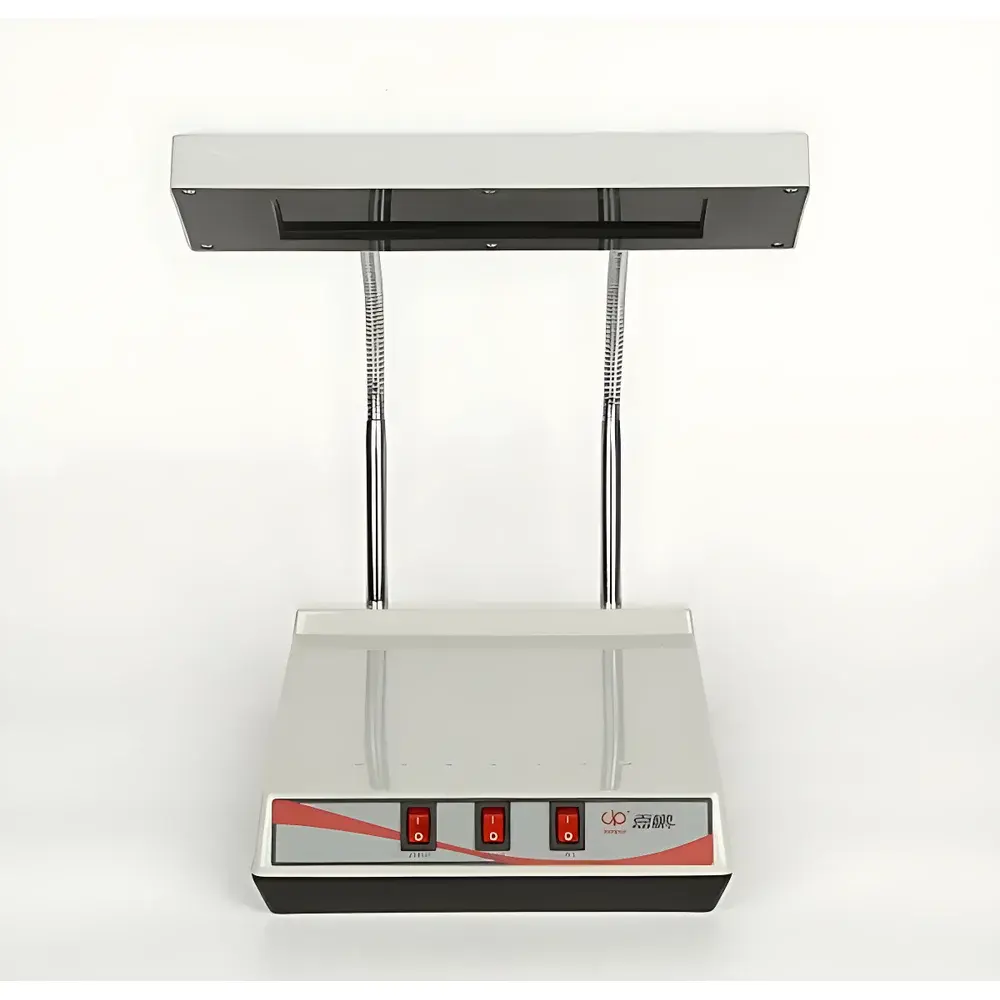
Jiapeng ZF-6 Desktop Triple-Mode UV Transilluminator
| Brand | Jiapeng |
|---|---|
| Origin | Shanghai, China |
| Model | ZF-6 |
| Instrument Type | Benchtop |
| Wavelength Modes | 254 nm and 365 nm (dual-band) |
| UV Filter Dimensions | 200 × 50 mm |
| UV Lamp Power | 8 W × 2 |
| Visible Light Lamp | 4 W × 1 |
| UV Intensity | 20 µW/cm² at 20 cm distance |
| Input Voltage | AC 220 V, 50/60 Hz |
| Dimensions (L×W×H) | 270 × 280 × 270 mm |
| Weight | 1.2 kg |
| Compliance | JJF 1936–2021 (National Verification Regulation for UV Analyzers) |
| Enclosure Material | High-strength, eco-friendly ABS polymer |
| UV Lamp Angle | Adjustable |
| Regulatory Status | Domestic (PRC) |
| Manufacturer Role | Authorized Distributor |
Overview
The Jiapeng ZF-6 Desktop Triple-Mode UV Transilluminator is a compact, benchtop instrument engineered for routine fluorescence visualization and gel documentation in molecular biology laboratories. It operates on the principle of ultraviolet-induced fluorescence excitation—where nucleic acids or proteins labeled with UV-sensitive dyes (e.g., ethidium bromide, SYBR Safe, or GelRed) absorb incident UV photons at 254 nm or 365 nm and re-emit visible light, enabling rapid detection and qualitative assessment of electrophoretic bands. Unlike high-end imaging systems, the ZF-6 delivers core transillumination functionality without integrated cameras or software-based quantification, making it suitable for labs requiring cost-effective, reliable, and low-maintenance visualization during agarose or polyacrylamide gel analysis, colony screening, or thin-layer chromatography (TLC) plate inspection.
Key Features
- Benchtop form factor with footprint under 0.08 m²—optimized for space-constrained lab benches and biosafety cabinets.
- Dual-wavelength UV emission (254 nm and 365 nm) via independently switchable lamp modules, supporting both high-sensitivity DNA detection (254 nm) and low-photodamage visualization (365 nm).
- High-transmission 200 × 50 mm UV interference filter ensures spectral purity and minimizes background scatter, enhancing contrast for faint bands.
- Adjustable UV lamp angle enables optimal illumination geometry across varied sample heights—including thick gels, multiwell plates, or irregularly shaped specimens.
- Robust ABS polymer housing—molded in one piece—provides mechanical stability, chemical resistance to common decontamination agents (e.g., 10% bleach, 70% ethanol), and compliance with IEC 61010-1 safety standards for laboratory electrical equipment.
- Calibrated UV output: 20 µW/cm² at 20 cm distance, verified per JJF 1936–2021—the national metrological verification regulation governing UV analyzer performance in China.
- Included visible white-light module (4 W) supports side-by-side comparison of stained gels under ambient illumination, aiding band identification and manual documentation.
Sample Compatibility & Compliance
The ZF-6 accommodates standard electrophoresis formats including mini-gels (up to 10 × 10 cm), TLC plates (20 × 20 cm), and Petri dishes (up to 100 mm diameter). Its open-top design permits direct access for UV-guided excision (i.e., “gel cutting”) using sterile scalpels or razor blades—though users must employ appropriate PPE (UV-blocking goggles, nitrile gloves, lab coat) per OSHA and ISO 20471 guidelines. The instrument meets JJF 1936–2021 requirements for irradiance uniformity, spectral bandwidth tolerance, and timer accuracy. While not certified to FDA 21 CFR Part 11 or ISO/IEC 17025, its design aligns with GLP-relevant operational controls when used within documented SOPs for qualitative gel assessment in academic, teaching, and QC environments.
Software & Data Management
The ZF-6 is a hardware-only transilluminator with no embedded microprocessor, touchscreen, or digital interface. It features a simple ship-type toggle switch for selecting 254 nm, 365 nm, or visible light modes—ensuring operational reliability, minimal failure points, and immunity to firmware corruption. As such, it generates no electronic records, audit trails, or metadata. Users intending to capture images must pair the unit with an external DSLR or scientific camera equipped with UV-transmissive optics and appropriate long-pass filters. No proprietary drivers or calibration software are required or provided.
Applications
- Routine visualization of DNA/RNA bands in agarose and polyacrylamide gels post-electrophoresis.
- Fluorescent dye-based protein detection (e.g., SYPRO Ruby-stained SDS-PAGE gels).
- TLC plate analysis for compound separation validation in organic synthesis and natural product isolation.
- Microbial colony screening on UV-responsive media (e.g., X-Gal plates for β-galactosidase activity).
- Forensic document examination and archaeological artifact fluorescence surveying (e.g., ink differentiation, pigment aging studies).
- Educational demonstrations of UV photophysics and nucleic acid staining principles in undergraduate life science curricula.
FAQ
Does the ZF-6 include a built-in camera or imaging system?
No. It is a dedicated transilluminator only; image capture requires an external camera and appropriate UV-blocking filters.
Can the ZF-6 be used for UV crosslinking of nucleic acids?
No. Its UV output intensity and spectral profile are optimized for visualization—not covalent crosslinking, which typically requires >100 mJ/cm² doses from dedicated UV crosslinkers.
Is the 254 nm mode safe for prolonged exposure?
254 nm UV-C radiation poses significant biological hazard. Always use certified UV-protective eyewear and minimize skin exposure; limit activation time to essential observation periods.
How often should the UV lamps be replaced?
Lamp efficacy declines after ~1,000 hours of cumulative operation. Replace both lamps simultaneously to maintain uniform irradiance across the viewing area.
Does the ZF-6 comply with international electromagnetic compatibility (EMC) standards?
It conforms to GB/T 18268.1–2010 (equivalent to IEC 61326-1), the Chinese national standard for EMC in laboratory equipment, but lacks CE or UKCA marking for EU/UK deployment.



