
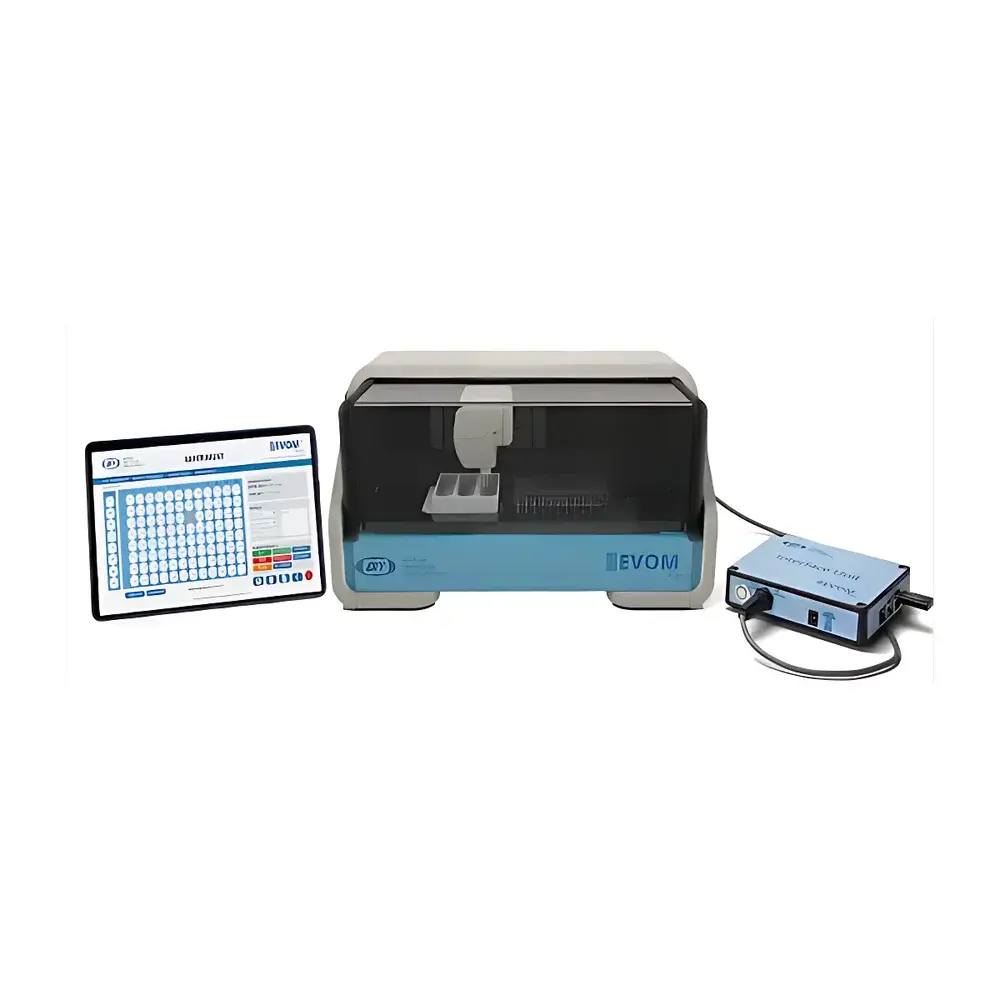
WPI EVOM AUTO Automated Transepithelial Electrical Resistance (TEER) Measurement System
| Brand | WPI |
|---|---|
| Origin | USA |
| Model | EVOM AUTO |
| Electrode Configurations | 8-pair or 4-pair |
| Compatible Plates | 96-well and 24-well formats (MatTek, Millipore, Corning) |
| In-Cubator Design | Yes, CO₂-compatible |
| Cleaning Stations | 3 integrated stations (pre-, mid-, and post-measurement |
| Control Interface | Web-based software with collision protection algorithm |
| Data Transfer | Secure, encrypted cloud- and local-network-enabled transfer via dedicated mobile app |
| Compliance | Designed for GLP/GMP-aligned workflows |
Overview
The WPI EVOM AUTO is an automated, incubator-compatible transepithelial electrical resistance (TEER) measurement system engineered for quantitative, non-invasive assessment of barrier integrity in monolayer cultures of epithelial and endothelial cells. It operates on the principle of alternating current (AC) impedance spectroscopy at low frequency (typically 12.5–25 Hz), applying a small sinusoidal voltage across a pair of Ag/AgCl electrodes positioned above and below the cell monolayer. The resulting current is measured to calculate real-time TEER values (Ω·cm²), which correlate directly with the tight junction formation, paracellular permeability, and functional maturity of the barrier model. Unlike manual or semi-automated systems, the EVOM AUTO eliminates operator-induced variability through fully programmable, position-accurate electrode actuation—enabling reproducible, high-throughput kinetic profiling of barrier dynamics under physiological conditions (e.g., 37 °C, 5% CO₂). Its compact footprint and sealed electronics allow direct integration into standard tissue culture incubators, minimizing thermal and pH perturbations during longitudinal measurements.
Key Features
- Fully automated electrode positioning with microstepper-driven Z-axis control and optical end-stop detection to prevent physical contact between electrodes and membrane inserts.
- Dual-configurable electrode arrays: 8-pair configuration for parallel TEER acquisition across all wells of a 96-well plate; 4-pair configuration optimized for 24-well plates or targeted multi-point sampling within larger formats.
- Three integrated cleaning and conditioning stations—including pre-measurement rinse, in-process electrolyte refresh, and post-measurement chlorination—ensuring consistent electrode surface chemistry and eliminating carryover artifacts.
- Web-native control software accessible via any modern browser (Chrome, Edge, Safari); no local installation or version-dependent updates required. Software architecture supports role-based user permissions and time-stamped session logging.
- Built-in collision avoidance logic continuously monitors motor torque and positional feedback to halt movement if unexpected resistance is detected—protecting both electrodes and delicate transwell membranes.
- Native compatibility with industry-standard transwell platforms from MatTek, Merck Millipore, and Corning, including polyester and polycarbonate membranes with pore sizes ranging from 0.4 µm to 3.0 µm.
Sample Compatibility & Compliance
The EVOM AUTO supports a broad range of in vitro barrier models, including but not limited to Caco-2, MDCK, HT-29, Calu-3, hCMEC/D3, RF/6A, ARPE-19, and primary human-derived epithelial and endothelial isolates. It is routinely deployed in studies requiring adherence to regulatory guidance frameworks—including ICH S7B, USP , and ISO 10993-12—for evaluating drug-induced barrier disruption or protective efficacy. The system’s firmware and software are architected to support ALCOA+ data integrity principles: attributable, legible, contemporaneous, original, accurate, complete, consistent, enduring, and available. Audit trails, electronic signatures, and exportable raw impedance datasets comply with FDA 21 CFR Part 11 and EU Annex 11 expectations for regulated environments.
Software & Data Management
Control and analysis are executed via WPI’s web-hosted TEER Manager platform, which provides real-time visualization of resistance trends, automatic baseline correction, and configurable pass/fail thresholds per well or plate. All measurement metadata—including timestamp, electrode ID, plate barcode (optional scanner integration), environmental sensor logs (temperature, CO₂), and user credentials—are embedded in each exported dataset (CSV, Excel, or HDF5). Encrypted data synchronization occurs over secure HTTPS or local LAN; optional integration with LIMS or ELN systems is supported via RESTful API. Mobile application functionality enables remote monitoring, ad hoc measurement triggering, and secure export to institutional cloud storage—without compromising firewall integrity.
Applications
- High-throughput screening of compound effects on intestinal, pulmonary, blood-brain, retinal, placental, and testicular barrier integrity.
- Quantitative evaluation of cytokine- or pathogen-mediated barrier disruption (e.g., TNF-α, IL-4, influenza A, SARS-CoV-2 spike protein).
- Longitudinal monitoring of monolayer maturation, confluence kinetics, and recovery post-wounding or chemical insult.
- Permeability correlation studies combining TEER with fluorescent tracer assays (e.g., FITC-dextran, sodium fluorescein) to distinguish paracellular vs. transcellular transport mechanisms.
- Toxicological profiling of nanomaterials, surfactants, or environmental pollutants using standardized barrier models per OECD TG 461 and ECVAM protocols.
- Pharmacodynamic validation of barrier-protective therapeutics—including Rho kinase inhibitors, JAK/STAT modulators, and tight junction protein stabilizers.
FAQ
Can the EVOM AUTO operate inside a standard CO₂ incubator without modification?
Yes—the system is rated for continuous operation at 37 °C and 5% CO₂; its electronics are conformally coated, and all moving components are sealed against humidity ingress.
Does the system require calibration before each use?
No routine recalibration is needed; factory calibration is traceable to NIST standards. Users perform daily verification using supplied 1000 Ω and 100 Ω reference resistors.
Is raw impedance phase and magnitude data accessible for advanced modeling?
Yes—full AC impedance spectra (|Z| and phase angle) are recorded at each measurement point and exportable for equivalent circuit modeling (e.g., Cole-Cole plots, Rb/Rt parameter extraction).
How does the system handle edge effects in 96-well plates?
Electrode positioning algorithms automatically compensate for meniscus curvature and well-to-well height variation using real-time capacitive sensing prior to voltage application.
Can multiple EVOM AUTO units be synchronized for parallel plate processing?
Yes—centralized orchestration is supported via the TEER Manager server, enabling staggered or simultaneous acquisition across up to 8 instruments with shared protocol templates and consolidated reporting.




