
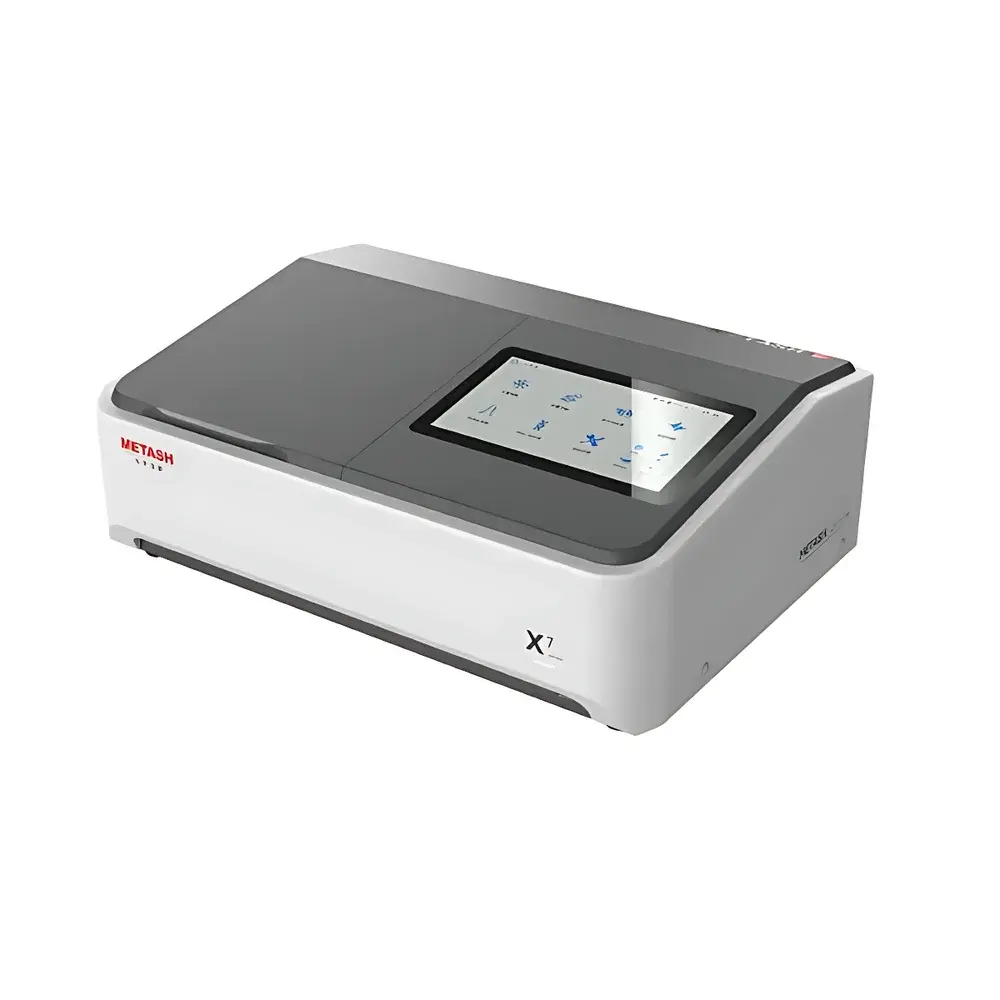
Metash X-7 UV-Vis Spectrophotometer
| Brand | Metash Instruments |
|---|---|
| Origin | Shanghai, China |
| Manufacturer Type | Direct Manufacturer |
| Model | X-7 |
| Optical System | Pseudo-Double-Beam |
| Detector | Silicon Photodiode |
| Wavelength Range | 190–1100 nm |
| Wavelength Accuracy | ±0.1 nm at D₂ line (656.1 nm), ±0.3 nm across full range |
| Wavelength Repeatability | ≤0.1 nm |
| Spectral Bandwidth | 1.8 nm |
| Stray Light | ≤0.03% T |
| Photometric Range | 0–200% Transmittance, –4.0 to +4.0 Absorbance, 0–9999 Concentration Units |
| Display | 10-inch capacitive multi-touch TFT LCD |
| Data Interface | USB 2.0 (for printer, flash drive, and PC connectivity) |
| Lamp Source | Imported long-life tungsten and deuterium lamps |
Overview
The Metash X-7 UV-Vis Spectrophotometer is a high-performance, pseudo-double-beam optical instrument engineered for precision quantitative and qualitative analysis in routine laboratory environments. It operates on the fundamental principle of Beer–Lambert law-based absorbance measurement, utilizing a stabilized dual-beam optical path that continuously monitors and compensates for source intensity drift in real time. This architecture significantly enhances baseline stability and photometric reproducibility—critical for regulatory-compliant workflows in pharmaceutical QC, environmental testing, food safety, and academic research. The instrument integrates a rigid 16 mm machined aluminum optical baseplate, isolating the entire light path from mechanical deformation or external vibration—a design feature directly contributing to long-term wavelength fidelity and inter-day measurement consistency.
Key Features
- Pseudo-double-beam optical system with real-time reference beam monitoring to correct for lamp intensity fluctuations and thermal drift.
- 10-inch industrial-grade capacitive multi-touch display with full-color TFT resolution (1280 × 800), enabling intuitive navigation, real-time spectral visualization, and on-device data annotation.
- Robust optical platform: suspended optical assembly mounted on a monolithic, stress-relieved aluminum chassis—eliminating micro-misalignment caused by thermal expansion or table vibration.
- High-purity optical components including imported deuterium and tungsten-halogen lamps, precision diffraction grating, and low-noise silicon photodiode detector—ensuring ≤0.03% T stray light performance and extended lamp service life (>2000 h).
- Onboard analytical modes: photometric measurement, fixed-wavelength quantitation, full-spectrum scanning (190–1100 nm), kinetic assay, multi-wavelength analysis, DNA/protein A₂₈₀/A₂₆₀ ratio calculation, and customizable method storage.
- Comprehensive peripheral support: compatibility with automated 8-cell rotating cuvette holders, micro-volume adapters (down to 50 µL), Peltier-controlled temperature-regulated sample changers, integrating sphere reflectance modules, and solid-sample rotating stages.
Sample Compatibility & Compliance
The X-7 accommodates standard 10 mm pathlength quartz, glass, or plastic cuvettes, as well as specialized accessories for microvolume, turbid, reflective, or solid-state samples. Its optical design meets essential requirements for ISO/IEC 17025-accredited laboratories and supports compliance with pharmacopeial methods (USP , EP 2.2.25, JP 2.04). All firmware and embedded software adhere to GLP/GMP principles—including user-level access control (admin/operator/guest tiers), full audit trail logging (timestamped operator ID, parameter changes, calibration events), and electronic signature-ready report generation. Data integrity is preserved via non-volatile internal memory and direct export to encrypted USB drives—fully traceable per FDA 21 CFR Part 11 Annex 11 expectations when paired with validated third-party LIMS integration.
Software & Data Management
The optional Metash SpectrumPro™ PC software extends the X-7’s capabilities beyond standalone operation. It enables advanced spectral processing—including derivative spectroscopy, peak deconvolution, spectral subtraction, and multivariate calibration (e.g., PLS regression for concentration prediction). Raw data files are saved in vendor-neutral CSV and XML formats, supporting interoperability with MATLAB, Python (NumPy/Pandas), and commercial chemometrics platforms. All instrument-generated records—including spectra, calibration curves, and QA/QC logs—are timestamped, digitally signed, and stored with immutable metadata (instrument ID, firmware version, operator ID, environmental sensor readings if enabled). Software installation packages include IQ/OQ documentation templates aligned with GAMP 5 guidelines.
Applications
The X-7 delivers reliable performance across diverse analytical domains: routine QC of active pharmaceutical ingredients (APIs) and excipients per ICH Q2(R2); enzymatic kinetics and protein folding studies using time-resolved absorbance; water quality assessment (NO₃⁻, PO₄³⁻, COD) per EPA Method 365.1 and ISO 7027; pigment concentration profiling in coatings and inks; nucleic acid purity verification (A₂₆₀/A₂₈₀, A₂₆₀/A₂₃₀); and educational use in undergraduate spectroscopy labs where robustness and pedagogical clarity are paramount.
FAQ
Does the X-7 support 21 CFR Part 11 compliance out of the box?
Yes—when used with SpectrumPro™ software and configured with role-based user accounts, electronic signatures, and audit-trail-enabled data export, it satisfies core Part 11 requirements for electronic records and signatures.
What is the typical warm-up time required before achieving wavelength accuracy specifications?
Under ambient conditions (20–25°C), the instrument achieves stable photometric output and meets ±0.1 nm wavelength accuracy within 15 minutes after power-on.
Can the X-7 perform simultaneous multi-wavelength kinetic measurements?
Yes—it supports up to 10 user-defined wavelengths for time-course monitoring, with data logged at intervals from 0.1 s to 60 min per point.
Is firmware upgrade supported via USB, and is version history retained?
Firmware updates are performed via USB stick; the system maintains a local revision log showing installed version, date, and checksum verification status.
How is stray light performance verified during factory calibration?
Stray light is measured using the sodium nitrite solution method (ASTM E387-06) at 220 nm and 340 nm, with results documented in the Certificate of Conformance shipped with each unit.



