
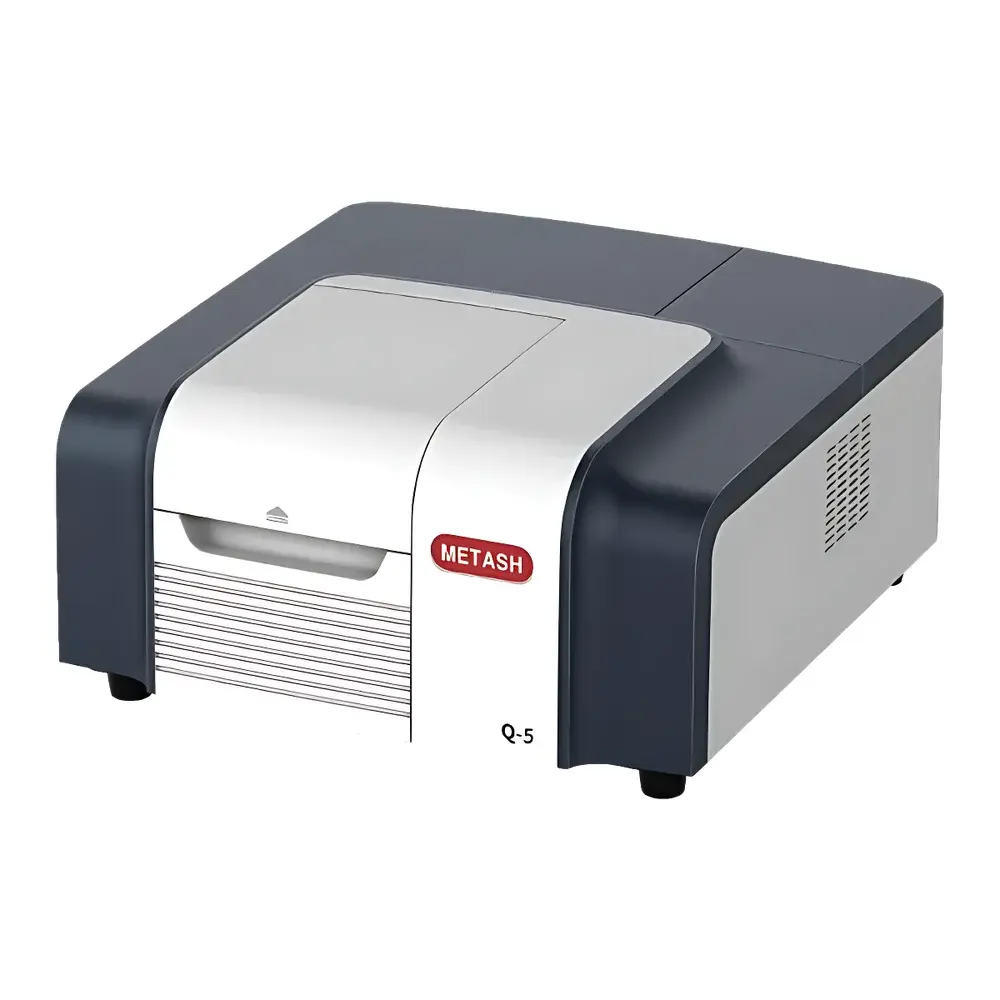
Metash Q-5 Dual-Beam Ultraviolet-Visible Spectrophotometer
| Brand | Metash Instruments |
|---|---|
| Origin | Shanghai, China |
| Manufacturer | Yes |
| Type | Domestic |
| Model | Q-5 |
| Optical Design | Dual-beam |
| Detector | Photomultiplier Tube (PMT) |
| Wavelength Range | 190–900 nm |
| Wavelength Scanning | Motorized Auto-Scan |
| Spectral Bandwidth | 1.8 nm |
| Wavelength Accuracy | ±0.3 nm |
| Wavelength Repeatability | ≤0.1 nm |
| Stray Light | ≤0.01% T |
| Photometric Accuracy | ±0.3% T |
| Photometric Repeatability | ≤0.1% T |
| Baseline Drift | ≤0.0003 Abs/h |
Overview
The Metash Q-5 is a high-performance dual-beam ultraviolet-visible (UV-Vis) spectrophotometer engineered for precision absorbance, transmittance, and reflectance measurements across the full 190–900 nm spectral range. Its Czerny–Turner monochromator optical architecture—coupled with a high-stability double-beam configuration—ensures continuous real-time compensation for source intensity fluctuations and environmental drift. This design significantly enhances photometric stability and measurement reproducibility, particularly during extended kinetic or multi-sample analyses. The instrument employs a high-quantum-efficiency photomultiplier tube (PMT) detector, selected for its wide dynamic gain range, sub-millisecond response time, and low dark current—critical attributes for trace-level quantitation and low-light applications such as nucleic acid and protein analysis at 260/280 nm. An integrated mercury lamp serves as an on-board wavelength reference standard, enabling automated, traceable wavelength calibration without external hardware or manual intervention.
Key Features
- Dual-beam Czerny–Turner optical system with optimized beam path geometry to minimize polarization effects and maximize photometric linearity
- Motorized auto-wavelength scanning with closed-loop position feedback for precise, repeatable spectral acquisition
- High-purity quartz optics and thermally stabilized monochromator housing to reduce thermal-induced wavelength drift
- Modular lamp compartment with plug-in deuterium and tungsten-halogen sources—enabling rapid, tool-free replacement with factory-aligned positioning
- Stray light suppression below 0.01% T at 220 nm (NaI) and 340 nm (NaNO₂), achieved through multi-stage baffling and optimized grating blaze angle selection
- Robust injection-molded chassis with EMI-shielded internal layout, supporting stable operation in shared laboratory environments
Sample Compatibility & Compliance
The Q-5 accommodates standard 10-mm rectangular cuvettes (glass, quartz, or plastic), as well as specialized sample formats via optional accessories—including integrating spheres (for diffuse reflectance), variable-pathlength cells (0.1–100 mm), thermostatted cell holders (±0.1 °C control), and motorized solid-sample stages with adjustable incidence angles. All optical components comply with ISO 9001-certified manufacturing protocols. The instrument meets key international performance standards including ASTM E275 (spectrophotometer terminology), ISO 6223 (UV-Vis performance verification), and USP (pharmaceutical spectrophotometric validation). Its firmware and software architecture support audit trail generation, electronic signatures, and user role-based access control—fully aligned with FDA 21 CFR Part 11 and GLP/GMP data integrity requirements.
Software & Data Management
The Q-5 is operated via Metash SpectraPro™ v3.x, a Windows-based analytical platform compliant with ICH M10 and ALCOA+ data governance principles. The software supports six core operational modes: Photometric Measurement, Quantitative Analysis (single/multi-point calibration with error propagation), Spectral Scanning (up to 3,200 data points per scan), Kinetic Monitoring (time-resolved absorbance at fixed or variable wavelengths), DNA/Protein Analysis (A260/A280 ratio, concentration, purity), and Multi-Component Analysis (multivariate regression). All raw spectra and processed results are stored in vendor-neutral .spc and .csv formats. Built-in features include automatic baseline correction, peak identification with second-derivative smoothing, spectral subtraction, and export-ready report templates with embedded metadata (operator ID, timestamp, instrument serial number, calibration status).
Applications
The Q-5 delivers validated performance across regulated and research-intensive workflows: quantitative determination of pharmaceutical actives per USP monographs; enzymatic reaction kinetics under controlled temperature; quality control of dyes and pigments in polymer formulations; assessment of nanoparticle surface plasmon resonance shifts; verification of oligonucleotide synthesis yield and purity; and routine water quality monitoring (e.g., nitrate, phosphate, COD via colorimetric assays). Its low stray light and high wavelength fidelity make it especially suitable for high-absorbance measurements (>3.0 Abs) where conventional single-beam instruments exhibit significant deviation.
FAQ
Does the Q-5 support IQ/OQ/PQ documentation packages for regulated laboratories?
Yes—Metash provides comprehensive qualification protocols (including test scripts, acceptance criteria, and blank execution records) aligned with ISO/IEC 17025 and ASTM E2500.
Can the instrument be integrated into a LIMS environment?
Yes—the SpectraPro™ software supports ODBC-compliant database connectivity and HL7-compatible result export for seamless LIMS integration.
Is the PMT detector replaceable by the end user?
No—detector replacement requires factory recalibration and optical alignment verification; only lamp modules and cuvette holders are field-serviceable.
What is the recommended calibration frequency for GMP compliance?
Wavelength calibration using the internal Hg lamp is performed automatically at startup; photometric calibration with NIST-traceable neutral density filters is recommended every 3 months or per internal SOP.
Does the Q-5 meet CE and RoHS directives?
Yes—the instrument carries CE marking and full RoHS 2011/65/EU compliance documentation, including material declarations and hazardous substance testing reports.





