
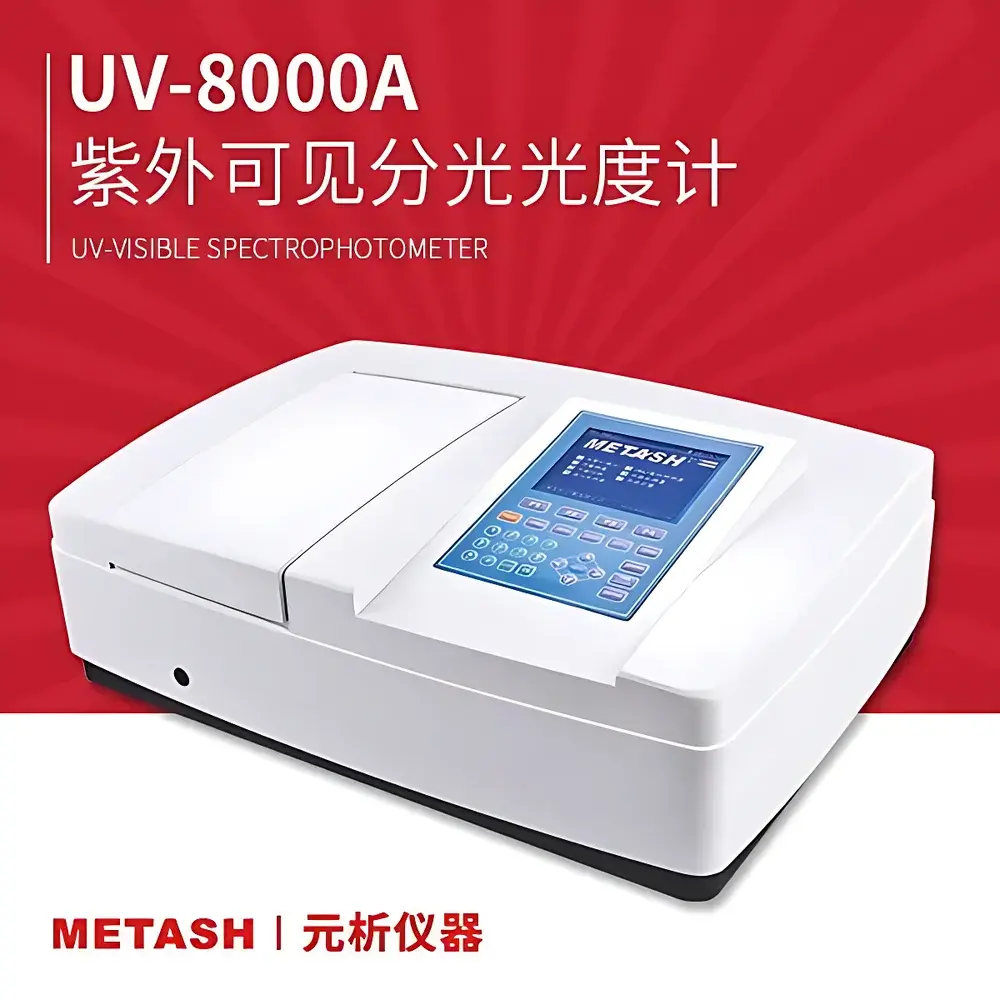
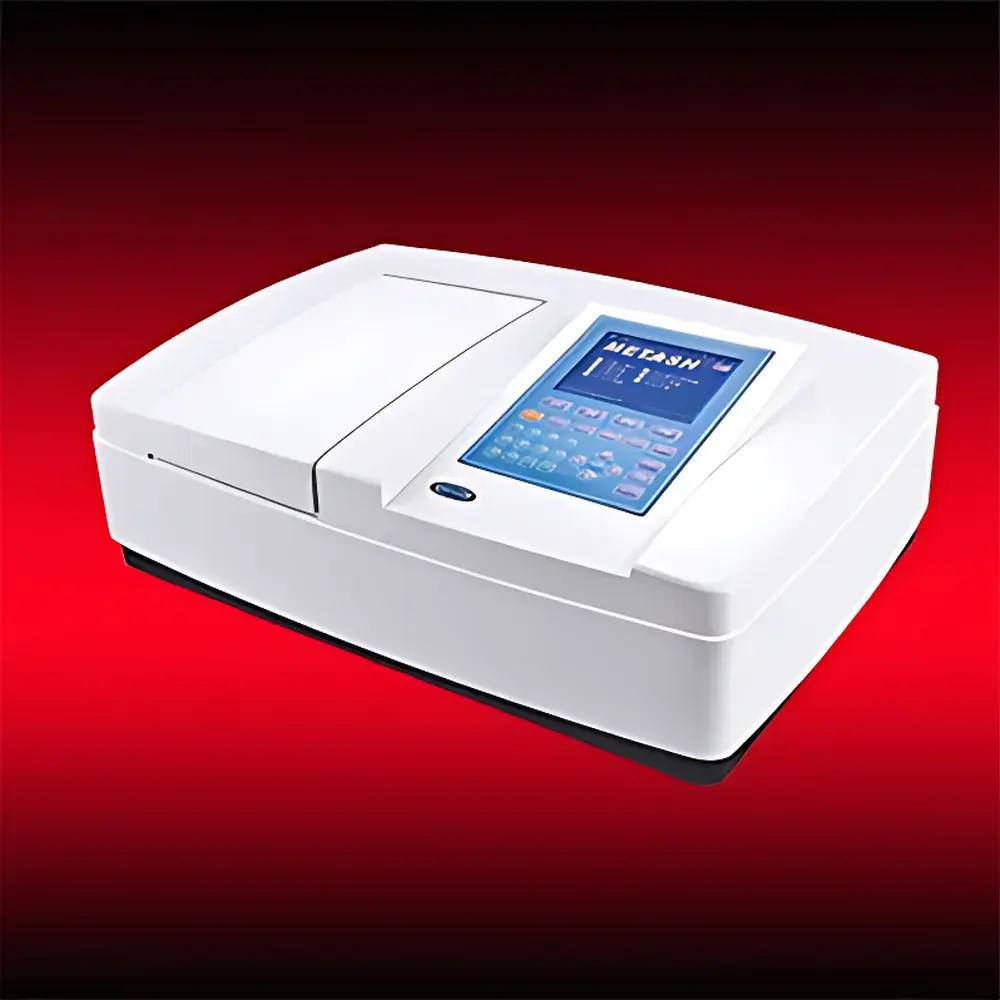
Metash UV-8000A Dual-Beam Ultraviolet-Visible Spectrophotometer
| Brand | Metash Instruments |
|---|---|
| Origin | Shanghai, China |
| Manufacturer Type | Original Equipment Manufacturer (OEM) |
| Product Category | Domestic |
| Model | UV-8000A |
| Optical System | Dual-Beam |
| Detector Type | Silicon Photocell |
| Wavelength Range | 190–1100 nm |
| Wavelength Accuracy | ±0.1 nm at D₂ line (656.1 nm), ±0.3 nm across full range |
| Wavelength Repeatability | ≤0.1 nm |
| Spectral Bandwidth | 1 nm |
| Stray Light | ≤0.05% T |
| Automation Level | Automatic Wavelength Scanning |
| Display | 6-inch LED Color LCD |
| Data Interface | USB |
| Software | GLP/GMP-Compliant PC Control Suite |
| Key Components | Imported Deuterium Lamp, Tungsten-Halogen Lamp, Precision Holographic Grating, Aerospace-Grade Aluminum Optical Base (16 mm thick) |
Overview
The Metash UV-8000A is a high-performance dual-beam ultraviolet-visible (UV-Vis) spectrophotometer engineered for precision absorbance, transmittance, and reflectance measurements across the 190–1100 nm spectral range. Its dual-beam optical architecture continuously compares sample and reference beam intensities in real time, effectively compensating for source drift, lamp fluctuations, and environmental instability—thereby delivering superior photometric stability and measurement reproducibility. The instrument employs a Czerny-Turner monochromator design with a holographic grating, optimized for high throughput in the UV region and minimal stray light generation. All critical optical components—including the deuterium and tungsten-halogen lamps, silicon photocell detector, and diffraction grating—are sourced from internationally certified suppliers to ensure long-term spectral fidelity and operational reliability.
Key Features
- Dual-beam optical path with real-time reference compensation, minimizing baseline drift and enhancing quantitative accuracy over extended measurement sessions.
- 16 mm-thick aerospace-grade aluminum optical base with suspended optical mount design—mechanically isolates the optical train from chassis deformation and external vibration, significantly improving long-term wavelength and photometric stability.
- High-resolution 6-inch color LED LCD display enabling standalone operation: full access to photometric mode, quantitative analysis (single/multi-point calibration), spectral scanning (up to 1200 nm/min), kinetic assays, DNA/protein A260/A280 ratio calculation, multi-wavelength quantitation, and direct thermal printing.
- Spectral bandwidth fixed at 1 nm—optimized for resolution of closely spaced absorption peaks while maintaining sufficient signal-to-noise ratio for routine QC and research applications.
- Stray light performance ≤0.05% T (at 220 nm and 340 nm), meeting ISO 9001 and ASTM E275 verification requirements for pharmaceutical and regulatory-compliant laboratories.
- Wavelength accuracy of ±0.1 nm at the deuterium 656.1 nm line and ±0.3 nm across the full range—validated per ISO/IEC 17025 traceable procedures using NIST-traceable holmium oxide and didymium filters.
Sample Compatibility & Compliance
The UV-8000A supports standard 10 mm pathlength cuvettes (quartz, glass, or plastic), as well as optional accessories including an automated 8-cell rotating sample changer, micro-volume cuvette holders (down to 50 µL), Peltier-controlled temperature-regulated cell holders (±0.1 °C), integrating sphere for diffuse reflectance, and specular reflection attachments. All hardware and firmware comply with electromagnetic compatibility (EMC) standards IEC 61326-1 and safety standard IEC 61010-1. The system is designed for use in GLP- and GMP-regulated environments: audit trail functionality, user-level access control (administrator/operator/guest), electronic signature support, and immutable data logging are embedded into the software architecture—fully aligned with FDA 21 CFR Part 11 requirements for electronic records and signatures.
Software & Data Management
The included PC-based analytical software provides a validated, modular interface supporting method development, instrument qualification (IQ/OQ/PQ templates), and full data lifecycle management. Raw spectral data are stored in vendor-neutral ASCII and CSV formats; processed results include annotated spectra, calibration curves with residual plots, kinetic time-series tables, and customizable PDF reports compliant with ISO/IEC 17025 reporting guidelines. Data integrity safeguards include automatic timestamping, operator ID tagging, version-controlled method storage, and encrypted local database archiving. Software updates are delivered via secure HTTPS channels with SHA-256 hash verification.
Applications
- Pharmaceutical quality control: assay of active pharmaceutical ingredients (APIs), excipient identification, dissolution testing, and stability-indicating methods per USP and EP 2.9.3.
- Environmental analysis: quantification of nitrate, phosphate, heavy metals (via complexometric assays), and organic pollutants (e.g., phenols, PAHs) in water and soil extracts.
- Life sciences: nucleic acid quantification (A260), protein concentration (A280, BCA, Bradford), enzyme kinetics (NADH/NADPH monitoring at 340 nm), and cell culture density (OD600).
- Materials science: thin-film thickness estimation via interference fringe analysis, bandgap determination of semiconductors, and pigment characterization in coatings and inks.
- Food & beverage: colorimetric analysis (CIELAB), antioxidant capacity (FRAP/DPPH), and adulterant screening (e.g., melamine in milk).
FAQ
Is the UV-8000A compliant with FDA 21 CFR Part 11?
Yes—the software includes role-based user authentication, electronic signatures, full audit trail (including parameter changes, data deletions, and report generation), and tamper-evident data storage.
What validation documentation is provided with the instrument?
Factory-installed IQ/OQ protocols, NIST-traceable wavelength and photometric accuracy verification certificates, and a comprehensive User Requirements Specification (URS) template are supplied.
Can the instrument be integrated into a LIMS environment?
Yes—via configurable ASCII/CSV export and optional OPC UA or RESTful API modules (available under extended software license).
Does the system support variable pathlength or flow cell configurations?
Standard configuration supports fixed-pathlength cuvettes; optional flow-through cells (10 mm, 50 mm) and adjustable pathlength holders (1–100 mm) are available as accessories.
What is the recommended calibration frequency for routine QC use?
Wavelength calibration is recommended before each analytical session using holmium oxide; photometric calibration should be performed daily using neutral density filters or potassium dichromate solutions per ISO 6060.




