
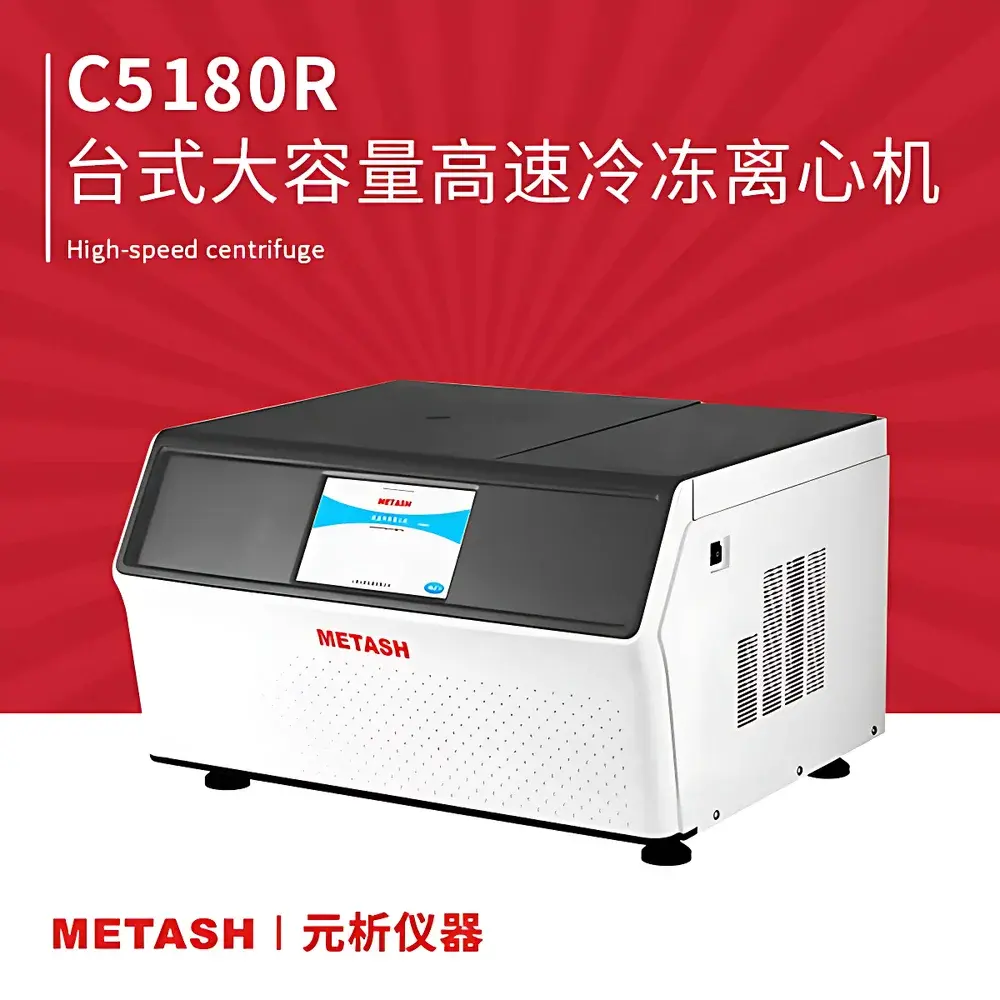
Metash C5180R Benchtop High-Capacity Refrigerated Centrifuge
| Brand | Metash Instruments |
|---|---|
| Origin | Shanghai, China |
| Manufacturer Type | Direct Manufacturer |
| Instrument Type | Benchtop Centrifuge |
| Speed Range | High-Speed (10,000–30,000 rpm) |
| Function | Refrigerated Centrifuge |
| Configuration | Fixed-Angle Rotor System |
| Max Capacity | 6 × 250 mL |
| Max Speed | 18,000 rpm |
| Max RCF | 28,978 × g |
| Temperature Range | −20 °C to +40 °C |
| Noise Level | ≤58 dB(A) |
| Power Supply | 220 V ±10%, 50 Hz ±1 Hz, 1200 W |
| Display | 10-inch HD Color Touchscreen |
| Acceleration/Deceleration | 10-step programmable |
| Timer Range | 1 min – 99 min (continuous operation mode available) |
| Refrigerant | R-134a |
| Drive Motor | Brushless AC Frequency-Controlled Motor |
Overview
The Metash C5180R is a high-performance benchtop refrigerated centrifuge engineered for demanding applications in life science laboratories, clinical diagnostics, and biopharmaceutical research. It operates on the principle of sedimentation under controlled gravitational force (RCF), enabling rapid and reproducible separation of biological samples—including cells, subcellular organelles, nucleic acids, proteins, and viral particles—based on density, size, and shape. Designed for continuous operation at up to 18,000 rpm and delivering a maximum relative centrifugal force of 28,978 × g, the C5180R combines high-speed capability with precise thermal regulation (−20 °C to +40 °C), ensuring sample integrity during extended runs. Its robust mechanical architecture integrates vibration-dampened motor mounting, V0-rated flame-retardant composite housing, and 360° uniform airflow cooling—critical for maintaining rotor stability, minimizing thermal gradients across the chamber, and preserving thermolabile biomolecules.
Key Features
- Brushless AC frequency-controlled motor with high starting torque, low noise (<58 dB[A]), and extended service life—optimized for consistent speed accuracy and energy efficiency
- Integrated R-134a refrigeration system with intelligent temperature compensation; maintains setpoint within ±1 °C across all rotor configurations without manual recalibration
- 10-inch HD color touchscreen running an Android-based OS with intuitive graphical interface, supporting multi-language UI and gesture-responsive navigation
- Auto-rotor recognition system that detects installed rotor type and enforces safe speed/temperature limits—preventing mismatched operation and mechanical failure
- Dual-lock safety mechanism combining electromagnetic feedback monitoring and physical latch engagement, certified to IEC 61010-2-020 for laboratory equipment
- Real-time imbalance detection with automatic shutdown upon deviation exceeding ISO 21501-4 thresholds; supports dynamic load tolerance up to 5 g mass differential per tube position
- Programmable acceleration/deceleration profiles (10-step), including “soft stop” and free-deceleration modes to prevent pellet resuspension in sensitive applications
- 30 user-defined protocols stored locally with timestamped execution logs—compliant with GLP documentation requirements
Sample Compatibility & Compliance
The C5180R accommodates a broad range of sample formats via 19 interchangeable rotor options, including fixed-angle rotors (e.g., 6 × 250 mL, 12 × 50 mL), swing-out carriers, and microplate adapters. It is validated for use with standard polypropylene, polycarbonate, and stainless-steel tubes meeting ASTM D543 and ISO 8536-1 specifications. The instrument conforms to key international safety and electromagnetic compatibility standards: IEC 61010-1 (safety), IEC 61326-1 (EMC), and ISO 13485 (for medical device manufacturing environments). Temperature control performance is traceable to NIST-calibrated references, and its data logging functionality supports audit-ready records aligned with FDA 21 CFR Part 11 requirements when used with validated networked software.
Software & Data Management
Embedded firmware provides local data storage for run history (≥10,000 cycles), error logs, and calibration events. Timestamped metadata—including rotor ID, actual RCF, chamber temperature deviation, and imbalance alerts—is exportable via USB or optional Ethernet module in CSV or XML format. Optional Metash CentriLink™ PC software enables remote monitoring, protocol synchronization across multiple instruments, and integration with LIMS platforms via HL7 or RESTful API. All electronic records include immutable audit trails with operator ID, time/date stamps, and change justification fields—supporting GxP-compliant workflows.
Applications
- Preparative isolation of mammalian cell nuclei and mitochondria at 15,000 × g for downstream proteomics
- High-yield plasmid DNA purification using silica-membrane spin columns requiring 18,000 rpm for optimal binding kinetics
- Clinical serum/plasma separation prior to ELISA or mass spectrometry analysis
- Virus concentration from cell culture supernatants via ultracentrifugation-compatible fixed-angle rotors
- Quality control of monoclonal antibody formulations under cold-chain conditions (2–8 °C)
- Routine QC of vaccine suspensions per USP sterility testing guidelines
FAQ
Does the C5180R support rotor validation and calibration traceability?
Yes—each rotor carries a unique QR-coded identifier linked to factory-certified performance data, including max speed, RCF curves, and thermal inertia profiles.
Can the instrument operate continuously for >8 hours?
Yes, with active cooling enabled and ambient temperature ≤25 °C, the system meets IEC 60068-2-14 thermal endurance criteria for uninterrupted 12-hour operation.
Is remote firmware update supported?
Firmware updates are performed via encrypted USB drive with SHA-256 signature verification; over-the-air updates require optional CentriLink™ gateway configuration.
What safety certifications does the C5180R hold?
It complies with IEC 61010-1 (Ed. 3), IEC 61010-2-020, and carries CE marking under the EU Machinery Directive 2006/42/EC and EMC Directive 2014/30/EU.
How is temperature uniformity verified across the rotor chamber?
Factory validation includes thermocouple mapping at 9 spatial points per rotor configuration, with ≤±0.8 °C deviation across the entire 6 × 250 mL load at −10 °C setpoint.



