
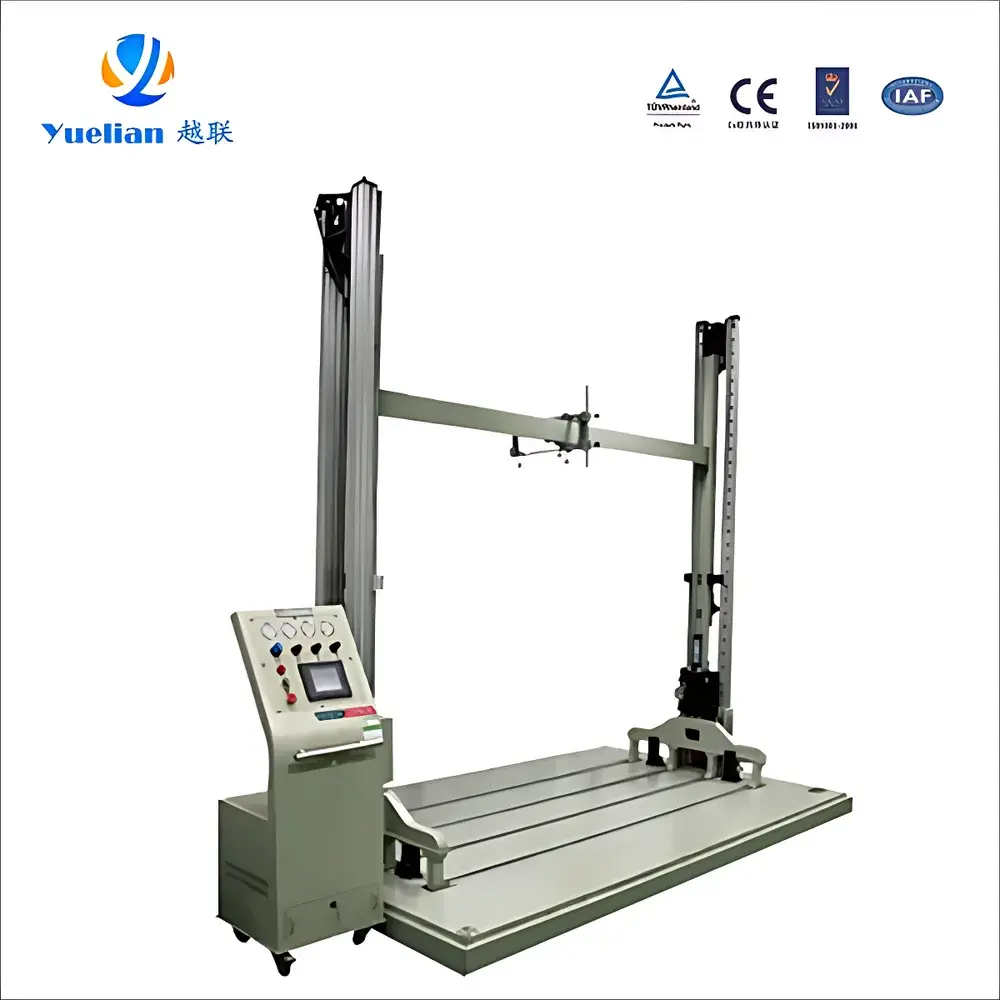
Yuelian YL-DBL-500 Battery Pack Drop Test Machine
| Brand | Yuelian |
|---|---|
| Origin | Guangdong, China |
| Manufacturer Type | Authorized Distributor |
| Country of Origin | China |
| Model | YL-DBL-500 |
| Quotation | Available upon Request |
| Chamber Internal Dimensions (W×D) | ~1500×1200 mm |
| Overall Dimensions (W×H×D) | ~2800×2000×1500 mm |
| Max Sample Size (W×H×D) | 1000×600×800 mm |
| Max Sample Weight | 500 kg |
| Frame Construction | Integrated monolithic structure with control console |
| Structural Material | High-strength industrial-grade steel plate, powder-coated in gray and blue |
| Base Frame | Reinforced thick-section steel |
| Control System | PLC + HMI touchscreen interface |
| Adjustable Drop Height Range | 10–1500 mm (adjustable in 0.1 mm increments) |
| Height Repeatability Error | ±2 mm |
| Height Display Resolution | 0.1 mm |
| Lifting Mechanism | Electromechanical linear actuator |
| Drop Actuation | Pneumatic release system |
| Impact Surfaces (standard & optional) | Hardened steel plate, polished granite slab, or laminated wood panel |
| Sample Holding Time Pre-Drop | 0–99 h 99 min 99 s (programmable) |
| Cross-Arm Specifications | Width ≤40 mm |
| Standard Accessories | Main unit, one set of universal adjustable clamping fixture |
| Power Supply | AC 380 V, 50 Hz |
Overview
The Yuelian YL-DBL-500 Battery Pack Drop Test Machine is an engineered test platform designed to evaluate the mechanical robustness of electric vehicle (EV) battery packs and high-voltage energy storage systems under controlled free-fall impact conditions. It operates on the principle of gravitational acceleration, enabling standardized simulation of accidental drops during handling, installation, or maintenance—scenarios identified as critical failure modes in UN GTR No. 20, ISO 12405-2, GB/T 31467.3, and SAE J2464. The system delivers repeatable, traceable, and auditable drop events with precise height control, programmable dwell time, and multi-surface impact capability. Its monolithic structural architecture ensures minimal vibration coupling and high positional stability, essential for maintaining alignment integrity between sample center-of-gravity and impact plane during release.
Key Features
- Electromechanically driven vertical lift mechanism with servo-controlled positioning accuracy of ±0.1 mm and repeatability within ±2 mm across full 10–1500 mm range
- Pneumatically actuated release system ensuring zero pre-release torque transfer and clean separation from cross-arm fixtures
- Modular impact surface configuration supporting interchangeable hardened steel (HV ≥550), calibrated granite (flatness ≤0.02 mm/m²), and laminated hardwood plates per ASTM D1037 requirements
- PLC-based control architecture with industrial HMI touchscreen interface offering password-protected parameter locking, event logging, and real-time height feedback
- Integrated safety interlocks including emergency stop circuitry, door position sensing, and load-cell monitored clamp engagement verification
- Universal clamping fixture with six-point adjustable mounting points (300–400 mm spacing) and ≤40 mm cross-arm width to minimize moment arm distortion during lift
- Programmable pre-drop dwell time (0–99 h 99 min 99 s) to simulate extended suspension prior to impact—a requirement in certain OEM-specific validation protocols
Sample Compatibility & Compliance
The YL-DBL-500 accommodates battery modules and complete packs up to 1000 mm (W) × 600 mm (H) × 800 mm (D) and 500 kg mass. Fixture geometry supports both bottom-mounted and side-mounted pack configurations typical of NCM, LFP, and solid-state cell architectures. All mechanical interfaces comply with ISO 26262 ASIL-B hardware design principles for functional safety-critical test equipment. The system meets electromagnetic compatibility (EMC) requirements per EN 61326-1 and is constructed using materials certified to RoHS Directive 2011/65/EU. Calibration procedures follow ISO/IEC 17025 guidelines, with traceability to national metrology institutes via third-party accredited service providers. Documentation packages include Factory Acceptance Test (FAT) reports, mechanical drawing sets, and compliance declarations aligned with EU Machinery Directive 2006/42/EC.
Software & Data Management
While the base YL-DBL-500 utilizes embedded PLC logic without external PC dependency, optional Ethernet/IP or Modbus TCP interfaces enable integration into centralized laboratory information management systems (LIMS). Event logs—including timestamped drop height, dwell duration, release confirmation, and operator ID—are stored locally on non-volatile memory with 10,000-event capacity and exportable via USB 2.0. Audit trail functionality satisfies FDA 21 CFR Part 11 requirements when paired with validated user access controls and electronic signature modules. Raw data output conforms to ASTM E1447-18 format for downstream statistical process control (SPC) analysis in Minitab or JMP environments.
Applications
- Validation of battery pack housing integrity per UN GTR No. 20 Annex 6 (Mechanical Abuse – Drop Test)
- Pre-certification testing for IEC 62660-2:2018 (Secondary lithium-ion cells for propulsion applications)
- OEM-specific durability qualification (e.g., VW TL 82403, GMW16890, Ford ES-XW7T-1A278-AC)
- Post-thermal-run mechanical stability assessment following thermal runaway propagation studies
- Supplier qualification audits requiring documented reproducibility of impact severity parameters
- Research into failure mode evolution under combined mechanical-electrochemical stress states
FAQ
What standards does the YL-DBL-500 support out-of-the-box?
The system is configured to execute tests compliant with GB/T 31467.3–2015, ISO 12405-2:2012, and UN GTR No. 20 Annex 6. Optional firmware upgrades extend coverage to SAE J2464 and UL 2580 Annex B.
Can the machine accommodate irregularly shaped battery enclosures?
Yes—the universal clamping system allows angular orientation adjustments and asymmetric load distribution mapping via calibrated torque monitoring at each fixture point.
Is calibration certification included with delivery?
A factory calibration report with uncertainty budget and traceability statement is supplied. On-site ISO/IEC 17025 accredited calibration is available as a separate service contract.
What maintenance intervals are recommended?
Lubrication of linear guide rails every 500 operational hours; pneumatic valve inspection every 1,000 cycles; annual verification of PLC timing synchronization and height encoder linearity.
Does the system support remote diagnostics?
Standard models include RS-485 serial port for local diagnostics. Ethernet-enabled variants support remote firmware updates and live parameter monitoring via secure VPN tunneling.
Related Products



